Yada Yada Hi Dharmasya — The Simple Meaning of Dharma and Avatāra
Does 'yada yada hi dharmasya' (Gita 4.7) speak only of God's avatāra?
The true meaning of this verse: whenever dharma declines in this world and adharma rises, God Himself takes on a body.
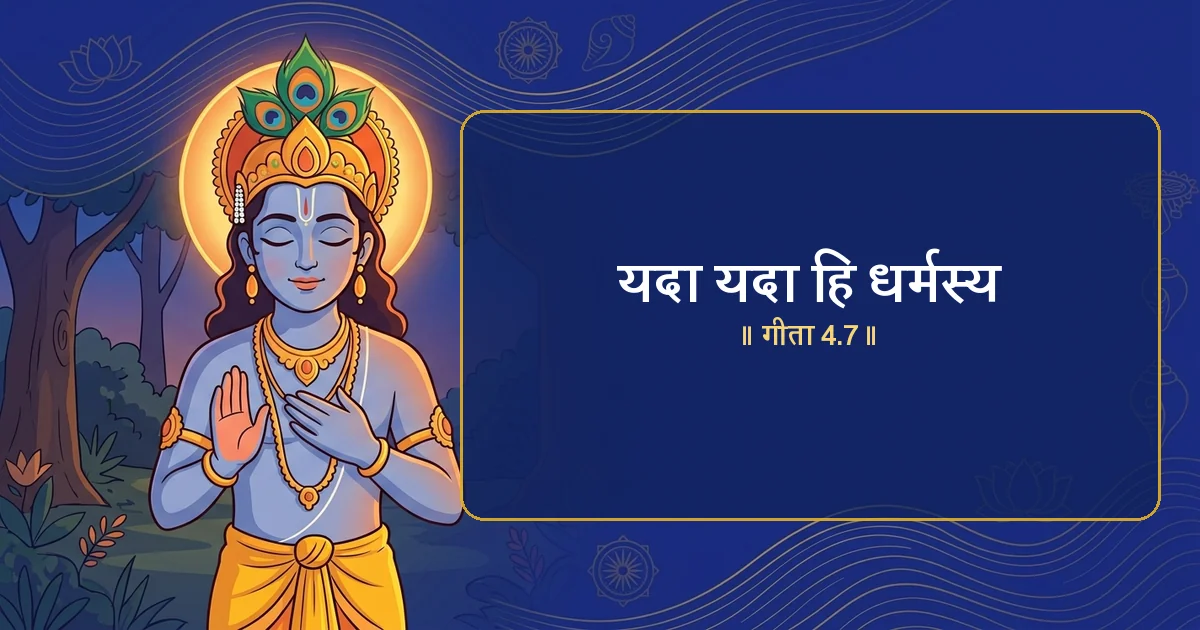
When injustice surrounds us on all sides, when lies begin to pass as truth, when every road ahead seems closed for the ordinary person — one question rises in the heart. Is anyone watching? Does anyone care?
The Verse (Gita 4.7 — Yada Yada Hi Dharmasya)
यदा यदा हि धर्मस्य ग्लानिर्भवति भारत।
अभ्युत्थानमधर्मस्य तदाऽऽत्मानं सृजाम्यहम्
yadā yadā hi dharmasya glānir bhavati bhārata
abhyutthānam adharmasya tadātmānaṁ sṛijāmyaham
When injustice surrounds us on all sides, when lies begin to pass as truth, when every road ahead seems closed for the ordinary person — one question rises in the heart. Is anyone watching? Does anyone care? This same question existed twenty-five hundred years ago. This verse was spoken in answer to that very question. But the answer given was not mere reassurance. It was the proclamation of a law woven into the very fabric of creation.
Word by Word
| Word | Meaning |
|---|---|
| यदा यदा | whenever, as often as |
| हि | certainly, indeed |
| धर्मस्य | of dharma |
| ग्लानिः | decline, waning |
| भवति | occurs, arises |
| भारत | O Bharata (Arjuna) |
| अभ्युत्थानम् | rise, aggressive upsurge |
| अधर्मस्य | of adharma |
| तदा | then |
| आत्मानम् | Myself |
| सृजामि | I manifest, I project forth |
| अहम् | I |
A Deeper Commentary on the Meaning of Yada Yada Hi Dharmasya
This verse is the proclamation of a cosmic order — one that no king or age can determine. Only the living condition of dharma governs it.
Yadā yadā: the double use of yadā is no coincidence. It signals not a fixed date but a continuously watchful response: whenever, as often as, wherever. The word glāniḥ comes from the root glai, meaning to wither, to grow weary.
Dharma here is not a stone building that collapses. It is a living, breathing being that grows enfeebled by society's transgressions, like a plant deprived of sunlight and water. The prefix abhi in abhyutthānam is stronger than a simple utthāna: this is the aggressive rise of adharma, not merely its presence. And finally, sṛijāmi: the root sṛij means to project, to emit, to send forth oneself.

Dharma is not a statute — it is a living force that can grow weary.
When a gardener sees that the garden's roots are beginning to dry up, he does not call in a new gardener from outside — he goes himself. He turns the soil and gives the roots new life. The sṛijāmyaham of the Supreme is just this. He does not descend from a distant realm above; He projects Himself from the unmanifest into the manifest. Just as a potter shapes clay from within — not an external force, but His own presence. This is the innermost mechanics of the avatāra: a projection, not a descent.
The Supreme does not descend from above — He projects Himself from the unmanifest into the manifest.
Yadā yadā holds another depth: this manifestation does not wait for a political crisis. It occurs when society's sense of dharma — that collective moral consciousness — begins to hollow out from within. A musician knows that a rāga goes wrong when the very frequency of the base note strays. This is not external noise, but the breaking of the inner melody. This is glāniḥ.

There is yet another layer to this principle: yadā yadā is not a single historical event but a cyclical and eternal process. Just as white blood cells awaken at infection — no special order, no fixed occasion — so does the Supreme respond in dharma's cosmic order. This response is inevitable and natural. In every age, in every civilization. No era stands beyond its reach.
A common misconception is that this verse speaks only of an excess of sinfulness — that when evildoers multiply excessively, the Supreme manifests. But the verse says dharmasya glāniḥ, not duṣṭānāṁ vṛddhiḥ. The focus is on the weariness of dharma, not on the count of evildoers. This distinction is crucial: a society may have few open villains.
Yet if there is collective indifference to truth, justice, and compassion, that too is the state of glāniḥ.
The weariness of dharma, not the number of evildoers — this is the true reason for divine manifestation.

Different philosophical traditions read this verse through their own lenses. In the Advaita view, the avatāra is Brahman's free play (līlā) within māyā — no arrival, no departure, only manifestation and dissolution. The bhakti tradition sees here the saguṇa compassion of the Supreme: He hears the cry of His devotees and takes a tangible form.
The Karma Yoga tradition treats this verse as a living inspiration. Whenever the glāni of dharma arises within you, you too can re-project that consciousness which has always been unmanifest within you.
Yada Yada Hi Dharmasya — Meaning in Today's Life
In Today's Life
This verse poses the question: when glāniḥ is visible, who is the answer?
Lokmanya Tilak: The Meaning of 4.7 in a Mandalay Cell
In 1908, while serving a six-year sentence on charges of sedition, Bal Gangadhar Tilak wrote Gita-Rahasya — in Marathi, grounded in reason. In his reading, yadā yadā was not a single historical event — it was an eternal framework. The person who sees dharmasya glāniḥ and stays silent is an obstruction to that cosmic process. The one who rises, speaks, and acts — that person becomes the instrument of that sṛijāmyaham.
Tilak established the Gita not as a scripture of passive surrender but of active engagement — and he considered this one verse its axis. Whichever field you inhabit — family, institution, society — that field's yadā yadā is watching you.

The Misconception That Diminishes This Verse
Most people associate this verse with an 'excess of evildoers.' But the verse does not say duṣṭānāṁ vṛddhiḥ — it says dharmasya glāniḥ. This distinction is decisive in daily life. In your workplace, there may be no open crime.
Yet if eyes drop at the demand of truth and heads nod at calls for justice but feet refuse to move, that too is the state of glāniḥ. The response this verse calls for is equally inescapable then.
A Three-Step Daily Practice
- Morning Observation (Prātaḥ-nirīkṣaṇ): Identify one place in your working life today where
glāniḥis visible. - The Day's Action: Take one concrete, small step at that one place — not complaint, but action.
- Evening Review (Sāyaṁ-samīkṣā): Did you become an instrument of that cosmic response today?
Yadā yadā is active within you too — are you ready to recognize it?
Notes for orchestrator:
Related Verses
- Gita 2.47: Karmaṇyevādhikāraste — What Is the Real Truth About Results?: Shared context: confusion, duty, purpose.
- Gita 2.48: Samatvam Yoga Ucyate — The True Meaning of Yogasthaḥ: Shared context: confusion, duty, purpose.
- Gita 2.50: Yogaḥ Karmasu Kauśalam — The Real Truth About Merit: Shared context: confusion, duty.
References
Frequently Asked Questions

Independent writer, jaapak.com
I built the Jaapak app. I write in simple Hindi on the Bhagavad Gita and the satsang tradition — so seekers don't struggle with the scripture.
Read all articlesAbout this article
About this article: this commentary is grounded in the original Sanskrit verse and the common understanding shared across Indian philosophical traditions. It is not a verbatim quotation of any single modern translator or commentator. All illustrations are digitally generated.