Yogaḥ Karmasu Kauśhalam — The Real Truth About Merit
Is 'buddhi-yukto jahāti' (Gita 2.50) only about abandoning bad actions?
The true meaning of this verse: merit also binds — releasing attachment to results is liberation.
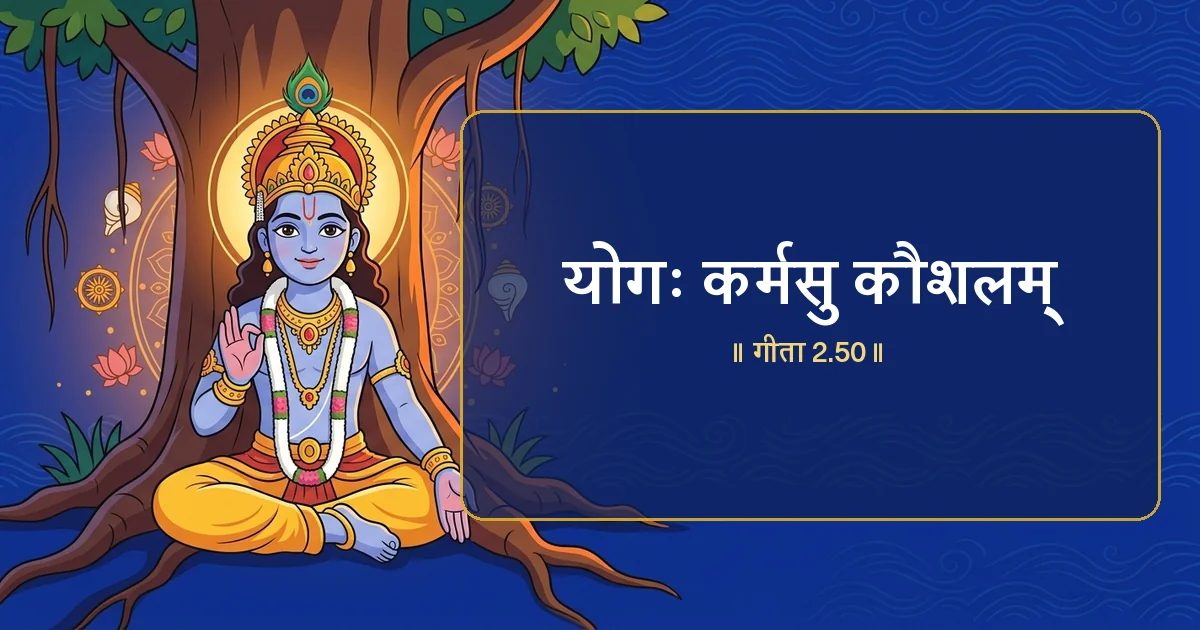
Chapter 2 — Sāṅkhya Yoga · Verse 50
Does 'yogaḥ karmasu kauśhalam' really mean 'become skilled in your work'? This is the common assumption. But Krishna here is defining skillfulness — not merely encouraging more of it.
The Verse (Gita 2.50 — Buddhi-yukto Jahātīha)
बुद्धियुक्तो जहातीह उभे सुकृतदुष्कृते।
तस्माद्योगाय युज्यस्व योगः कर्मसु कौशलम्
buddhi-yukto jahātīha ubhe sukṛita-duṣhkṛite
tasmād yogāya yujyasva yogaḥ karmasu kauśhalam
What Does Yogaḥ Karmasu Kauśhalam Mean? (Simply Put)
Yogaḥ karmasu kauśhalam means: yoga is skillfulness in action. The common reading takes this to mean "do your work better." But the verse says: one whose intellect is grounded in equanimity is freed from both merit and sin. True skillfulness is not technique — it is that steadiness of mind which prevents action from becoming bondage.
When 'yogaḥ karmasu kauśhalam' was first memorised from school Hindi textbooks, the takeaway seemed clear: this is a formula for efficiency — do your work well, that is all. The iconic scene from B.R. Chopra's Mahabharat only reinforced that impression. But this verse is offering a definition, not a prescription. And within that definition lies a secret that will unfold further.
Word-by-Word Analysis
| Word | Meaning |
|---|---|
| बुद्धि | intellect / equanimity |
| युक्तः | endowed (with) |
| जहाति | abandons |
| इह | in this very life |
| उभे | both |
| सुकृत | meritorious actions |
| दुष्कृते | sinful actions |
| तस्मात् | therefore |
| योगाय | for yoga |
| युज्यस्व | engage yourself |
| योगः | yoga |
| कर्मसु | in actions |
| कौशलम् | is skillfulness |
Deep Commentary on Yogaḥ Karmasu Kauśhalam
Buddhi-yukta: The True Weight of the Word
The verse's opening word 'buddhi-yukta' carries two interwoven meanings. First, a person endowed with equanimous intellect; second, a sādhaka whose mind is steady in samattva-yoga. The root of 'jahāti' is the dhātu 'hā,' meaning to relinquish, to let go. Here a subtle point lies hidden. 'Sukṛita-duṣhkṛite' is a dvandva (conjunctive) compound, in which meritorious action and sinful action are bound together as one pair. The verse states that the one with a steady intellect lets go of both — in this very life ('iha'). Notice: not only sin, but merit too. This very word-structure reveals that the subject of bondage is not the category of action but attachment to its fruits.
Merit also binds, if you are bound to its fruits.
Merit Also Binds: The Most Difficult Truth
Most people believe the purpose of dharma is to avoid sin and accumulate merit. The Gita inverts this belief entirely. Virtuous actions yield good results; vicious actions yield bad results. Both situations bind you to future births, new circumstances, new desires. Consider a potter. If he makes beautiful pots, demand grows in the market and he is compelled to keep making more. If he makes broken pots, he must spin the wheel again to repay his debts. In both directions the wheel keeps turning. Liberation comes when he severs his identity from the good or bad outcomes of his pots. Merit fills the treasury — but a treasury is also a burden. This is why a 'buddhi-yukta' is not merely a good person; it is one who knows how to be fully free from the chain of fruits. The first time I read this line I had to stop — because it upends the entire arithmetic of sin and merit.

Karmasu: The Secret of the Plural
In 'yogaḥ karmasu kauśhalam,' the word 'karmasu' is in the plural. This small grammatical detail says a great deal. The scriptures tell us that yoga is not mastered in one action but across many actions — in the kitchen, at the shop, in the children's studies, in caring for an ailing mother, all at once and each separately. The plural signals variety, fragmentation, the tangles of daily life. Yoga's stage is not a mountain cave; it is this scattered world in which ten tasks run simultaneously.
Karmasu is plural — yoga's stage is scattered life itself.
The Greatest Misconception About Kauśhala
The popular reading of 'kauśhala' makes a significant error. People take it to mean skill, competence, expertise — a fine craftsman, a sharp trader, a successful speaker. The Gita is saying nothing of the sort. If kauśhala only meant external success, then every successful person would automatically be a yogī — which is plainly not the case. In the śāstric sense, kauśhala is the art of not losing one's inner balance. Whether success comes or failure, whether praise arrives or criticism, whether health prevails or illness — the scales of the mind must not waver. That is the real expertise. External skill may come after a thousand lifetimes of effort; this inner kauśhala is the rarer attainment.

Kauśhala is not about measurement — it is about inner balance.
Three Perspectives: Sāṅkhya, Karma Yoga, Bhakti
Three traditions read this verse in their own ways. In Sāṅkhya philosophy, sambuddhi means understanding the distinction between Purusha and Prakriti, so that the fruits of both kinds of action fall to Prakriti's account while the ātman remains untouched. The Karma Yoga stream reads it as the abandonment of attachment to fruit — keep acting, but do not claim ownership of the outcomes. The Bhakti tradition says the same thing in the language of love: surrender all fruits — good and bad alike — at His feet, and what bondage can remain? All three paths arrive at the same destination. The moment the mind's lean shifts away from the fruit, the intellect becomes yukta, and yoga descends of its own accord.
Yogaḥ Karmasu Kauśhalam in Today's Life
In Today's Life
This verse overturns one idea: liberation comes not from the category of action, but from detachment.
The Mistake of Reading Karmasu Kauśhalam as 'Skill'
A confusion returns to this verse again and again. People take 'yogaḥ karmasu kauśhalam' to mean 'excellence in work is yoga.' The conclusion follows: the more skilled the craftsman, the more successful the entrepreneur, the greater the yogī. This reads well on paper, but the Gita is saying no such thing. If external competence were yoga, every skilled surgeon would automatically be liberated. The 'kauśhala' of this verse is inner balance — not external results. If the mind neither swells with success nor collapses under criticism, that is true karmasu kauśhala. 'Karmasu' is plural: this balance is not to be found in one task alone, but across all tasks simultaneously — in the kitchen, in the office, in relationships.
Buddhi-yukta in Vinoba Bhave's Bhoodan Padayatra
In 1951, Vinoba Bhave's padayātrā began from the village of Pochampalli in Andhra and continued for thirteen years. Walking across the country on foot, he gathered millions of acres of land from landlords for landless farmers. This was an immense act of merit. Yet Vinoba placed his name on no trust and accepted no political office. When a village gave no land, he walked on. When a landlord donated a thousand acres, he moved with equal ease toward the next village. Ubhe sukṛitaduṣhkṛite jahāti — one who has not grasped even the fruits of merit is truly buddhi-yukta. Vinoba's life was a living commentary on this single line.

A Three-Step Daily Practice
Morning resolve: Hold the day's key tasks in mind — and release their outcomes right there. "Whether this happens or not, I am not staked upon it."
The day's action: Pour full energy into every task. The moment a task is done, regard it as 'complete' and let it go. No pride, no anxiety.
Evening review: Did the mind swell with praise today? Did it sink under criticism? That caught attachment is tomorrow's practice.
How many actions today were accompanied by equanimity — that is the daily question of karmasu kauśhalam.
Related Verses
- Gita 2.48: Samatvam Yoga Uchyate: The Real Meaning of Yogasthah: Shared themes: attachment, confusion, detachment.
- Gita 2.47: Karmanye Vadhikaraste: What Is the Real Truth About Results?: Shared themes: attachment, confusion, duty.
- Gita 4.7: Yada Yada Hi Dharmasya: The Simple Meaning of Dharma and Avatar: Shared themes: confusion, duty.
References
Frequently Asked Questions

Independent writer, jaapak.com
I built the Jaapak app. I write in simple Hindi on the Bhagavad Gita and the satsang tradition — so seekers don't struggle with the scripture.
Read all articlesAbout this article
About this article: this commentary is grounded in the original Sanskrit verse and the common understanding shared across Indian philosophical traditions. It is not a verbatim quotation of any single modern translator or commentator. All illustrations are digitally generated.