Karmaṇye Vādhikāras Te — What is the Real Truth About the Fruits of Action?
Does 'Karmaṇye vādhikāras te' (Gita 2.47) only teach us not to worry about results?
The real meaning: you have the right to action alone, not to its fruits.
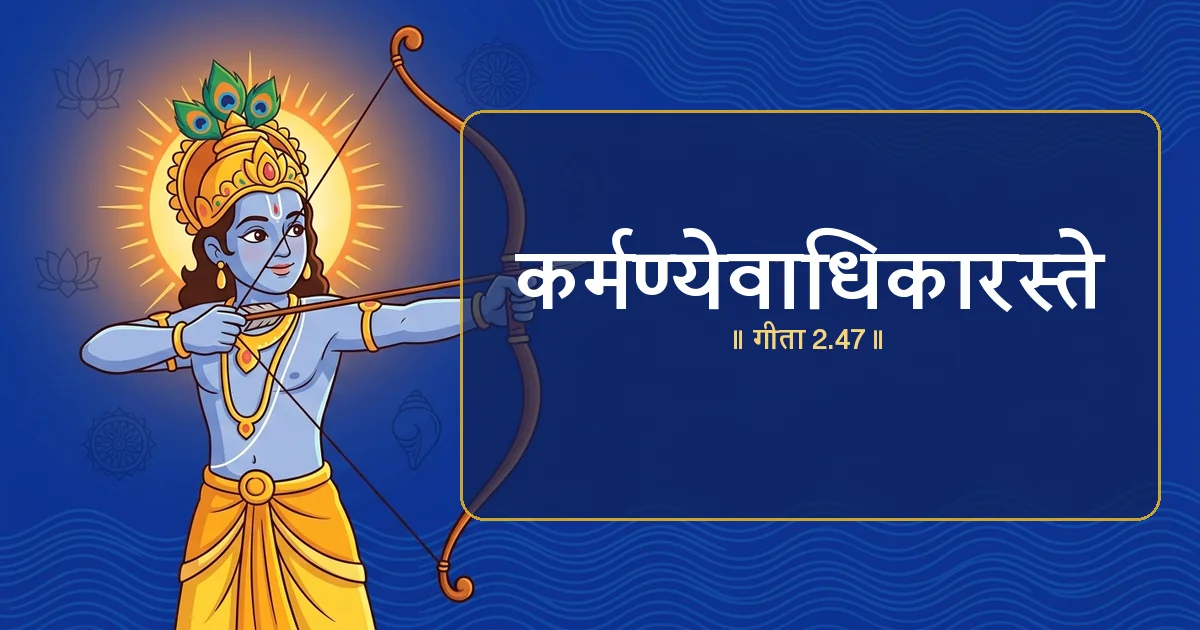
Chapter 2 — Sānkhya Yog · Verse 47
Does 'don't worry about the fruits' mean that results don't matter? This is precisely the misunderstanding that turns this verse into a counsel for inaction. Krishna says exactly the opposite.
The Verse
कर्मण्येवाधिकारस्ते मा फलेषु कदाचन।
मा कर्मफलहेतुर्भूर्मा ते सङ्गोऽस्त्वकर्मणि
karmaṇy-evādhikāras te mā phaleṣhu kadāchana
mā karma-phala-hetur bhūr mā te saṅgo 'stvakarmaṇi
What Does Karmaṇye Vādhikāras Te Mean? (In Simple Terms)
Karmaṇye vādhikāras te means: you have the right to action, not to its fruits. The common belief is that it means 'don't care about the result.' But Krishna is saying two things at once: do not make the fruit the motive for action, and do not fall into inaction either. This is not a message of indifference — it is a message of balance.
When B.R. Chopra's Mahabharat aired on Sunday mornings, this verse was memorised almost without trying. That scene of Krishna: charioteer on the battlefield, hand raised, voice grave — it was imprinted on an entire generation's mind. Written in exams, heard from grandparents, sung in temples. But that rote understanding of 'don't worry about results' and the verse's actual meaning are two different things. That difference now opens up.
Word-by-Word (Padacchhed)
| Word | Meaning |
|---|---|
| कर्मणि | in action |
| एव | only / indeed |
| अधिकारः | the right / domain |
| ते | your |
| मा | not |
| फलेषु | in the fruits |
| कदाचन | ever / at any time |
| मा | never |
| कर्मफल | of the fruits of action |
| हेतुः | the cause / motive |
| भूः | become |
| मा | not |
| ते | your |
| सङ्गः | attachment |
| अस्तु | let there be |
| अकर्मणि | in inaction |
Deep Commentary on Karmaṇye Vādhikāras Te
Action is in your hands; its fruit is not. This is the heartbeat of this verse.

The words "karmaṇi" and "phaleṣhu" carry a subtle Sanskrit signal. Both are in the saptamī vibhakti (locative case), meaning "in action" and "in the fruits." Translators often render this as "the right to action" or "authority over the fruits," but the original verse says no such thing. This is not about ownership — it is simply a boundary line for a domain: where you can move, and where your hand simply cannot reach.
Authority here is not ownership — it is a domain.
Read the word "adhikāra" not as "entitlement" but as "responsibility" or "domain" — the entire verse suddenly opens up. "Kadāchana" means never, at no time whatsoever — it is a sharp nail of warning.
Now pay attention to the word "karma-phala-hetuḥ." Its literal meaning is: "the cause of the fruits of action." The verse is stopping you from seeing yourself as that cause. This is not merely moral counsel — it is a deep philosophical point. Fruits are born from the convergence of countless forces: season, soil, readiness, time, the actions of others, and yes, your effort too. But your effort is only one thread in this weave, not the entire cloth. The ego slips precisely here, when it says, "I did this."
When a musician sings a raga, they produce notes — their domain is the note. But what wave will rise in the listener's heart, when they will be moved, when they will leave — that is determined not by the note but by the inner state of the one who hears.
The note belongs to the singer; its effect belongs to the listener.
If the singer tries every time to make the listener weep, they will either stop singing altogether or become artificial. This very flaw enters action when the gaze becomes fixed on the result.

One more layer. At the end of the verse is a protective shield. Lest you think: "The fruit is not in my hands anyway, so why work at all?" — this is a backdoor that the verse shuts in advance. Nishkāmatā (desirelessness) is not a synonym for laziness; it allows the fire of action to burn all the more cleanly. The person who releases the grip on results does not scatter their energy — they gather it in one place.
Many read this and conclude that "don't worry about fruits" means become indifferent to outcomes, stop caring altogether. This reading is entirely wrong. When a potter places clay on the wheel, every finger works with full concentration to shape the pot. The potter is not inattentive — they are pouring their entire focus into the action, which is exactly why the pot takes form. Indifference should be not toward the fruit but toward the attachment fixed on the fruit. "The fruit will surely come to me" and "I am the one who produces the fruit" — where these two notions break down, that is where real action is born.
Karma Yoga takes this verse as its root mantra: let there be action, but let there be no sense of being the doer. Sānkhya philosophy explains this through the distinction between Prakṛiti and Puruṣha. Actions unfold within the guṇas (qualities) of Prakṛiti; Puruṣha is only the witness — so the very claim of being the cause of results is false. Advaita Vedānta takes this one step further. When the "I" is ultimately pure consciousness itself, who remains separately to enjoy the fruit? Bhakti Mārg brings a sweet turn — release the claim on the fruit, and offer it to the very One by whose grace action became possible.
Release the fruit — but hold action all the more deeply.
Four directions, one centre.

In Today's Life
This verse applies today in precisely the same situations Arjuna faced two thousand years ago: where one pours heart and soul into something, and then the weight of the result begins to feel unbearable.
When the Grip of Results Overtakes Life
Two Bhajan Marg satsangs directly discuss this verse: "How is Action Possible Without Desire for its Fruits?" and "Complete Karma Yoga". Maharaj Ji opened up this teaching through one example each in these two satsangs, and both point to the same truth. A farmer labours day and night in the field; the harvest is nearly ready — and then hail falls. Now calculations begin inside: where will the children's school fees come from, how will his daughter's wedding happen? Despair descends so deep that sometimes the thought of "giving up this body" begins to find a place in the mind. The very same story belongs to a student who fails an exam: mocked by friends, scolded at home, a young person broken so deeply inside that life itself is placed in the circle of question marks. The verse steadies one here: keep acting — the farmer in the field, the student over the book — but the result is not your identity. If it comes, good; if it does not, action remains, life remains, and tomorrow the chance to sow again remains.
"If I Don't Want the Fruits, Why Should I Work?": The Biggest Misconception Today
Thousands of questions about this verse on the internet rest on a single confusion: "If there is no desire for results, where will motivation come from?" In an office, the same question arrives as: "If I don't care about my performance review, won't my manager overlook me?" The answer is direct. The verse does not take away the goal of work — it takes away the ownership-claim over it. Prepare fully for your review, keep your work targets in focus, seek honest feedback from your team. But when sleep breaks at three in the morning because of "what if it doesn't happen" — that worry is not your work. Hold the goal in your hands; release the expectation from your mind. That distinction is the essence of the entire verse.
Three Commentaries Written in Prison
This one verse showed the way to three different eras of modern India — and all three encountered it in prison. Lokmanya Tilak wrote Gita-Rahasya in Mandalay Prison in 1910–11, based on this very verse: he described Karma Yoga not as "a teaching to abandon work" but as "a teaching to free work from attachment." Mahatma Gandhi gave this the name Anāsakti Yoga: not indifference, but the removal of the mind's bondage to results. Bhagat Singh wrote in prison a few days before his execution that his karma was to complete his lines; when they would be published — or whether ever — was not in his domain. All three grasped the same subtle point: "adhikāra" here does not translate directly as entitlement — it means domain of action, the scope of one's responsibility. Where you can apply your labour, apply it fully. Everything else is in the hands of history and time.

The simplest framework for bringing this verse into daily life is to divide the day into three: morning Saṅkalpa (a short list of what is within my domain today), the day's Karma (with full heart, without tallying results every hour), evening Samīkṣhā (did I fulfil my domain — or did I waste energy worrying over what was not in my domain?).
Can you, looking at today's work through these three parts, recognise where anxiety crept into a space that was never your domain?
Related Verses
- Gita 2.48: Samatvam Yoga Uchyate — The Real Meaning of Yogasthah: Shared themes: attachment, confusion, duty.
- Gita 2.50: Yogah Karmasu Kaushalam — The Real Truth About Merit: Shared themes: attachment, confusion, duty.
- Gita 4.7: Yada Yada Hi Dharmasya — The Simple Meaning of Dharma and the Avatar: Shared themes: confusion, duty, purpose.
References
Frequently Asked Questions

Independent writer, jaapak.com
I built the Jaapak app. I write in simple Hindi on the Bhagavad Gita and the satsang tradition — so seekers don't struggle with the scripture.
Read all articlesAbout this article
About this article: this commentary is grounded in the original Sanskrit verse and the common understanding shared across Indian philosophical traditions. It is not a verbatim quotation of any single modern translator or commentator. All illustrations are digitally generated.