Samatvaṁ Yoga Uchyate — The True Meaning of Yoga-sthaḥ
Does 'yoga-sthaḥ kuru karmāṇi saṅgaṁ' (Gita 2.48) only mean meditating before you act?
The true meaning of this verse: samatva — remaining the same in success and failure — this is what Sri Krishna called yoga.
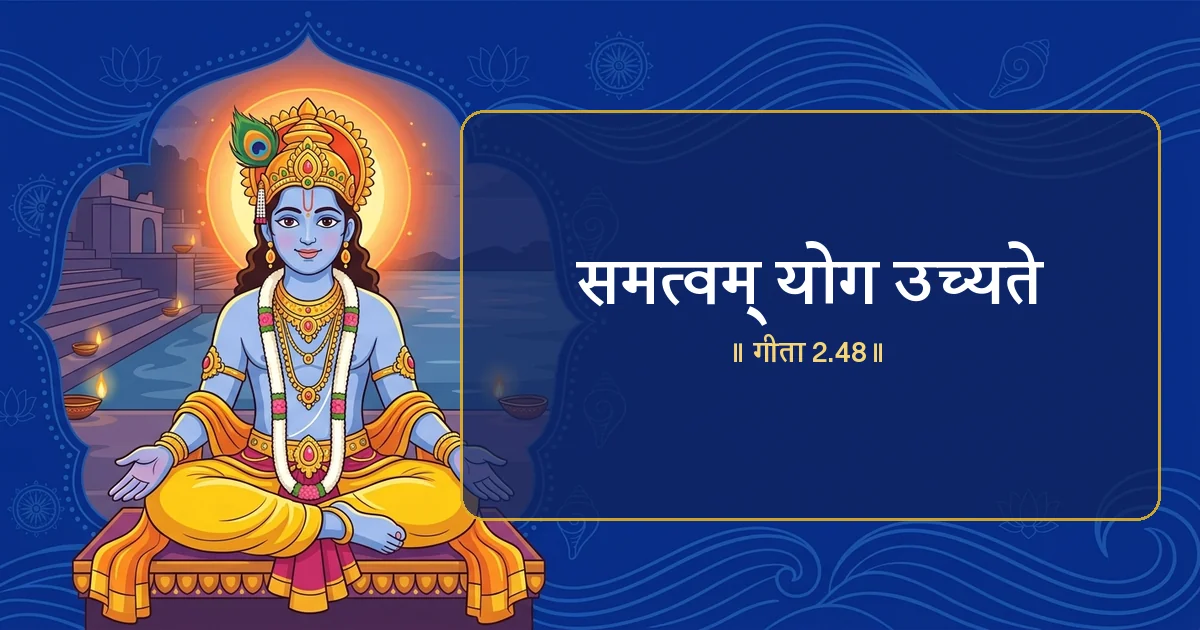
Chapter 2 — Sānkhya Yog · Verse 48
Is Gita 2.48 saying we should be indifferent to success and failure? Most people understand it this way — that 'indifference' is 'equanimity.' But the two are different, and that difference holds the depth of this verse.
The Verse (Gita 2.48 — Yoga-sthaḥ Kuru Karmāṇi)
योगस्थः कुरु कर्माणि सङ्गं त्यक्त्वा धनञ्जय।
सिद्ध्यसिद्ध्योः समो भूत्वा समत्वं योग उच्यते
yoga-sthaḥ kuru karmāṇi saṅgaṁ tyaktvā dhanañjaya
siddhy-asiddhyoḥ samo bhūtvā samatvaṁ yoga uchyate
What Does Samatvaṁ Yoga Uchyate Actually Mean? (Simply Put)
Samatvaṁ yoga uchyate. Krishna here is saying that yoga is not a posture or a meditation technique. Remaining steady in the mind through success and failure, acting without attachment to outcomes — this is yoga. Usually people interpret 'don't worry about results' as indifference. But samatva means inner steadiness, not indifference.
In B.R. Chopra's Mahabharat, when Arjuna's chariot stood between the two armies, that scene would stay in the eyes as a child. When the words 'yoga-sthaḥ kuru karmāṇi' were memorized, it is hard to say. But then 'yoga' seemed to mean 'union,' perhaps 'exercise.' That samatva itself is yoga — this understanding came much later, when life's first great failure stood squarely before me.
Word-by-Word Analysis
| Word | Meaning |
|---|---|
| योगस्थः | established in yoga |
| कुरु | do / perform |
| कर्माणि | actions / duties |
| सङ्गं | attachment |
| त्यक्त्वा | having renounced |
| धनञ्जय | O Dhanañjaya (Arjuna) |
| सिद्ध्यसिद्ध्योः | in success and failure |
| समो | with equanimity |
| भूत्वा | having become |
| समत्वं | equanimity |
| योग | yoga |
| उच्यते | is called |
Deep Commentary on the Meaning of Samatvaṁ Yoga Uchyate
Yoga-sthaḥ and Samatvaṁ: The Equation Hidden in the Words
Sri Krishna makes a simple declaration here. "Samatvaṁ yoga uchyate." Meaning: equanimity itself is called yoga. This is not a simile, nor a figure of speech. It is a direct equation. One word becomes the synonym of the other.
The weight of "yoga-sthaḥ" also comes from this same equation. First you must be established in yoga, then act. The order cannot be reversed. Yoga does not come through acting. Action begins from being seated in yoga.
The "tyaktvā" in "saṅgaṁ tyaktvā" is a fully completed action. Arjuna must abandon attachment before action even begins — not halfway through, but having already left it behind before he starts.
Samatva is not a definition of yoga — it is yoga's synonym.
Samatva Is Yoga: Not a Definition, but an Identity
Imagine a musician. They are singing a rāga in a gathering. Some listeners say "bravo," some sit in silence, some get up and leave. But their note? It does not know the difference. Their melodic phrases remain steady; their breath flows even.
This is samatva. Whatever wind blows outside, the lamp within burns with the same flame. This does not come from any technique, nor is it found at the end of any practice. It is the state in which you abide.

Sri Krishna is not describing yoga as a process here. He is calling it a mental posture. Not an āsana, but a resting state. Not a sādhanā, but being settled.
Siddhi and Asiddhi: Not in Between, but in Both Together
"Siddhy-asiddhyoḥ" is a special grammatical form. It is in the dual number and the locative case. Its meaning is: within both success and failure — not in the middle, not above, but within both, simultaneously.
Then comes "bhūtvā." Having become. This is a demand for complete identity-transformation. You must be equanimous — not try to be equanimous. Trying is an external matter; being is internal.
Look at a potter's wheel. Sometimes it spins fast, sometimes it slows. Sometimes the clay centers perfectly, sometimes it threatens to scatter. But the potter's hand? In both moments it holds the clay with the same steadiness. In the moment of success, with that same hand; in the moment of failure, with that same hand.

You must be equanimous — not try to be equanimous.
The Greatest Misconception: Doing Yoga vs. Being in Yoga
Today many people treat yoga as an activity. Morning postures, prāṇāyāma, meditation. Half an hour, an hour, then finished. After this begins life's restless work and dealings.
But this verse turns that understanding upside down. Yoga is not something to "do." Yoga is a state of "being." When you are established in equanimity, only then are you in yoga. When you have fallen from that, no physical posture can make you a yogi.
This is not wordplay. This is a fundamental difference in vision. A yogi is not one who does yoga. A yogi is one who is in yoga.
Yoga is not something to do — it is a state of being.
Three Streams: Karma Yoga, Sānkhya, and Bhakti
This very verse is the confluence of three philosophical streams. Karma yoga says: act, but abandon attachment. Sānkhya says: understand the distinction between the witness and the witnessed, then pleasure and pain no longer feel like yours. Bhakti says: place the fruit at the Lord's feet, then victory and defeat no longer remain yours.
The conclusion of all three is one. Let the mind be equanimous. Let the external accounting be left to the One above. Inner peace itself is the true yoga. And this equanimity is the stage upon which Arjuna must establish his action.
In Today's Life
On the day results turn out contrary to expectation, that very evening reveals how deeply this verse has truly penetrated.
Yoga-sthaḥ: Practicing Sādhanā and Being in Yoga
A question comes again and again about this verse: if yoga is the equanimity of the mind, then what use is morning sādhanā (āsanas, prāṇāyāma, meditation)? This confusion arises because the word "yoga" is being understood as an activity.
"Yoga-sthaḥ" is an adjectival state-marker, not a verbal noun. You do not do yoga; you are in yoga. Sādhanā can be a path toward that state. But sādhanā is not itself the goal.
The difference is this: in a three-hour meeting where the decision did not go in your favor, what state of mind did you return in that evening? If the mind wavered there, then the morning time was spent in exercise, not in yoga. Exercise is good. It is not yoga.
Lokmanya Tilak's Mandālay Cell and the Meaning of Samatvaṁ Yoga
In 1908, the British government sent Lokmanya Bal Gangadhar Tilak to Mandālay prison. Six years. In that cell he wrote Gita Rahasya, a complete treatise on Karma Yoga.

Tilak's central question was: if we must abandon concern for results, what is the meaning of the struggle for freedom? His answer was that detachment from results and firmness in action go hand in hand. Prison walls are the result. Continuing to write — that is yoga-sthaḥ karma.
This question is alive even today. Results are often not in your hands. Equanimity and action — both are in your hands.
Three Points for Daily Practice
Morning resolve: What is today's work? Decide that; the discussion of results comes later.
Day's action: After every decision, one question: did this come from action, or from restlessness?
Evening review: Whatever turned out differently from expectation — how did the mind remain?
If you have the courage to ask the third question, work on samatva is happening.
Who is the most honest witness to your action — the result, or the mind from which the action emerged?
Related Verses
- Gita 2.50: Yogaḥ Karmasu Kauśalam — The Real Truth About Merit: Shared context: attachment, confusion, detachment.
- Gita 2.47: Karmaṇy-evādhikāraste — What Is the Real Truth About Results?: Shared context: attachment, confusion, duty.
- Gita 4.7: Yadā Yadā Hi Dharmasya — The Simple Meaning of Dharma and Avatāra: Shared context: confusion, duty, purpose.
References
Frequently Asked Questions
Independent writer, jaapak.com
I built the Jaapak app. I write in simple Hindi on the Bhagavad Gita and the satsang tradition — so seekers don't struggle with the scripture.
Read all articlesAbout this article
About this article: this commentary is grounded in the original Sanskrit verse and the common understanding shared across Indian philosophical traditions. It is not a verbatim quotation of any single modern translator or commentator. All illustrations are digitally generated.