Vihāya Kāmān: The True Peace of Nirmama and Nirahamkāra
Does 'vihāya kāmān' (Gita 2.71) speak only of outer renunciation?
The real meaning of this verse: one who lives free of 'mine' and 'I' is the one who finds true peace.
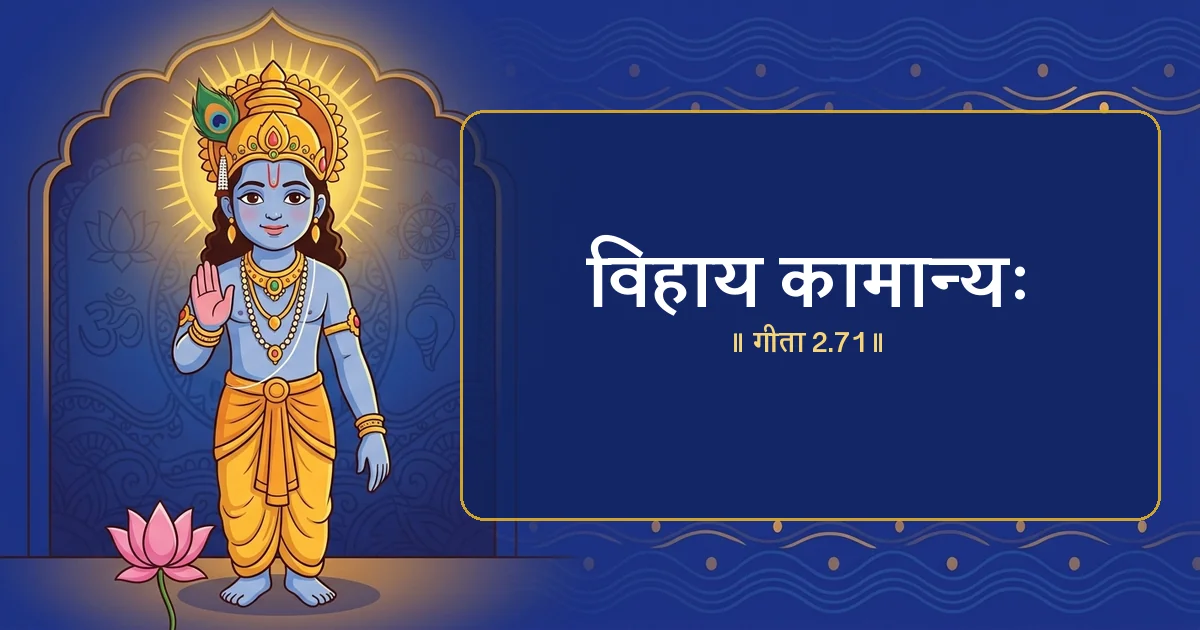
Chapter 2 · Sānkhya Yog · Verse 71
'Abandoning all desires' sounds like it means renouncing the world and retreating to the forest. The verse points to an inward path instead.
The Verse (Gita 2.71, Vihāya Kāmān)
विहाय कामान्यः सर्वान्पुमांश्चरति निःस्पृहः।
निर्ममो निरहंकारः स शांतिमधिगच्छति
vihāya kāmān yaḥ sarvān pumānśh charati niḥspṛihaḥ
nirmamo nirahankāraḥ sa śhāntim adhigachchhati
What Does Vihāya Kāmān Mean? (In Simple Terms)
'Nirmamo nirahamkāraḥ' means one in whose mind the sense of 'this is mine' and 'I am this' has completely dissolved. Many people mistakenly equate this with sannyāsa, leaving home behind. But verse 2.71 says this is an inner state: to live free of all desire, possessiveness (mamtva), and ego is the very gateway to true peace.
Three words appear together in this verse: niḥspṛihaḥ, nirmamaḥ, nirahamkāraḥ. Each carries the prefix 'nir-', meaning 'without.' Without longing, without possessiveness, without ego. But are these three separate tasks, or do they grow from the same root? And what is the path to cutting that root when the mind keeps giving birth to new desires every day?
Word-by-Word (Padachhed)
| Word | Meaning |
|---|---|
| विहाय | having abandoned |
| कामान् | desires (accusative plural) |
| यः | who |
| सर्वान् | all |
| पुमान् | a person |
| चरति | moves about / lives |
| निःस्पृहः | free from craving |
| निर्ममः | free from possessiveness |
| निरहंकारः | free from ego |
| सः | that one |
| शांतिम् | peace (accusative) |
| अधिगच्छति | attains / reaches |
Commentary on Vihāya Kāmān
Vihāya and Niḥspṛihaḥ: Two Ends of the Same Thread
Two words are placed side by side in the verse's first line. Vihāya means to abandon. And niḥspṛihaḥ, one in whom not even a hidden trace of longing remains. These two are not the same.
A person can let go of something outwardly, yet a faint wanting of it can remain tucked away in a corner of the mind. That same wanting then surfaces unexpectedly, in a dream, a conversation, or a flash of anger. This is the verse's standard: letting go is not enough, the root of wanting itself must be uprooted.
Here another word draws attention: charati. The text does not say one remains. It says one moves. The root verb car itself means motion. So the person who has abandoned desires does not sit still somewhere. He moves through the world, works, talks. He simply does not cling to things.
Letting go of a desire is one thing; having no desire at all is something entirely different.
Charati: Not Renunciation, but Active Journey
Many readers believe that the path to peace lies in leaving home, abandoning one's livelihood, separating from family, and going to the forest. The verse directly refutes this understanding.
Consider the postman. Every day he delivers letters to dozens of homes. Every envelope bears someone else's name.
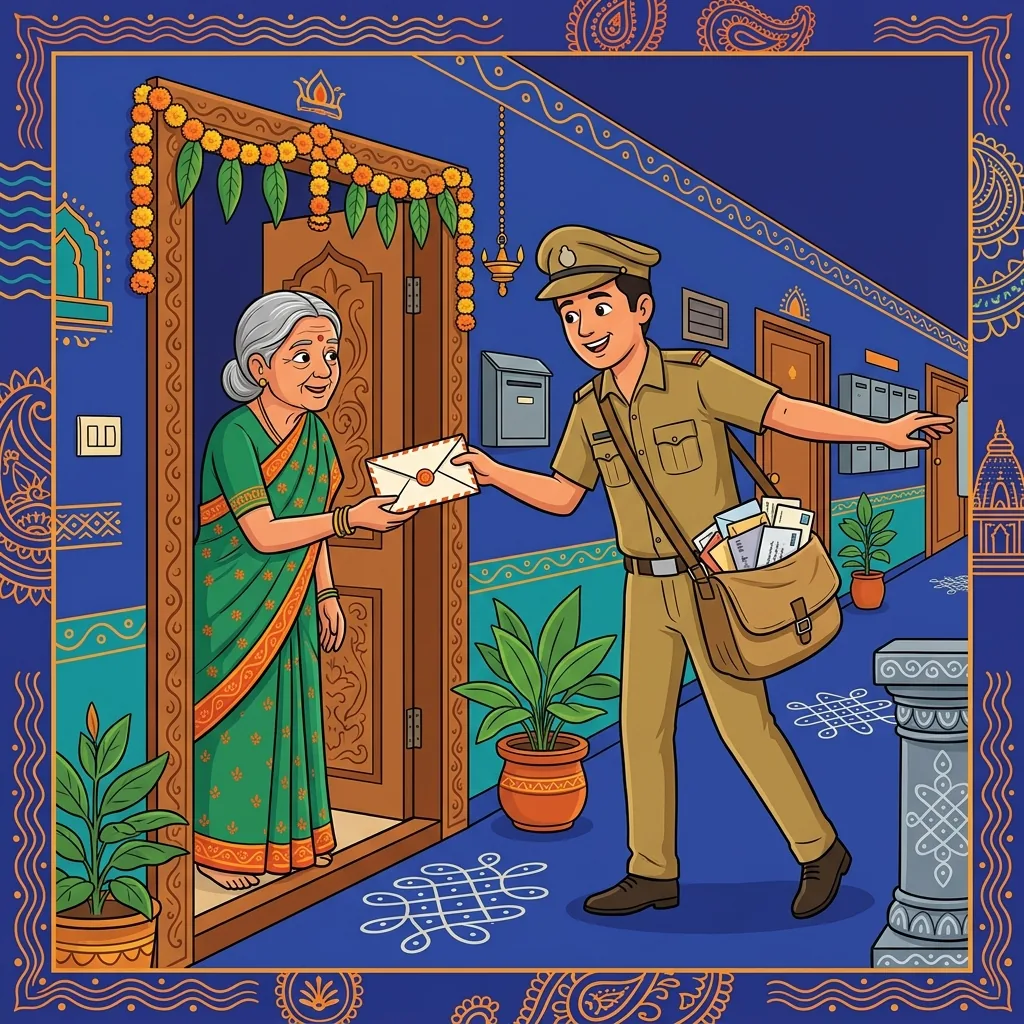
He does not read them. He handles them, delivers them, and moves on. At the end of the day, his bag is empty, and his mind light with it.
Now imagine. This same postman pauses at every envelope, wondering, 'Why isn't this for me?' 'Why don't I get such news?' His work would stop right there. The bag heavy, and the mind heavier still.
The person this verse describes is like that first postman. He moves through the world, fulfils his duties, but does not affix his name-tag to every experience. When I first read this, I had to stop and think, because this is not about fleeing, but about keeping moving.
Peace is not inaction. It is another name for unencumbered movement.
Nirmama and Nirahamkāra: Two Distinct Pillars
The second line brings two adjectives in succession. Nirmamaḥ, one in whom the sense of mine is absent. And nirahamkāraḥ, one in whom the sense of I is absent. The text does not merge them. It counts them separately. There is a reason. Both are two distinct pillars of false identity.
- Nirmama releases the outer grip, the habit of stamping mine on house, money, relationships.
- Nirahamkāra releases the inner grip, removing the stamps of I am learned, I am successful, I am suffering.
A person can donate all his wealth and still walk around with the stamp I am the greatest renunciant pressed into his mind. His grip has not loosened. It has merely changed form. The verse calls for both pillars to fall together.
On stage, an actor plays the role of a king. He wears the crown, speaks royal lines. When the curtain falls, he removes the crown.

He does not consider the crown mine, nor does he identify I am the king. This is precisely what this verse points toward.
The Biggest Misconception: Peace Is Not Inaction
The moment people hear the word peace, they imagine: sitting still, falling silent, withdrawing from action. The text declares this picture wrong.
A river descends from the mountain, crosses the plains, merges into the sea. Along the way there are rocks, bends, and depths.

But the river does not get stuck anywhere. It does not pause at every stone and say this is mine. This is its true peace: not still, but flowing.
Still water stagnates. A free-flowing stream stays clear. The peace of this verse is like that free stream, poised within flow.
Adhigachchhati: To Arrive, Not to Stumble Upon
One more word at the end deserves attention. Adhigachchhati, he reaches, he arrives. The text does not say peace befalls him. It says he arrives at peace. Peace is not an object lying in some corner that one stumbles upon by chance. It is a place the seeker arrives at by walking there on his own feet.
Like a guest who travels to a distant city to visit a relative. The journey must be undertaken oneself. On arrival, the host's home is warm and welcoming, but the guest does not claim it as his own.
He stays, receives the warmth, and returns when it is time. Peace too is like that stay, not accidentally received, but consciously walked toward.
One who clings nowhere is the one who arrives everywhere.
Vihāya Kāmān in Today's Life
In Today's Life
This verse changes one assumption: peace does not come from acquiring something. It comes from ceasing to cling to anything.
Nirmamo Nirahamkāraḥ: Must You Give Up Everything to Find Peace?
This is the deepest confusion about this verse. People believe: if you want peace, first leave home, abandon your livelihood, separate from family.
But one word in the verse shatters this image. Charati: meaning he moves. The ideal person here is not seated in stillness. He is active in the world.
The difference is only this. He does not stamp his name on every experience.
The verse counts two things separately:
- Nirmama: not saying mine over house, wealth, relationships.
- Nirahamkāra: I am a renunciant, I am wise, this too is a grip.
One who leaves everything for the forest, yet carries in the mind the stamp 'I am the greatest renunciant,' has only deepened his grip. When I first encountered this distinction, I had to stop.
Vihāya Kāmān: Guru Tegh Bahadur's Lived Verse, November 1675
November 1675. Chandni Chowk, Delhi.

The ninth Sikh Guru, Shri Guru Tegh Bahadur Ji, sat awaiting his death. One option remained: to accept Islam.
He refused. For whom?
For the Kashmiri Pandits. Whose faith was different from his own. Whose caste was also different. To protect their right to their God.
This is nirmama: the wall of my people dissolving. This is nirahamkāra: no desire for name, glory, or remembrance. And this is śhāntim adhigachchhati. He accepted even death without any claim upon it.
Few people live vihāya kāmān. Many write about it.
Three-Step Daily Practice:
1. Morning question: 'What am I clinging to today?' Name it. The act of naming it creates a little distance from it.
2. Daily action: In each task, just that task. Fruit, recognition, outcome come later. Simply complete this moment.
3. Evening review: 'Was there a moment today when I did something without any claim?' That moment is the seed of peace.
Was there a moment today when you fulfilled a duty without any sense of mine?
Related Verses
- Gita 2.48: Samatvam Yoga Uchyate: the Real Meaning of Yogasthah: Shared context: attachment, detachment, purpose.
- Gita 2.50: Yogah Karmasu Kaushalam: the Real Truth About Merit: Shared context: attachment, detachment, liberation.
- Gita 18.66: Sarvadharmān Parityajya: the Real Meaning of Surrender: Shared context: attachment, detachment, liberation.
References
Frequently Asked Questions
Independent writer, jaapak.com
I built the Jaapak app. I write in simple Hindi on the Bhagavad Gita and the satsang tradition, so seekers don't struggle with the scripture.
Read all articlesAbout this article
About this article: this commentary is grounded in the original Sanskrit verse and the common understanding shared across Indian philosophical traditions. It is not a verbatim quotation of any single modern translator or commentator. All illustrations are digitally generated.
Related Articles
Bhagavad Gita Quotes in English: 15 Shlokas with Meaning

How to Use Japa Mala: Premanand Maharaj's Way
Why Divine Name Chanting Feels Empty: a Saint's Answer
The Power of Naam Jap: Beyond Ritual to True Sadhana
How to Calm the Mind: The Power of Naam Jap
How to Focus the Mind in Naam Jap: Premanand Maharaj