na hanyate hanyamane sharire: The Truth of the Soul's Unborn Nature
Does 'na jāyate mriyate vā' (Gita 2.20) only speak of the soul's immortality?
The true meaning of this verse: the ātmā is unborn, eternal, and everlasting — it never dies when the body dies.
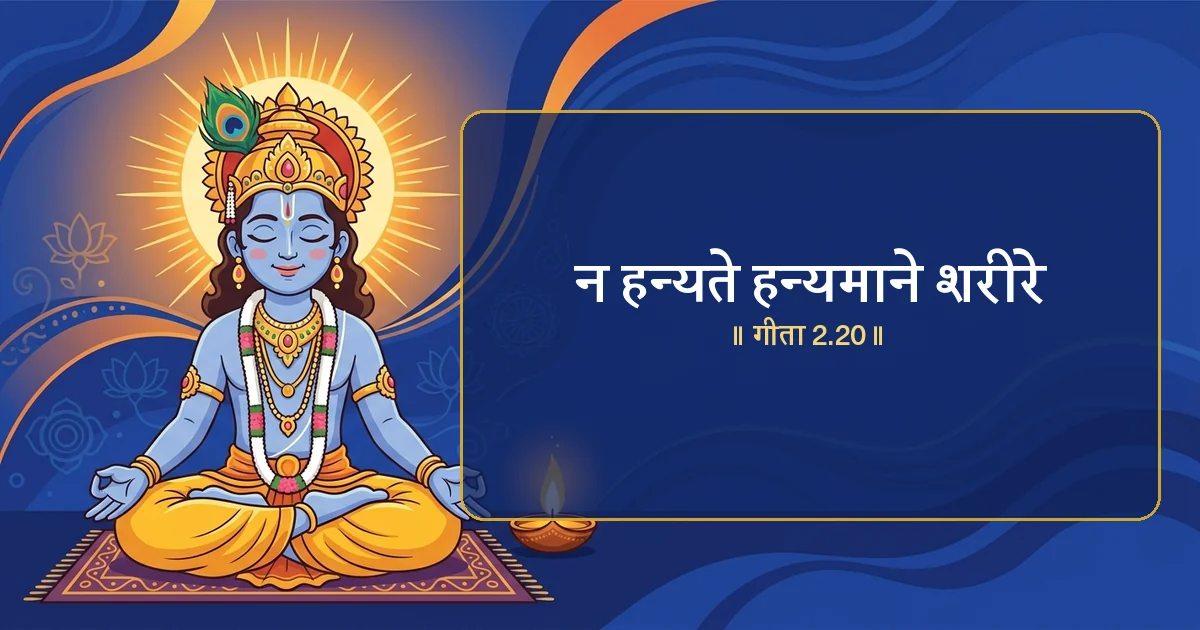
Chapter 2 — Sānkhya Yog · Verse 20
Does this verse merely say that 'the soul takes birth after death'? That is what most people understand. But Krishna is saying something far larger here — the ātmā is not part of the birth-death game at all.
The Verse (Gita 2.20 — na jāyate mriyate vā)
न जायते म्रियते वा कदाचि
न्नायं भूत्वा भविता वा न भूयः।
अजो नित्यः शाश्वतोऽयं पुराणो
न हन्यते हन्यमाने शरीरे
na jāyate mriyate vā kadāchin
nāyaṁ bhūtvā bhavitā vā na bhūyaḥ
ajo nityaḥ śhāśhvato 'yaṁ purāṇo
na hanyate hanyamāne śharīre
What Does na hanyate hanyamane sharire Mean? (Simply Put)
na jāyate mriyate vā kadācit: The ātmā was never born and will never die. Most people read this verse as proof of rebirth (punarjanma). But the real point is that the ātmā is not in the cycle of birth and death at all. The body may be cut, burned, or reduced to nothing — the ātmā remains untouched. It is aja (unborn), nitya (eternal), śhāśhvata (everlasting).
When B.R. Chopra's Mahabharat aired on Sunday mornings on Indian television, this verse became the collective memory of a generation. Krishna's voice, those words na jāyate mriyate — heard again and again in childhood until they were memorized by heart. Grandmothers recited them in their daily pāṭh, they appeared in school textbooks, they echoed in temples. We kept repeating "the ātmā is immortal" without grasping that its meaning reaches entirely beyond birth and death. That meaning opens up now.
Word-by-Word (Padachhed)
| Word | Meaning |
|---|---|
| न | not |
| जायते | is born |
| म्रियते | dies |
| वा | or |
| कदाचित् | ever / at any time |
| न | not |
| अयम् | this (one) |
| भूत्वा | having once come into being |
| भविता | will become |
| वा | or |
| न | not |
| भूयः | again |
| अजः | unborn (aja) |
| नित्यः | eternal (nitya) |
| शाश्वतः | everlasting (śhāśhvata) |
| अयम् | this |
| पुराणः | primordial / ancient |
| न | not |
| हन्यते | is slain / destroyed |
| हन्यमाने | when being slain / destroyed |
| शरीरे | of the body |
Deep Commentary on na hanyate hanyamane sharire
Aja, Nitya, Śhāśhvata: The Four Dimensions of One Ātmā
Begin with the four root words. Aja means unborn — that which never had a beginning. Nitya is that which is never interrupted across any span of time. Śhāśhvata points toward the future — that which will never come to an end. Purāṇa points toward the past — that which is the most ancient yet remains fresh in every moment.
Four words together open four dimensions of the ātmā: no beginning, no interruption, no end, no aging.
The verse then makes a further, subtler move. Jāyate, mriyate, bhūtvā, bhavitā: these four verbs are not chosen by chance. The body passes through six transformations — coming into being, existing, growing, changing, declining, perishing. The verse negates all these changes, one by one, in sequence.
Each verb is a closed door to which the ātmā's identity cannot be pinned.
Two Planes: Two Truths in the Same Moment
The subtlest grammatical pivot of the verse is hidden in hanyamāne śharīre. This is a locative absolute construction — a device that places two events simultaneously in the same moment but on two entirely different planes. Its literal meaning is: "even as the body is being slain." It is not a condition; it is a concurrent state.
Understand it through the eyes of a potter. A potter smashes a clay pot. The pot's form scatters — but the space that the pot had enclosed within itself remains untouched. The space was never broken, because it was never made. The event of the pot breaking and the unbroken nature of the space exist in the same moment, but on two distinct levels.

The body's destruction and the ātmā's wholeness are two layers of the same moment.
When you grasp this grammar, death shifts from being an event into being a scene. What occurs, occurs upon the body. The witness itself remains unchanged.
The Musical Note: The Nāda That Comes from Nowhere
Consider another angle. A musician plucks the strings of a tānpūrā. A rāga manifests as sound, then grows still and vanishes. But the tonal space from which the rāga arose was never created. The silence into which it returned was already there before.

This analogy clarified something for me for the first time: the ātmā does not come from anywhere and does not go anywhere. It is like that tonal space which remains the same before every rāga, during it, and after it. The body is a raised form — a momentary sound. The ātmā is the silent ground upon which all forms rise and fall.
The Greatest Misconception: Immortal vs. Unborn
This is where people stumble most. Almost everyone, hearing "the ātmā is immortal," imagines it means something that endures for a very long time. That is half the truth.
The verse says the ātmā is also aja — unborn. What was never born raises no question of death at all. Immortality is a claim within time. Being unborn is a claim outside of time.
Immortality is infinite time; unborn-ness is the complete absence of time.
This distinction seems small. At the practical level it is enormous. The very idea of immortality makes the mind anxious — "How will I pass an eternity?" The moment you grasp unborn-ness, time itself becomes small.
Three Perspectives: Advaita, Sānkhya, Bhakti
This single verse takes three different colors across three schools of thought.
In Advaita's view, the verse says that ātmā and Brahman are two names for one reality. The play of birth and death is the script of māyā; the witnessing seer remains untouched.
In Sānkhya's view, Puruṣa (consciousness) and Prakṛti (body-mind) are two entirely separate principles. The body is destroyed, but Puruṣa was never joined to it in the first place.
In the Bhakti stream, the ātmā is the jīva — an eternal fragment of the Lord. The body's funeral pyre burns, but the jīva remains safe with its Master.
The truth common to all three is this: the events of the body are separate from the being of the ātmā. The difference is only in vocabulary.
na hanyate hanyamane sharire In Today's Life
In Today's Life
The awareness of unborn-ness removes the very ground on which fear stands.
The Misconception of Immortality and Unborn-ness
Thousands of questions about this verse online keep stalling at one point: "If the ātmā is immortal, what will it be like to exist for eternity?" The question is standing on the wrong ground.
The word immortal assumes that the ātmā continues for a very long time within time. The verse is saying something different: the ātmā is aja — unborn. For that which was never born, the question "for how long?" simply does not arise.
Immortality is a matter within time. Unborn-ness is a matter outside time. This difference seems small. At the practical level it is enormous. The imagination of immortality exhausts the mind; the awareness of unborn-ness frees the mind from time itself.
Birthlessness in the Cell at Mandalay
In 1908, the British government sentenced Lokmanya Tilak to six years in Mandalay Prison on charges of sedition. In that very captivity he wrote Gita Rahasya, counted among the most extensive modern commentaries on the Gita.

His analysis of this verse connects directly to Karma Yoga: the ātmā that is unborn cannot be touched by bars. For him it was both scriptural inquiry and a lived test. Every morning in Mandalay was an examination of that analysis.
Reading his biography, I felt for the first time that na hanyate hanyamane śharīre becomes even sharper under pressure.
Three Moments: Morning, Day, Night
- Morning resolve: Name the role you are about to step into. Then pause for a moment and ask: are this role and I the same thing?
- Midday action: When an event shakes you, note that moment. Is what was shaken truly you?
- Night review: Write one sentence: In which moment today did I see the difference between my role and my self?
What is the pressure in your own life in which this unborn-ness might open in an entirely different color?
Related Verses
- Gita 2.48: samatvam yoga ucyate — the real meaning of yogasthaḥ: shared theme: detachment.
- Gita 2.50: yogaḥ karmasu kauśhalam — the real truth about puṇya: shared theme: detachment.
- Gita 4.7: yadā yadā hi dharmasya — the simple meaning of dharma and avatāra: shared theme: faith.
References
Frequently Asked Questions
Independent writer, jaapak.com
I built the Jaapak app. I write in simple Hindi on the Bhagavad Gita and the satsang tradition — so seekers don't struggle with the scripture.
Read all articlesAbout this article
About this article: this commentary is grounded in the original Sanskrit verse and the common understanding shared across Indian philosophical traditions. It is not a verbatim quotation of any single modern translator or commentator. All illustrations are digitally generated.