The Yoga Ladder: How the Soul Connects with God
Sanatana Dharma's real yoga, from animal life up to bhakti. The yoga ladder explained rung by rung, Patanjali's eight limbs, and the nine processes of
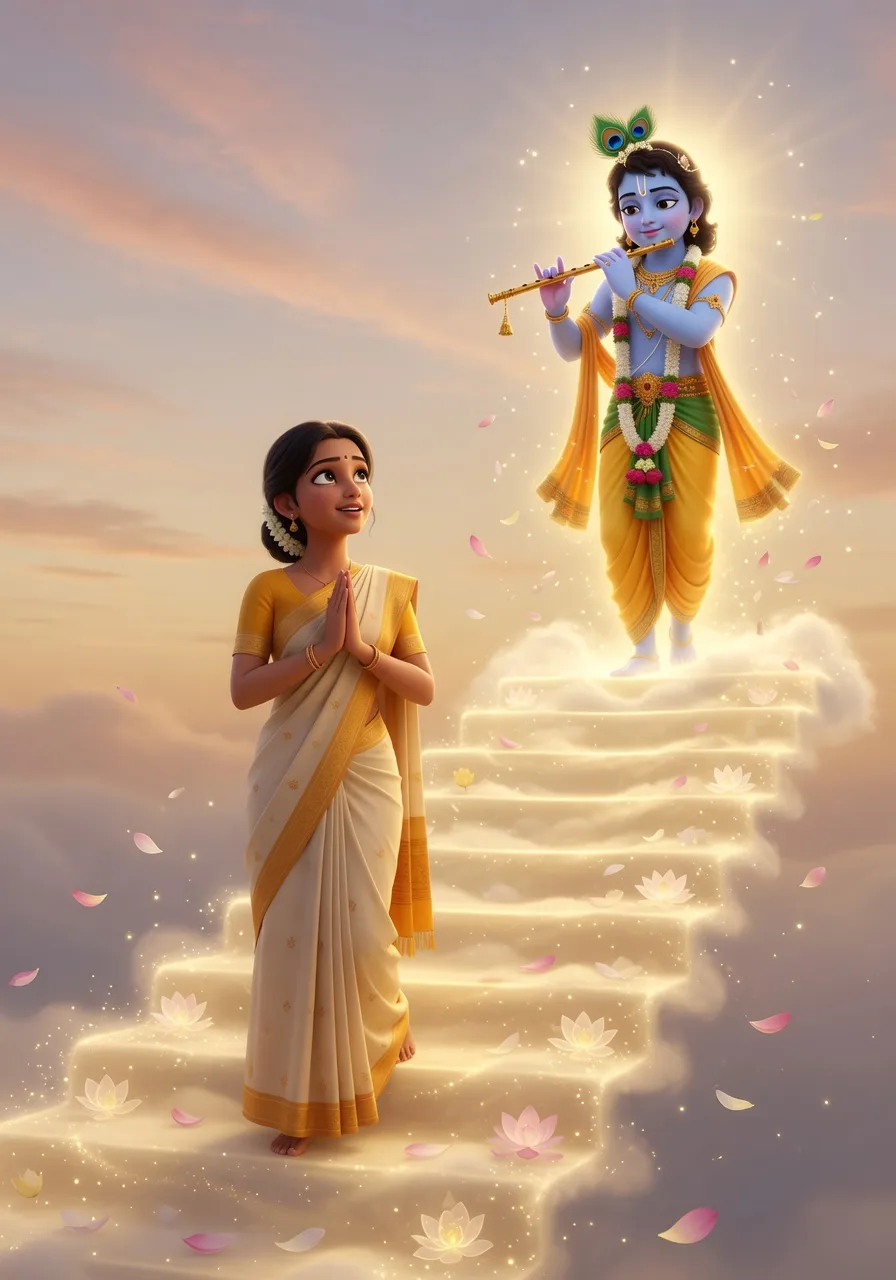
Yoga means to connect with the supreme Lord. That is the whole of it. The word has become a fitness fad in much of the world, good for the body and good for the mind, and there is nothing wrong with that, except that the one thing which makes yoga yoga gets left out. The missing factor is spirituality, the actual connection with the supreme. Without that link a yoga class is a physical exercise or a mental one, and useful as far as it goes, but it is not yet yoga. This lesson climbs the whole yoga ladder, from the bottom rung up to the top, and then looks closely at the highest rung, bhakti, and its nine limbs.
What is the yoga ladder?
Picture a ladder. Each rung is a way of living, and each one carries the soul a little closer to the Lord. You can climb it step by step, or, as we will see, you can take a direct route straight to the top. Here is the whole ladder before we walk through it.

The bottom rung: living like an animal
If all a person does is eat, sleep, mate, and defend, that life is on the level of an animal. An animal does exactly those four things, and when a human being does only those four, knowing better, it sinks toward the bottom of the pile. This is close to sinful life, and it leads downward, to lower species and lower planets, even to hellish conditions if a life is sinful enough. Sadly this probably accounts for most of the world. We do not want to be in this category, and the good news is that simply by asking these questions you have already left it.
Karma kanda: working for a reward
The next step up is karma kanda, fruitive ritual. This means performing the sacrifices prescribed in the Vedas to please the demigods, so that they grant something in return. The mood is "I do something in order to get something back." It is regulated sense enjoyment, kept within the bounds of scripture. The scriptures permit a householder to enjoy family life and the senses, as long as it is done according to their rules. Pious public works of the same kind, building a hospital or a school, count here too. They are good acts, yet they are not connected to the supreme Lord, so they stay within this world.
Where does a karma-kanda life lead? Either back to earth, or up to the heavenly planets for a short stay, long enough to enjoy the good karma earned, after which the soul returns to earth once the credit runs out. For this reason karma kanda is barely on the yoga ladder at all. It is pious, it is not sinful, but it does not connect us with God.
Karma yoga and nishkama karma yoga
Now the word yoga enters. Karma yoga means doing your prescribed duties without being attached to their fruits. You do what you are meant to do, and if it succeeds, good, and if it fails, also good, because you have let go of the results. This is a strong place to stand. Such a person stays peaceful, never too anxious over success and never too crushed by failure, always steady.
Nishkama karma yoga takes one more step. Here the fruits are not merely renounced, they are attached to the Lord. You act for the Lord's pleasure and hand the benefit to him. The difference sounds small and is large. Karma yoga need not include any idea of God at all, since a person can be detached from results without ever thinking of him. The moment God is brought into the equation, and the fruits are offered to the supreme Lord, it becomes nishkama karma. This earns a good birth in the next life, or the heavenly planets, or the planets of the forefathers, the Prajapatis, and it gives the soul a platform from which to rise toward the spiritual world. A good place to begin, though not the summit.
Gyana yoga: the path of knowledge
Higher than karma is gyana yoga, the path of knowledge, and it sits very close to bhakti. Here a person has renounced the fruits of work, lives austerely, and gathers knowledge about Brahman, the formless aspect of God we met in the last lesson. The gyani reads, reflects, and discriminates between what is real and what is not, what is supreme and what is not, and arrives at a fine realization: that we are not this body. That alone is a high understanding.
The destination of the gyani is usually the Brahman conception of God. These seekers tend to be captivated by the Lord's effulgence and to look no further than the light, so they can become stuck there. It is still better than karma yoga, because they act in a renounced spirit and gain real knowledge of God. Reading the Bhagavad Gita, by contrast, takes a person straight to the Lord rather than leaving them in the glow around him.
Dhyana yoga and the eight limbs of ashtanga
Higher again is dhyana yoga, also called ashtanga yoga, the eightfold path. Now a person controls the mind, which the earlier rungs did not strictly require, and meditates on the Lord within, usually on the Paramatma. Done at a serious level this can carry the soul to the spiritual world, though often without a direct relationship with God. Such a soul may exist there like grass, watching and enjoying the Lord's pastimes from the side without taking part.
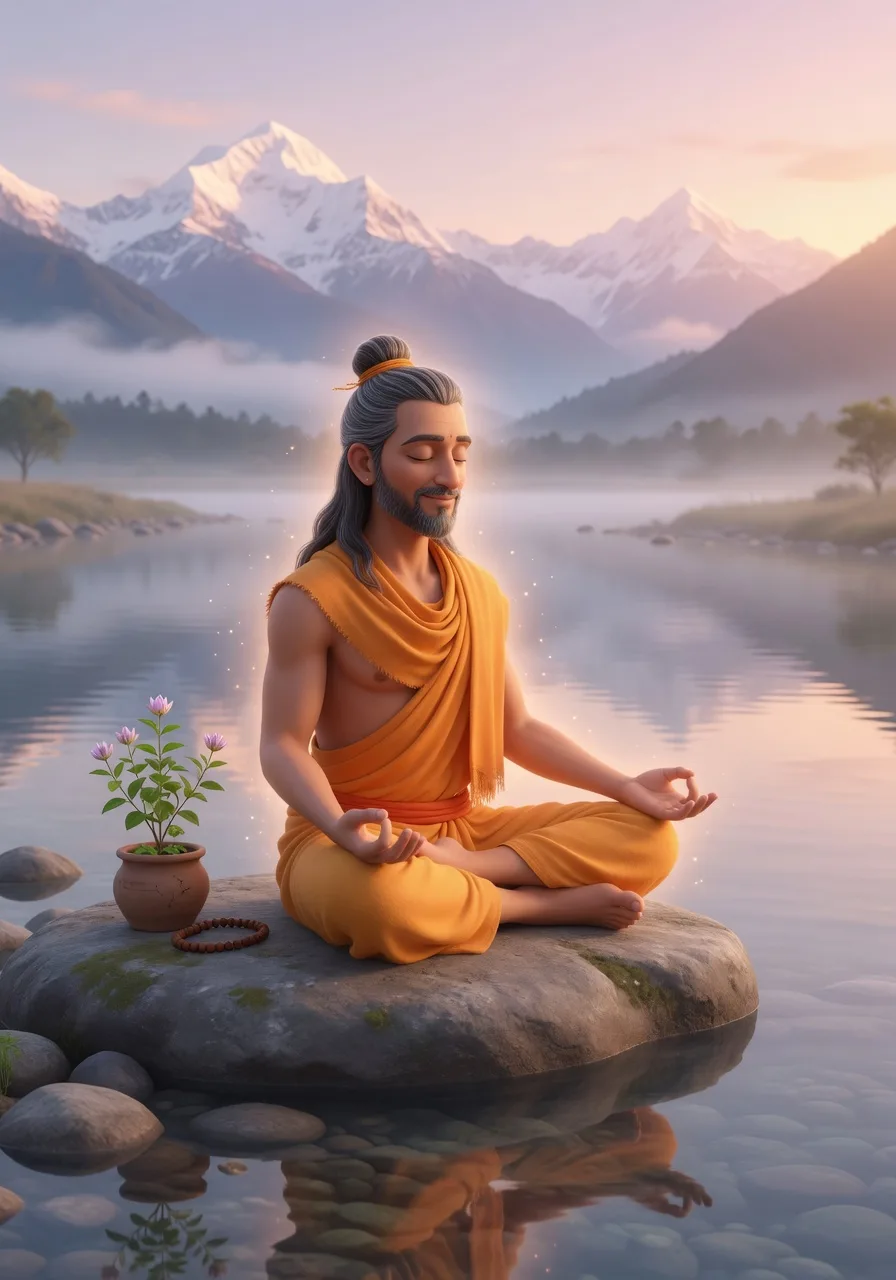
This is the path Krishna lays out in the sixth chapter of the Bhagavad Gita. Arjuna had wanted to retire to the forest instead of fighting, so Krishna told him what the forest path would actually require. After hearing the full method Arjuna replied that it was impossible, that for him it was easier to control the wind than to control the mind in the way Krishna had described. Krishna agreed that it is difficult, and said it can still be done, through steady practice and detachment. In this age that difficulty is very real. Try to chant for even five minutes and notice how many times the mind slips away to something material.
The authorized framework for this path is Patanjali's system, climbed in eight stages.
| Limb | What it involves |
|---|---|
| Yama | restraint, not lying, stealing, or harming any being |
| Niyama | observance, purity, contentment, austerity, study of scripture, surrender |
| Asana | postures that steady the body so the mind can settle |
| Pranayama | breath control, regulating the vital force to calm the mind |
| Pratyahara | drawing the senses back from smell, sound, touch, and sight |
| Dharana | concentration, fixing the mind on one point |
| Dhyana | meditation, an unbroken flow of focus on the Lord |
| Samadhi | full absorption, nothing left between the soul and the supreme |
Notice where the world's popular yoga stops. It works on asana and pranayama, the postures and the breathing, and goes no further. Those two limbs are healthy, and they do steady the body and the mind, but on their own they are bodily and mental exercise. The remaining limbs, and above all the spiritual connection, are what turn the practice into yoga.
Bhakti yoga: the top of the ladder
The final rung is bhakti yoga, loving devotional service to the supreme Lord. This is the one we recommend, and there are good reasons why.
Bhakti connects the soul to the Lord directly. Every lower rung is in some way indirect. The gyani must decipher a mountain of knowledge before even approaching who God is. The ashtanga yogi must master the mind and senses through stage after stage before any realization comes. Karma yoga may carry no thought of God at all. Bhakti skips the detours and joins the soul to the supreme straight away. It also contains the others within it, so nothing of value on the lower rungs is lost.
There is a further mercy here. The ladder can be climbed one rung at a time, the way you take a staircase, or it can be taken like an elevator, straight to the top. Wherever you stand on the ladder right now, nothing stops you from going directly to bhakti. In an age of short lives, that speed is a gift.
Bhakti is not tied to one form of the Lord. Krishna, Vishnu, Ramachandra, any of the avatars, the same loving service applies. And here is what Krishna himself says about the whole ladder, at the close of the sixth chapter, the very chapter that taught Arjuna the hard ashtanga path:
"Of all yogis, the one with great faith who always abides in me, thinks of me within himself, and renders transcendental loving service to me, he is the most intimately united with me in yoga, and is the highest of all. That is my opinion." (Bhagavad Gita 6.47)
The Lord ends a chapter on meditation by naming the devotee, not the meditator, as the highest yogi.
What are the nine limbs of bhakti?
If bhakti is the goal, what does it actually look like in practice? The answer was given long ago by Prahlada Maharaja, in a verse of the Srimad Bhagavatam:
"sravanam kirtanam visnoh smaranam pada-sevanam / arcanam vandanam dasyam sakhyam atma-nivedanam" (Srimad Bhagavatam 7.5.23)
These are the nine processes of pure devotional service. Connect with any one of them, or a combination, or all nine, and you are properly situated in bhakti. Scripture even hands us a devotee who perfected each single process, so we can see what one limb, taken to its depth, can do.
| # | Process | Meaning | Perfected by |
|---|---|---|---|
| 1 | Shravanam | hearing about the Lord | Parikshit Maharaja |
| 2 | Kirtanam | chanting and singing his names | Sukadeva Goswami |
| 3 | Smaranam | remembering him | Prahlada Maharaja |
| 4 | Pada-sevanam | serving his lotus feet | Lakshmi Devi |
| 5 | Archanam | deity worship | Prithu Maharaja |
| 6 | Vandanam | offering prayers | Akrura |
| 7 | Dasyam | serving as his servant | Hanuman |
| 8 | Sakhyam | befriending him | Arjuna |
| 9 | Atma-nivedanam | full surrender | Bali Maharaja |
Hearing. Hearing is the easiest way to connect, and the beginning of bhakti. A message heard with attention enters the heart and can remake a life. Parikshit Maharaja, grandson of Arjuna, perfected himself through this one process. Cursed to die in seven days, this righteous king did not fight the curse. He went to the bank of the Ganga and waited for wise people to instruct him. The Bhagavad Gita teaches what to do while we are living, and the Bhagavatam what to do at the end, which was the question he now faced. When Sukadeva Goswami spoke the Bhagavatam to him over seven days and nights, simply by hearing it he realized God and reached the spiritual world. Hearing is also the first sense to awaken in the womb and the last to leave at death.
Chanting. Singing the Lord's names, and hearing yourself sing them, purifies very fast. Chaitanya Mahaprabhu's words cheto-darpana-marjanam describe it: chanting cleanses the mirror of the heart of all its dust. The reciter himself, Sukadeva Goswami, the sixteen-year-old son of Vyasadeva, was so renounced and so perfected that all those great sages gave way to him and let him sit and answer the king's questions. He is counted among the great authorities on the Bhagavatam.
Remembering. To remember the Lord constantly, in good times, bad times, and ordinary times, is the third process, and Prahlada Maharaja embodied it. Tortured again and again by his own father Hiranyakashipu, the boy never once asked the Lord to protect him. He simply kept remembering, Om Namo Bhagavate Vasudevaya, asking nothing for himself, and the Lord came to shield him in every danger. So absorbed was he that he took his father's cruelty as a kind of play and never thought ill of anyone, and the Srimad Bhagavatam devotes two whole chapters to his character. To protect him the Lord at last appeared as the half-man, half-lion Nrisimhadeva, and devotees still sing the Nrisimha prayers each day, asking to be protected only so they can keep serving the Lord, never for their own comfort. When his aunt Holika, granted immunity from fire, sat in the flames holding him, it was she who burned while Prahlada sat undisturbed, absorbed in the Lord.
Serving the lotus feet. Lakshmi Devi, the goddess of fortune, is forever engaged in serving the Lord's lotus feet and never leaves his side. Many people worship Lakshmi for wealth without understanding that Lakshmi is only ever where Narayana is. Worship Narayana, and Lakshmi comes of her own accord.
Deity worship. The deity is an authorized extension of the Lord, like a genuine postbox: drop in a letter and it reaches its destination, because the box is authorized. Whatever worship is offered to a bona fide deity reaches the supreme Lord, for the deity and the Lord are not different. Prithu Maharaja, described in the fourth canto of the Bhagavatam, perfected this process by offering all the wealth of his kingdom to the Lord, so pleasing him that one of Vishnu's own servants, and even Lord Shiva, came to honour the king.
Offering prayers. Akrura perfected his life through prayer while traveling to Vrindavan to bring Krishna to Mathura on Kamsa's orders. Though sent by the tyrant, Akrura was the Lord's devotee, and on the road he saw Krishna's footprints in the dust and was overwhelmed, offering prayer after prayer. From him we learn how to approach a holy place. A temple is Vrindavan, no different from the spiritual world, so we go with a heart of devotion, feeling fortunate and even unqualified to be allowed in. We thank those who made the visit possible, glorify the Lord's feet, meditate on his form and pastimes, and keep to talk of Krishna alone, with no gossip and no politics.
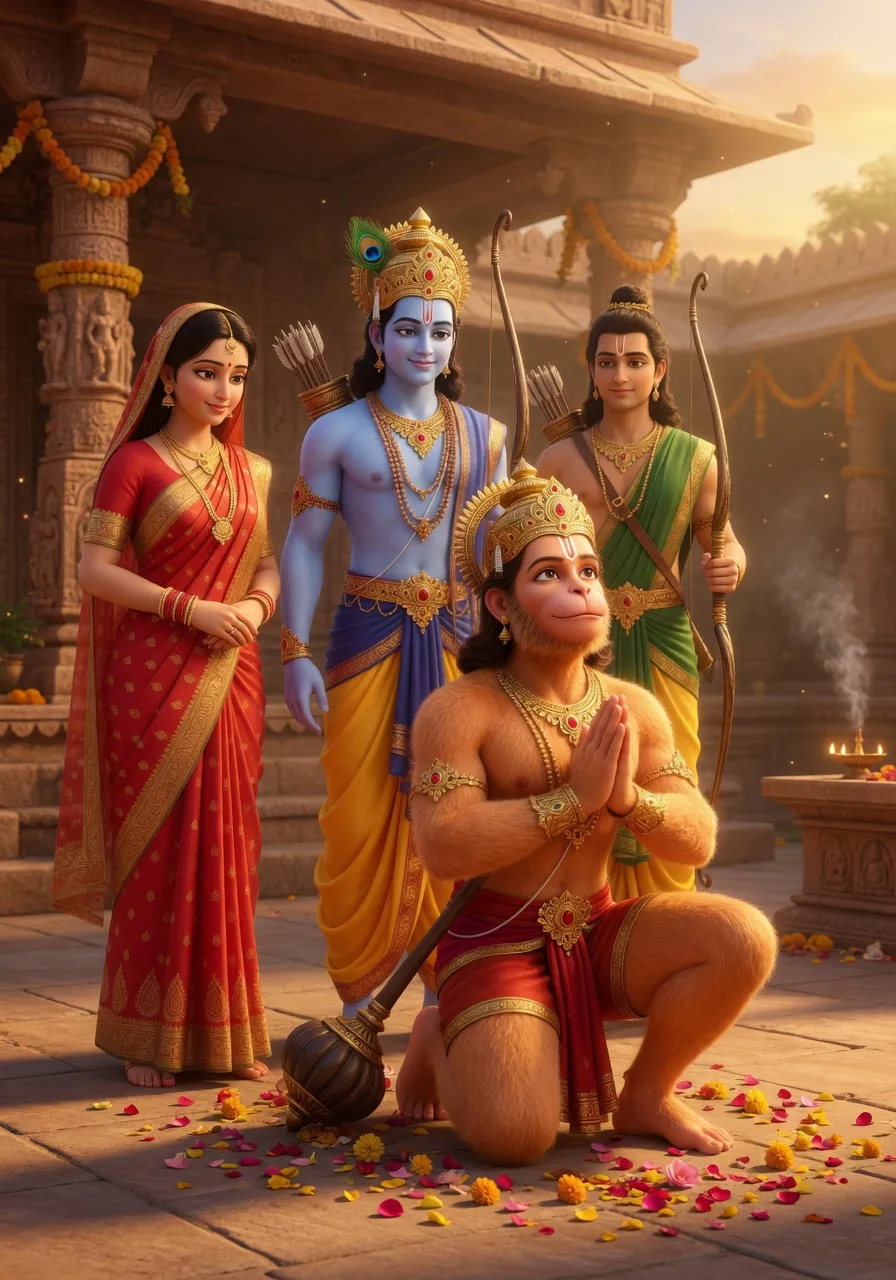
Serving as a servant. Hanuman is the supreme example of dasyam. As the intimate servant of Lord Ramachandra he carried out every order through every difficulty, and would know the Lord's wish even before it was spoken. In this world "servant" sounds low, yet in the spiritual world the servant is the real master, winning over the Lord by love. Becoming the Lord's servant is no inferior position, because the reciprocation he gives is extraordinary.
Befriending him. Arjuna perfected friendship with the Lord. He grew so close to Krishna that the Lord agreed to become his chariot driver. Directing the chariot, Arjuna would even signal Krishna with a nudge of his foot to turn the horses one way or the other. It is a humble position, and the Lord accepted it gladly to serve his friend. If we carry that mood, the relationship of friendship with the supreme Lord is open to us too.
Full surrender. Bali Maharaja perfected atma-nivedanam, giving everything. When the dwarf-brahmana Vamanadev came to his sacrifice and asked for three steps of land, Bali offered far more. His own spiritual master Sukracharya warned him that the boy was Vishnu and would take everything, and Bali answered that if Vishnu himself had come to beg, he would give him all he had. He disobeyed his guru and surrendered completely. The Lord covered the earth with one step and all of creation with the second, then asked where to place the third, and Bali offered his own head. Pleased, the Lord gave him the realm of Sutala and became his gatekeeper, the master made servant by a devotee's surrender.
One devotee who perfected all nine
Scripture also gives one king who practiced all nine processes at once, Ambarisha Maharaja. The Bhagavatam describes how he fixed his mind on the Lord's lotus feet, his words on describing the Lord's glories, his hands on cleansing the temple, his ears on hearing about Krishna, his eyes on seeing the deity and the holy places of Mathura and Vrindavan, his sense of touch on the bodies of devotees, his sense of smell on the tulasi offered to the Lord, his tongue on the Lord's prasad, his legs on walking to holy temples, his head on bowing before the Lord, and his every desire on serving the Lord around the clock. He never once wanted anything for his own enjoyment. This is the way to grow attached to the Lord and free of all material craving, and we can follow these devotees in our own small measure, especially as we grow older and see that little else really matters.
How do we protect our bhakti once it begins?
When devotion takes root it is like planting a seed, the bhakti-lata-bija, the seed of the devotional creeper. Any gardener knows what comes next. The seed sprouts, and the little plant has to be watered, tended, and guarded, because weeds spring up alongside it and will choke it if left alone. Bad association and the many temptations of this world are those weeds. To keep the creeper of bhakti growing toward its fruit, which is prema, pure love of God, we water it through these nine processes and we learn to spot the weeds and pull them out. The full method of tending the creeper is a study in itself, for another day.
Key terms from this lesson
| Term | Meaning |
|---|---|
| Yoga | to connect with the supreme Lord |
| Karma kanda | Vedic ritual for material reward, barely on the ladder |
| Karma yoga | doing one's duty without attachment to the fruits |
| Nishkama karma yoga | offering the fruits of work to the Lord |
| Gyana yoga | the path of knowledge, ending in Brahman realization |
| Ashtanga yoga | the eightfold path of Patanjali, mind control and meditation |
| Bhakti yoga | loving devotional service, the top of the ladder |
| Navadha bhakti | the nine processes of devotional service |
| Bhakti-lata-bija | the seed of the devotional creeper that must be tended |
| Prema | pure, unconditional love of God, the fruit of bhakti |
What to carry forward
- Yoga means connection with God. Without that, it is only exercise.
- The ladder rises from animal life through karma, knowledge, and meditation up to bhakti.
- Each lower rung is partial or indirect. Bhakti connects the soul to the Lord directly and contains the rest.
- You can climb rung by rung or go straight to bhakti from wherever you are.
- Krishna names the loving devotee, not the meditator, as the highest yogi (Gita 6.47).
- Bhakti has nine limbs, and one devotee perfected each, while Ambarisha perfected all nine.
- In this age, attentive chanting of the holy name is the simplest and surest connection.
Previous lesson: ← The three aspects of Godhead
Next lesson: Temple worship and the meaning of arati →
Back to the full course index.
Frequently Asked Questions
Independent writer, jaapak.com
I built the Jaapak app. I write in simple Hindi on the Bhagavad Gita and the satsang tradition — so seekers don't struggle with the scripture.
Read all articlesAbout this article
The commentary is based on the general understanding of the Sanatan tradition and written in accessible language. No verbatim quotation of any modern commentator is used.