What Is Sanatana Dharma? Meaning, Scriptures & the Eternal Way of Life
Sanatana Dharma is the original name behind the word Hinduism. Understand its meaning, the Shruti and Smriti scriptures, the four Vedas, the Bhagavad Gita
Most of us grew up calling it Hinduism. The older and truer name is Sanatana Dharma, the eternal way. It is not a religion you keep for one day a week. It is a way of living that touches every hour, from birth to death. This first lesson sets the foundation: where the name came from, what the scriptures actually are, why the Bhagavad Gita sits at the centre, and how one God can have many devatas.
Why is it called Sanatana Dharma and not Hinduism?
Sanatana Dharma is the real name. The word "Hindu" appears nowhere in the scriptures. It came from outside.
When the Mughal invaders crossed the Sindhu (Indus) river around the 12th and 13th centuries, their tongue could not manage the "s" sound. Sindhu slid into Indu, then Hindu. Everyone living beyond that river got the label. So the word began as geography, not as faith.
Two Sanskrit words hold the real meaning:
- Sanatana means eternal, without beginning or end.
- Dharma means principle, duty, the right way to live. "Religion" is far too small a word for it.
The same thing happened to the country's name. "India" was handed down from outside as well, and it carried a sting. It points to "indigenous", a word the invaders used for the people whose land they had taken. The older, dignified name is Bharat. In your own speech, lean towards Sanatana Dharma and Bharat. Keep "Hindu" for people who only recognise that word, and explain the rest when there is time.
Why is dharma called a way of life?
Because it never clocks off.
In some faiths you visit a place of worship on one day, and the rest of the week runs on its own rules. Sanatana Dharma does not work in a slot. Its principles shape food, work, relationships, worship, and even how we meet death. That reach into every hour is what makes it a way of life and not a weekly appointment.
Is it mythology or history?
Treat it as history. The pastimes of the Lord and the events held in the scriptures are taken as real, not as invented tales.
The habit of calling them "mythology" is worth dropping. The word quietly turns living truth into a bedtime story, and faith leaks away. We believe these accounts. We trust them. So we speak of them as fact.
What are Shruti and Smriti?
The scriptures fall into two great families. Shruti is the eternal layer that never changes. Smriti is the remembered layer that can shift with time.
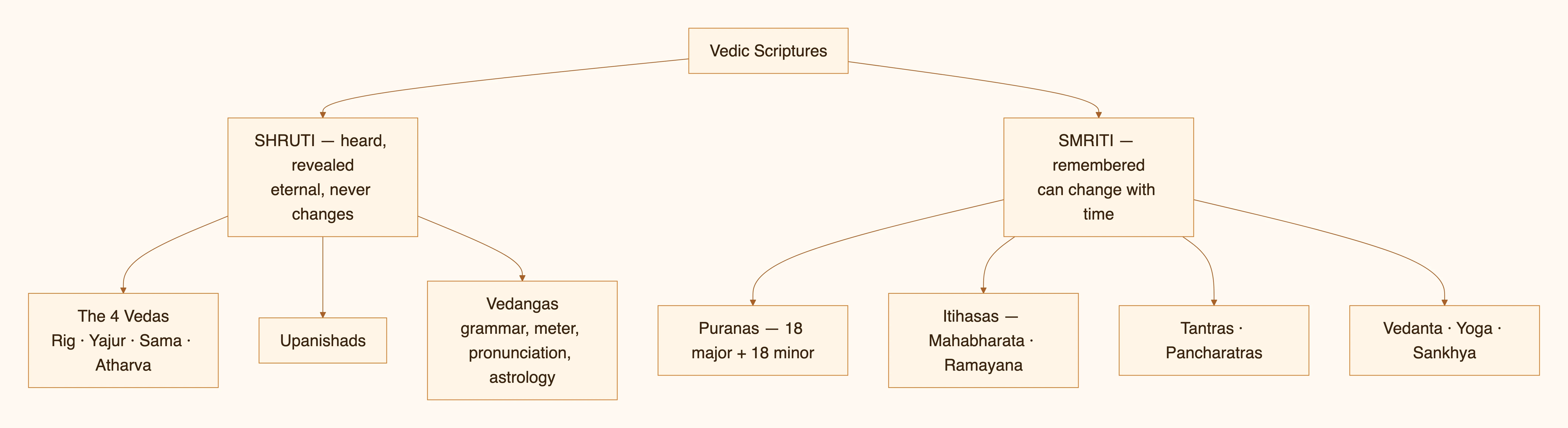
Shruti means "that which is heard". It is revealed, eternal, and fixed. It holds the four Vedas, the Upavedas, the Upanishads, and the Vedangas. Each Veda itself carries three layers: the Samhita (the hymns), the Brahmanas (the ritual manuals), and the Upanishads (the philosophy). The Vedangas are the supporting sciences of pronunciation, grammar, etymology, meter, and astrology that keep the Vedas intact. The precision matters. A mantra chanted in the wrong meter can fail, and sometimes it can backfire. This is also why so few brahmanas in this age can recite the Vedas correctly.
Smriti means "that which is remembered". It is supplementary, it can change with time and place, and it carries weight only where it agrees with Shruti. Here sit the Puranas (18 major and 18 minor), the Itihasas such as the Mahabharata and Ramayana, the Tantras and Pancharatras, the Vaishnava methods of worship, Vedanta, Yoga, and Sankhya.
The scale is hard to picture. The full body of Vedic knowledge is reckoned at two to three billion verses. Only a few tens of thousands survive today. Most of it is already lost to this age.
Why is the Bhagavad Gita so important?
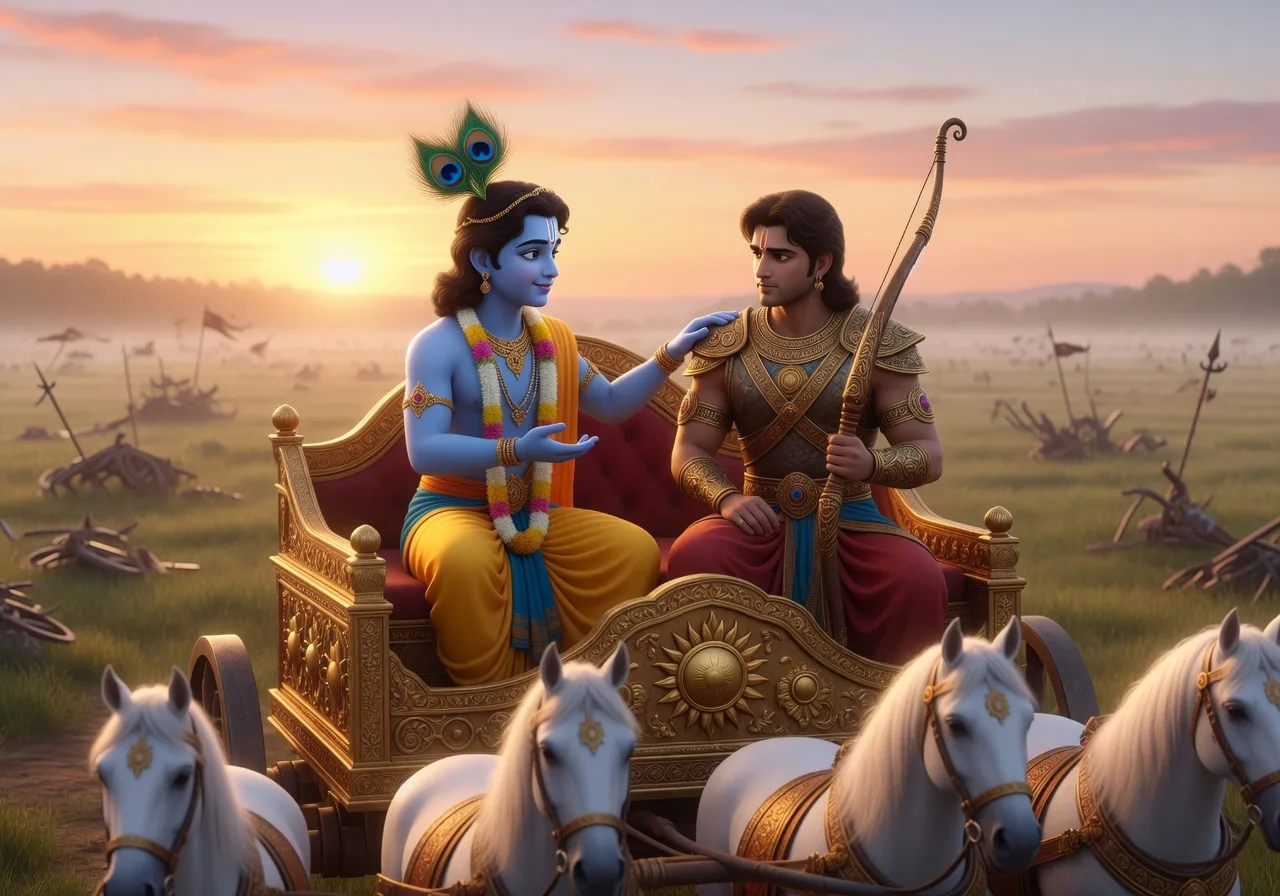
Because it is the whole Veda folded into 700 verses. When that vast library grew too large to study, or even to survive, Krishna pressed its essence into the Gita. He speaks about 570 of those verses himself.
Others stood near Arjuna who could have spoken. Narada, Vyasa, Balarama. None could have distilled billions of verses this cleanly. Only the Supreme could do it. The Gita became a working map for life. Our years are short and the scriptures are deep, and a person can get lost in one branch until life runs out. The Gita keeps us from that.
It holds a rare double status. The principles are eternal and spoken by the Lord, which is the stamp of Shruti. Yet it sits inside the Mahabharata, which is remembered history, the stamp of Smriti. That double footing gives it unusual authority.
One thing the Gita leaves out is the structure of the universe. That map of the cosmos sits in the Srimad Bhagavatam instead. Krishna kept the Gita to what a person actually needs for living, and left the cosmology to another book.
What are the four Vedas?
A short walk through each one.
Rig Veda carries hymns of praise to the devatas: Indra, Vayu, Agni, Surya. This is the world of karma-kanda, a kind of exchange where praise is offered and a worldly result is asked back. Four priests run these rites, and the one called the Hota calls the devatas with Rig Veda mantras. Only a properly trained brahmana can chant them well enough to get the result. Much of the Rig Veda deals with the soma ritual, the extraction and purification of the juice of the soma herb, a drink meant only for the devatas. The Rig Veda also holds the Purusha Sukta, found in its 90th chapter, the devatas' own prayer to Vishnu for protection. It is worth hearing every day.
Yajur Veda is the priest's manual for the great fire sacrifices, like the Ashwamedha and the Rajasuya. It once held 109 branches of knowledge, and only seven survive now. It comes in a White and a Black recension, one carrying the hymns and rites, the other the interpretations. Those grand sacrifices belong to earlier ages, so its everyday use now is small.
Sama Veda sets Vedic verses to melody. About 1,549 of them, most drawn from the Rig Veda, sung in ceremony by the priest called the Udgata. Of its original thousand branches, only three survive today.
Atharva Veda gathers prayers, charms and remedies: worship of the planets, protection from illness, formulas for averting evil, and some material that edges into black magic.
Step back, and a pattern appears. The Vedas mostly aim at material betterment through the devatas, who have the power to grant worldly gains. Vishnu is different. He grants liberation and lifts us out of this world entirely. So the deeper spiritual goal sits quietly inside the Vedas, waiting to be found.
This is also why heaven is not the aim. Heaven is a high reward, but it runs out, and the soul falls back into the cycle. The real destination lies past heaven, in the spiritual world that does not decay.
One God, or many gods?
One God. The idea of "many gods" is the most common confusion, and even practising families carry it.
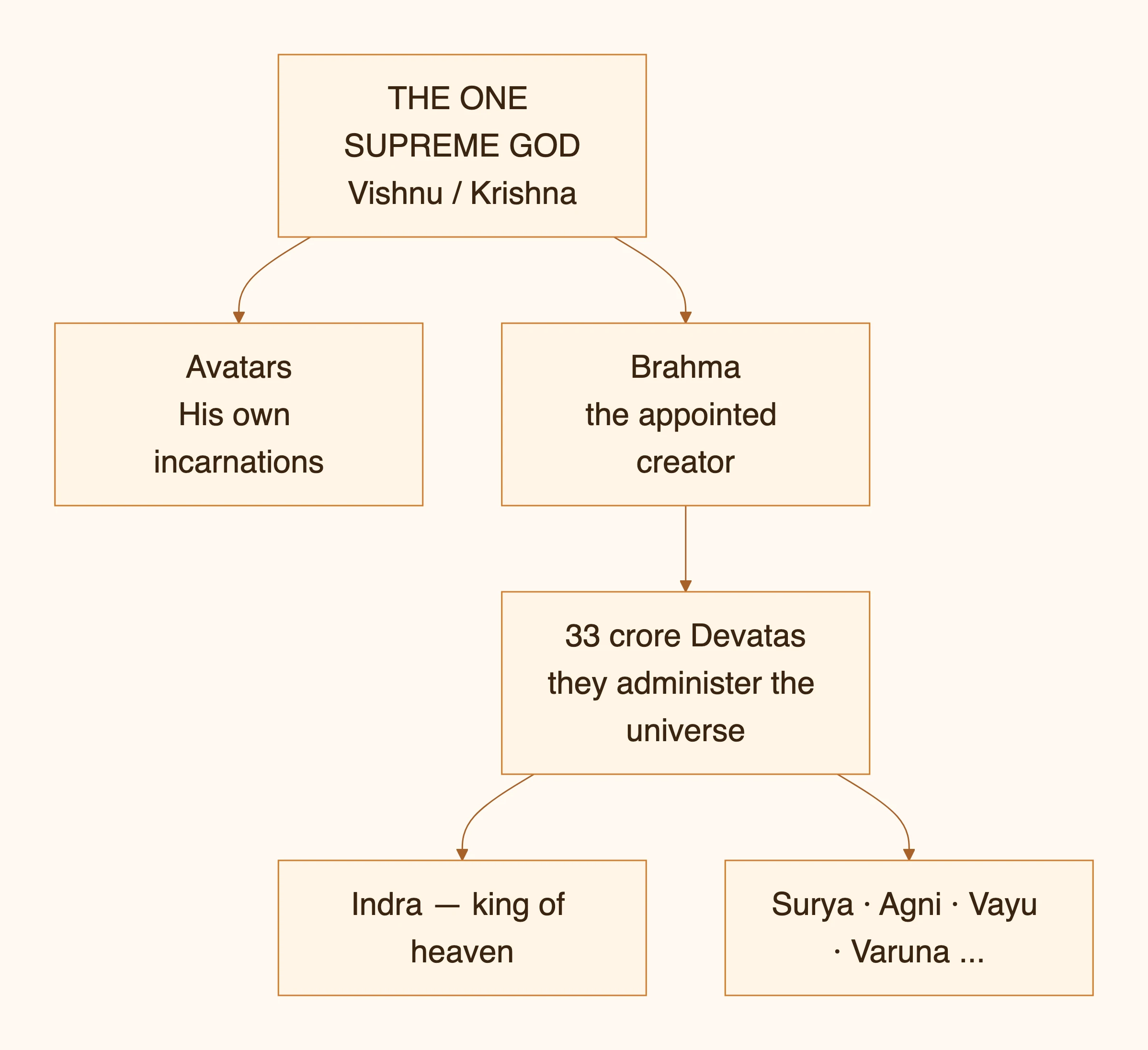
There is one Supreme. He appears in many avatars, his own incarnations. He is also served by many devatas who run the working parts of the universe. A devata's name behaves like an office. The post outlasts whoever holds it. "Indra", king of heaven, is a chair that passes to whoever earns it through enough good deeds and charity, the way a prime minister's seat passes from one holder to the next.
There is a catch worth naming. Climbing into a devata's post is still time spent inside the temporary world. The day comes when even an Indra or a Surya is knocked off the chair and falls back. The position is grand, yet it is not the freedom we are actually after.
Picture how a country runs. A head of state appoints a leader, who appoints a cabinet. In the same shape, God appoints Brahma, and 33 crore devatas assist him. The devatas are not imaginary and not "mythological". They are real officers of the Supreme, able to grant worldly boons inside their own department.
Why does so much of the Veda focus on ritual?
Because ritual is a beginning, not a home. Praying to a devata for health or wealth looks purely material. Its quiet purpose is to soften the ego and refine what we want.
The moment we ask a higher power for our needs, we admit we are not the doer. That admission is the first polish on the mind. The danger is staying at the counter forever, asking for more, never moving on. Used well, ritual teaches us our dependence, first on the devatas, and finally on the Supreme himself.

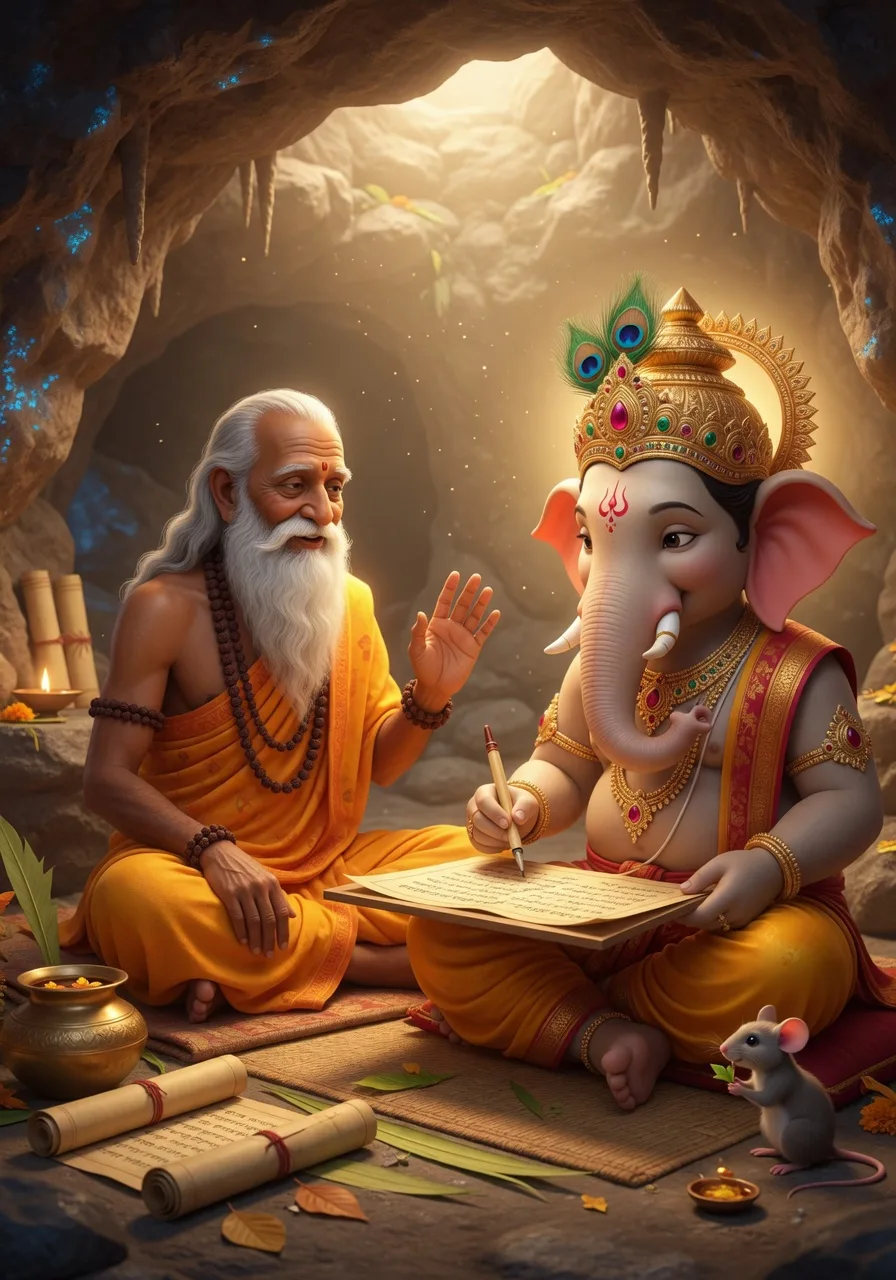
Key terms from this lesson
| Term | Meaning |
|---|---|
| Sanatana | Eternal; without beginning or end |
| Dharma | Principle, duty, the right way of life (wider than "religion") |
| Bharat | The true, original name of India |
| Sindhu | The Indus river; source of the mispronounced word "Hindu" |
| Shruti | "Heard"; revealed, eternal scripture (Vedas, Upanishads) |
| Smriti | "Remembered"; derived scripture that can change (Puranas, Itihasas) |
| Samhita / Brahmana / Upanishad | The three layers inside each Veda: hymns, ritual manuals, philosophy |
| Veda | Revealed knowledge: Rig, Yajur, Sama, Atharva |
| Vedanga | Supporting sciences that protect the Vedas (grammar, meter, astrology) |
| Purusha Sukta | A Rig Veda hymn (90th chapter); the devatas' prayer to Vishnu |
| Soma | A sacred herb and its juice, offered in Vedic ritual, meant for the devatas |
| Karma-kanda | The ritual portion of the Vedas, aimed at material results |
| Devata | A demigod; an officer of the universe (an "office") |
| Avatara | A descent or incarnation of God |
| Yuga | A cosmic age: Satya, Treta, Dwapara, Kali |
| Dakshina | An offering to a teacher or priest, given freely, never demanded |
What to carry forward
- Say "Sanatana Dharma" and "Bharat" in your own speech.
- Live it daily, not only at the temple.
- Drop the word "mythology" for the scriptures.
- You do not need every text. The Gita is the practical key.
- Always ask for the meaning behind a ritual.
- Hold the picture of one God with many devatas.
- Heaven is not the goal. The spiritual world beyond it is.
- Give from the heart, and stay wary of anyone who demands payment for sacred service.
Next lesson: The scriptures of Sanatana Dharma →
Back to the full course index.
Frequently Asked Questions
Independent writer, jaapak.com
I built the Jaapak app. I write in simple Hindi on the Bhagavad Gita and the satsang tradition — so seekers don't struggle with the scripture.
Read all articlesAbout this article
The commentary is based on the general understanding of the Sanatan tradition and written in accessible language. No verbatim quotation of any modern commentator is used.