The Vedic Conception of Time: Yugas, Kalpa & the Lifespan of Brahma
How Sanatana Dharma measures time: the breath of Maha Vishnu, the day of Brahma (Kalpa), the four yugas and their lifespans, where we sit in the cosmic clock
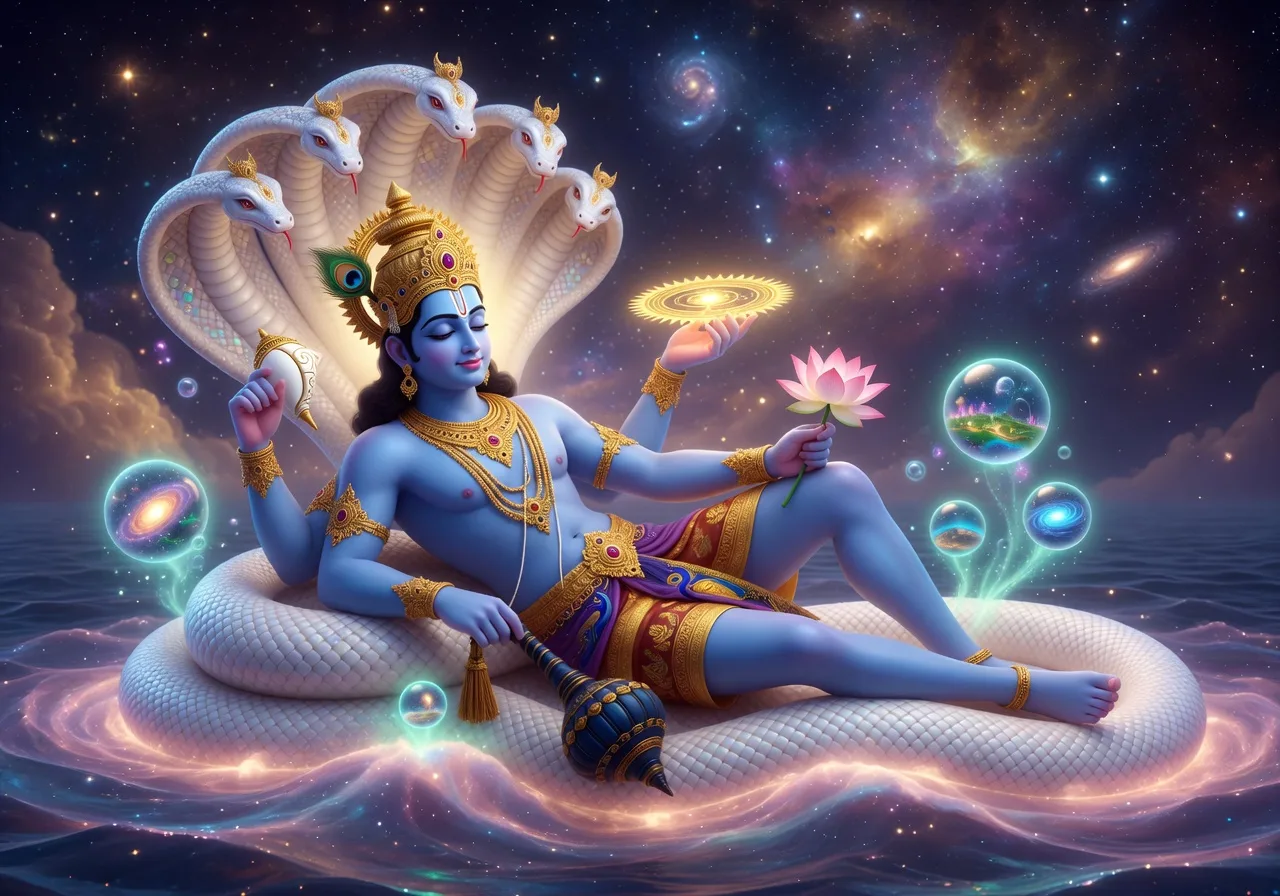
Get ready for big numbers. The Vedic measure of time looks nothing like the clock we live by. A single breath of one form of God lasts longer than the entire age of our universe, and our whole recorded history is a rounding error inside it. This lesson lays out that cosmic clock in order, from the breath of Maha Vishnu down to the Kali Yuga we are standing in, and then asks what such numbers are meant to do to us.
Where do these numbers come from?
Two scriptures. The figures here are not invented. They are drawn from the Brahma Samhita, first spoken by Lord Brahma at the dawn of creation once he reached self-realisation, and from the Srimad Bhagavatam. Both are highly regarded, and they agree.
How is time different in the spiritual world?
In our world, time is the master. It destroys everything and controls everything: birth, death, old age, disease, and the march of past into future. In the spiritual world the order flips. Time still exists, but it serves God rather than ruling anyone. The Lord controls it.
What does the map of the worlds look like?
Our material world is small. It is less than a quarter of the Lord's whole creation. The rest is spiritual.
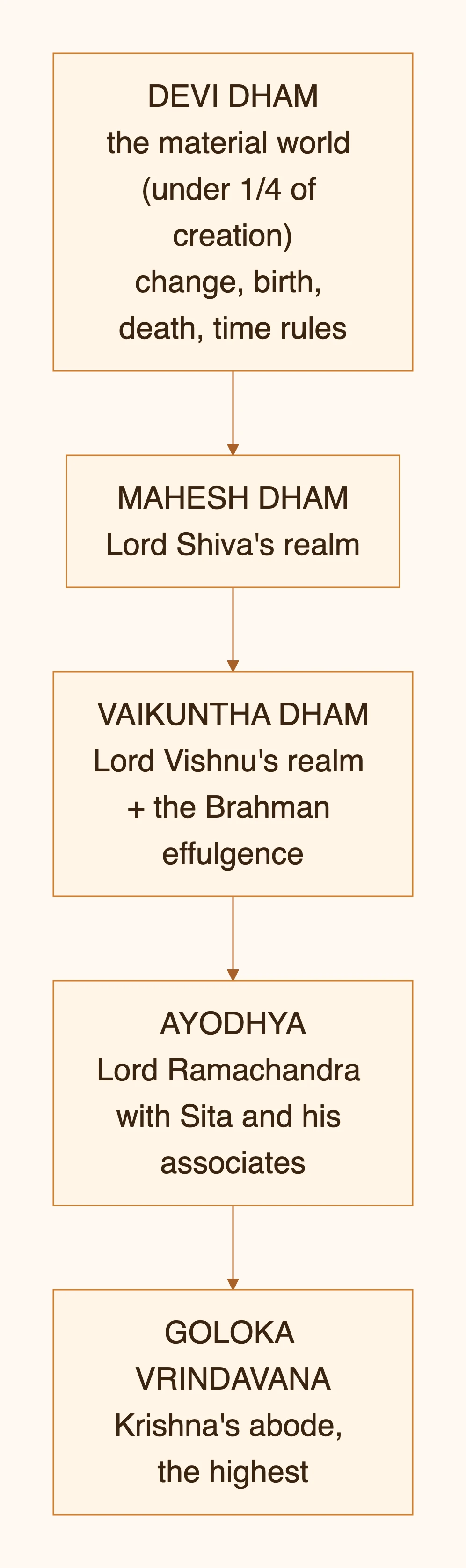
Our world is called Devi Dham, where everything changes. Beyond it is Mahesh Dham, where Lord Shiva lives with his deities. Beyond that is Vaikuntha Dham, the realm of Lord Vishnu, near the Brahman effulgence. Beyond even Vaikuntha is Ayodhya, where Lord Ramachandra lives eternally with Sita Mata and his associates. And beyond Ayodhya is Goloka Vrindavana, the highest abode of all.
How is the material world created?
Through a chain of expansions, each one a form of the same God. The Bhagavatam opens it with a single line: Ishvara Parama Krishna, Sac-cid-ananda Vigraha, Anadir Adi Govinda, Sarva Karana Karanam. Krishna is the cause of all causes.
- From Krishna comes Balarama, the first expansion, as powerful as Krishna. These are all Vishnu Tattva forms. One God, many forms.
- Through the quadruple expansions (the Catur Vyuha), from Sankarshana comes Narayana, who lives in Vaikuntha. A second set of expansions brings Maha Vishnu.
- Maha Vishnu, also called Karanadakshayi Vishnu, is the primary creator. He reclines on the causal ocean. When he breathes out, millions of universes pour from the pores of his body. We live inside one of them. When he breathes in, every universe returns into him.
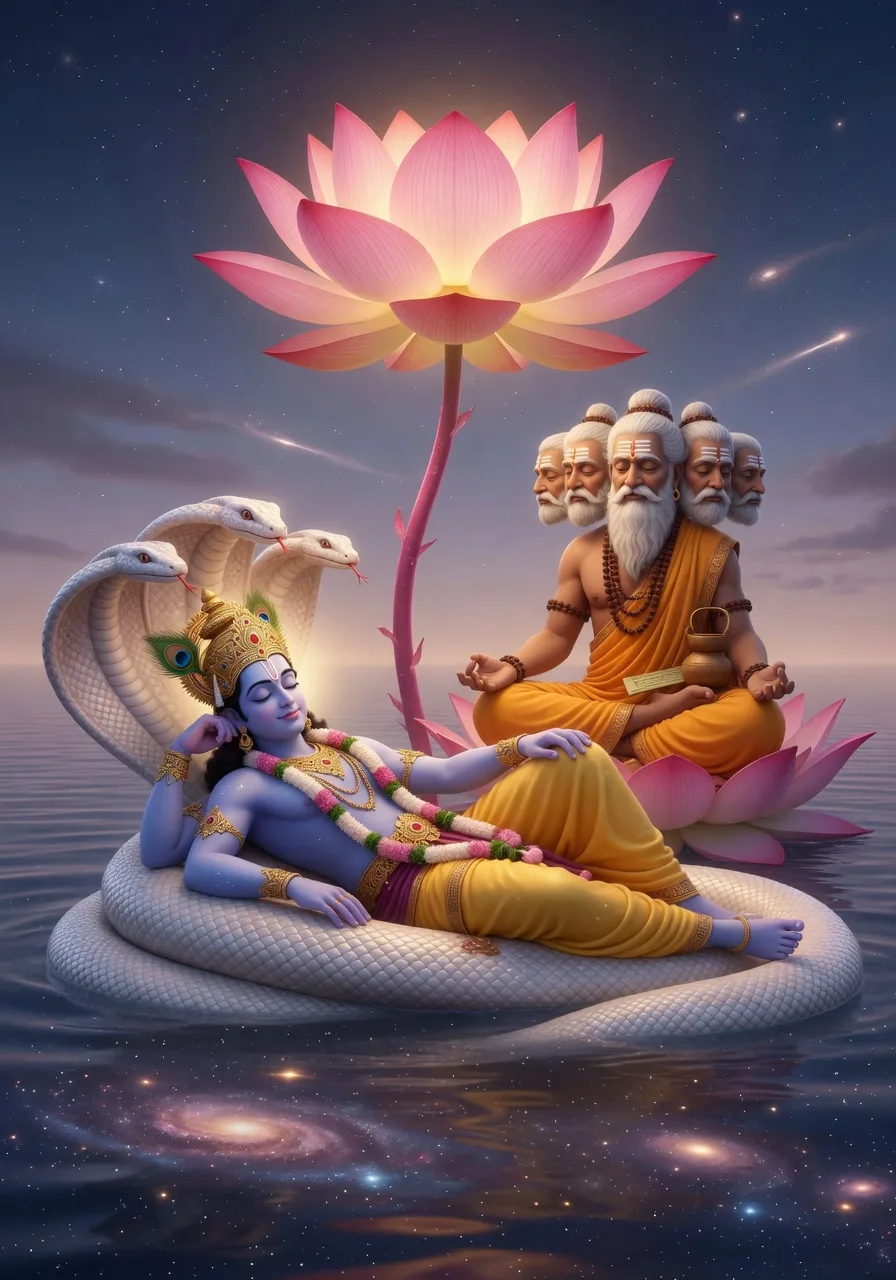
- Into each single universe he expands again as Garbhodakshayi Vishnu, who lies on the ocean within. From his navel a lotus sprouts, and on that lotus sits Lord Brahma, the four-headed secondary creator.
Brahma is not God. He is an ordinary living entity, but one of immense piety and power, empowered by the Lord to build our world. Each universe holds 14 planetary systems, and we sit on Bhur Loka, in the middle.
How long is one breath of Maha Vishnu?
311 trillion 40 billion years. One breath. That single span is also the lifespan of the universes, because the moment he breathes in, they all dissolve back into him. It is the same as the lifespan of Brahma, whose life equals the life of the universe.
Krishna marks the theme in the Bhagavad Gita, eleventh chapter, verse 32: time destroys all. Yet one who remembers Krishna at the moment of death reaches the supreme Lord. So for a devotee, time can turn from master into servant.
What is the clock of Brahma?
Brahma's life breaks down into units, and they are staggering. His day alone, just the twelve daytime hours, is called a Kalpa and lasts 4.32 billion years.
| Unit of time | Human years |
|---|---|
| Kali Yuga | 432,000 |
| Dwapara Yuga | 864,000 |
| Treta Yuga | 1,296,000 |
| Satya Yuga | 1,728,000 |
| One Maha Yuga (all four together) | 4,320,000 |
| One Manvantara (71 Maha Yugas, the reign of one Manu) | ~306 million |
| One day of Brahma / Kalpa (1,000 Maha Yugas) | 4.32 billion |
| One full day and night of Brahma | 8.64 billion |
| One year of Brahma | ~3.11 trillion |
| Full life of Brahma (100 of his years) | 311 trillion 40 billion |
The Gita gives the anchor: Sahasra-yuga-paryantam ahar yad brahmano viduh. A thousand ages make one day of Brahma, and his night is just as long. The exact arithmetic runs through 14 Manus, each ruling 71 Maha Yugas (994 in all), plus the Sandhyas, the junction-gaps between them, which round the day to 1,000 Maha Yugas.
To feel the scale from our side: one whole Maha Yuga, all 4.32 million years of it, passes in 43.2 seconds of Brahma's time. And a single one of his seconds equals 100,000 human years.
Where are we right now in this clock?
Deep inside it, and the position is precise. 50 years of Brahma have already passed (the final kalpa of that fiftieth year is the Padma Kalpa). We are now in the first day of his 51st year, a day named the Shveta Varaha Kalpa.
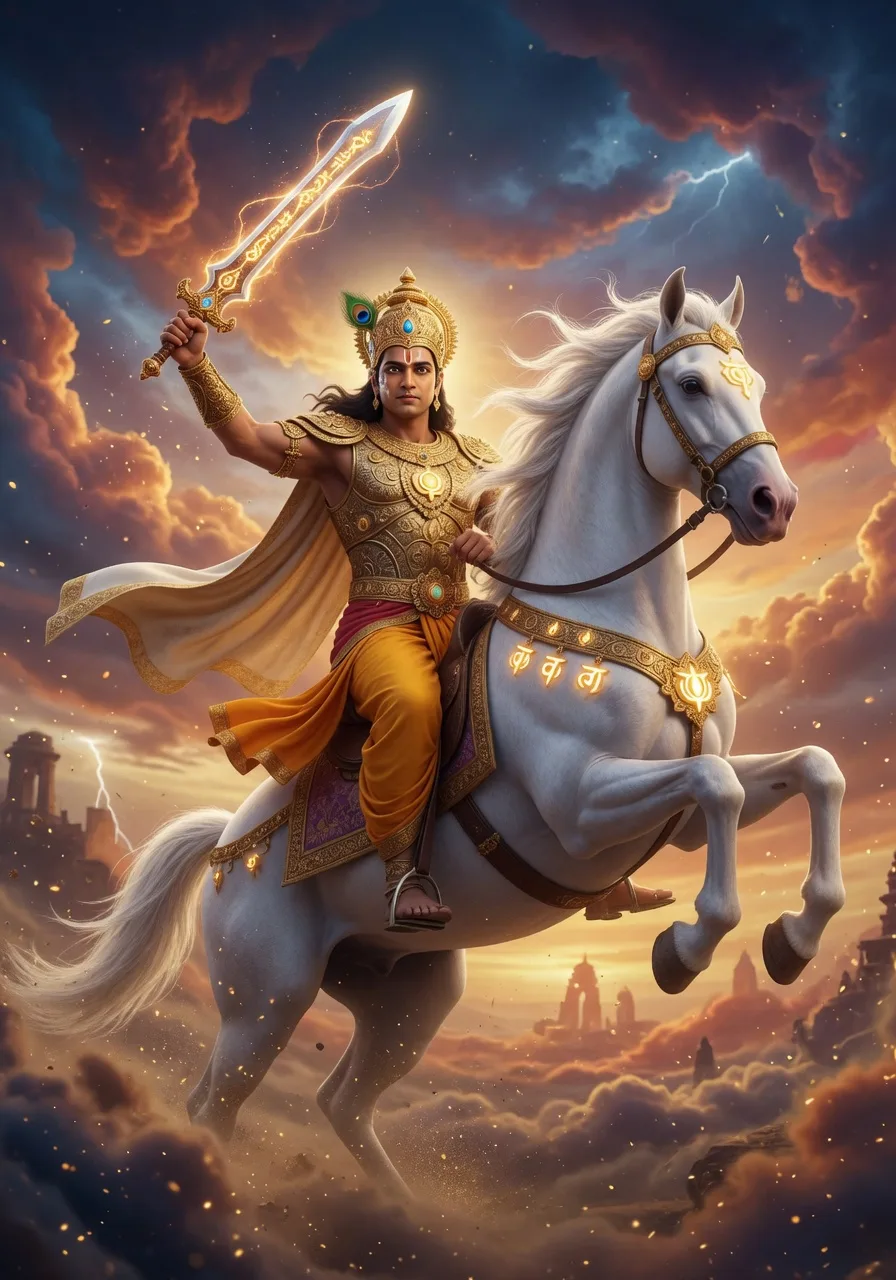
Within this single day there are 14 Manvantaras. Six have passed. We are in the seventh, the Vaivasvata Manvantara. Inside it, 27 of its 71 Maha Yugas are gone, so we sit in the 28th Maha Yuga. Of that Maha Yuga, Satya, Treta, and Dwapara are complete, which leaves us here, in Kali Yuga, begun in 3102 BC.
Add it up and roughly 155 trillion 521 billion years have passed since this Brahma began. On the clock of Brahma Loka, the time is about 11:28 in the morning, just short of noon, in this one long day. The Srimad Bhagavatam fixes the halfway mark itself (third canto, chapter 11, verse 34): Brahma's hundred years split into two halves, the first now over, the second now running.
How did people reach God in each yuga?
Each yuga is shorter and harsher than the last, lifespans shrink, and the recommended path to God changes to match.
| Yuga | Human lifespan | The path that worked |
|---|---|---|
| Satya | ~100,000 years | Meditation (tapasya). People were peaceful and could meditate for ages without hunger or sleep |
| Treta | ~10,000 years | Great fire sacrifices (yagya). People were very wealthy |
| Dwapara | ~1,000 years | Opulent deity worship |
| Kali | ~100 years at best | Chanting the holy names (kirtan, bhajan) |
This is the hidden mercy of Kali Yuga. Meditation, sacrifice, and grand temple worship are nearly impossible now, so God lowered the bar. What once took 100,000 years of meditation in Satya Yuga, we can reach in a few years simply by chanting his names. The age is dark, yet that one door is wide open.
Where do the world's religions sit on this timeline?
Against 4.32 million years, every organised religion is recent. The seven major ones split by birthplace. Islam, Judaism, and Christianity rose in the Middle East. Sanatana Dharma, Sikhism, Jainism, and Buddhism rose in Bharat.
| Religion | Origin | Age (approx.) | Main scripture |
|---|---|---|---|
| Sanatana Dharma | Bharat | far beyond 5,000 yrs (written ~5,000) | The Vedas and many more |
| Judaism | Middle East | 2,586 yrs | Tanakh (Torah, Nevi'im, Kethuvim) |
| Jainism | Bharat | 2,500 yrs | Agamas |
| Buddhism | Bharat | 2,483 yrs | Tripitaka |
| Christianity | Middle East | ~2,000 yrs | Bible (Old and New Testament) |
| Islam | Middle East | 1,400 yrs | Quran |
| Sikhism | Bharat | 600 yrs | Guru Granth |
Sikhism is itself part of Sanatana Dharma, its warrior and protector aspect. Jainism traces back to Rishabhadev, an incarnation of Krishna, and Buddhism likewise has its root here. And where most of these faiths follow a single core text, Sanatana Dharma holds a whole library.
Why do these huge numbers matter?
To make us small in the right way. Set against the breath of Maha Vishnu, we are tiny specks, not just in the spiritual world but even inside this material one. We tend to act as if we are the centre, as if nothing turns without us. The cosmic clock corrects that. It is not about putting ourselves down. We still give our very best. But we give it with humility, and that humility becomes our strength. It lets us serve the Lord rather than imagine he depends on us. Once a soul truly connects with him, material time loosens its grip, because that soul now rests under his protection.
Key terms from this lesson
| Term | Meaning |
|---|---|
| Maha Vishnu | Karanadakshayi Vishnu; the primary creator whose breath releases the universes |
| Garbhodakshayi Vishnu | The Vishnu form within each universe, from whose navel Brahma appears |
| Brahma | The empowered four-headed secondary creator (not God); lives one universe-lifespan |
| Kalpa | One day of Brahma; 4.32 billion human years |
| Manvantara | The reign of one Manu; 71 Maha Yugas (~306 million years) |
| Maha Yuga | One full cycle of the four yugas; 4.32 million years |
| Sandhya | A junction-gap between cycles; a partial devastation and rest |
| Yuga | One of the four ages: Satya, Treta, Dwapara, Kali |
| Devi Dham | The material world (under one quarter of creation) |
| Mahesh Dham / Vaikuntha / Ayodhya / Goloka | The rising tiers of the spiritual world |
| Prasad | Food first offered to the Lord; eating it becomes a spiritual act |
What to carry forward
- The numbers rest on two scriptures, the Brahma Samhita and the Srimad Bhagavatam.
- One breath of Maha Vishnu, 311 trillion 40 billion years, is the life of the universe and of Brahma.
- A day of Brahma (Kalpa) is 4.32 billion years and holds 1,000 Maha Yugas.
- We are in the 28th Maha Yuga of the 7th Manvantara of Brahma's 51st year, in Kali Yuga since 3102 BC.
- Each yuga has its own path: meditation, sacrifice, deity worship, and now chanting.
- Kali Yuga's gift is the holy name, the easiest door in the hardest age.
- These vast scales are a lesson in humility, the kind that lets us serve.
- Good karma is still a chain. Offer your acts to the Lord and they carry you home.
Previous lesson: ← The scriptures of Sanatana Dharma
Next lesson: Is there a God? (Ishvara) →
Back to the full course index.
Frequently Asked Questions
Independent writer, jaapak.com
I built the Jaapak app. I write in simple Hindi on the Bhagavad Gita and the satsang tradition — so seekers don't struggle with the scripture.
Read all articlesAbout this article
The commentary is based on the general understanding of the Sanatan tradition and written in accessible language. No verbatim quotation of any modern commentator is used.