The Three Modes of Material Nature: Sattva, Rajas, Tamas, and Reading Your Own Mode
The three gunas of Sanatana Dharma: goodness (sattva), passion (rajas), and ignorance (tamas). The three energies, where each mode leads your next life, and

This whole material world is woven from three threads. Krishna calls them the gunas, the modes of nature: goodness, passion, and ignorance. They colour everything you see, hear, taste, touch, and smell, and they quietly steer how you act. Krishna gives them a whole chapter of the Gita, and a teacher of this course was once told that if you truly grasp that one chapter, this could be your last life here. This lesson explains the three modes, and then hands you a table to read which one is running you.
What are the three energies of the Lord?
Before the modes, the bigger map. Everything is one of three energies.
- Internal energy: the Lord himself together with the spiritual world. It is eternal and always manifest.
- External energy: the material world. Also eternal, but it appears and disappears. When Maha Vishnu breathes out, the universes pour forth and this energy is manifest. When he breathes in, they withdraw, and it still exists but is unseen.
- Marginal energy: us, the jivas, the souls. We are called marginal because we are tiny, and can fall on either side. Linked to the internal energy we are properly placed. Right now we identify with the external energy, and that is why we are stuck here.
Think of an ocean, the land, and the beach between them. The ocean is the internal energy, the land is the external, and the beach, sometimes wet, sometimes dry, is us. Our true constitutional position is sat-chit-ananda: sat, eternal, chit, full of knowledge, ananda, full of joy. In that state we hold an eternal spiritual form shaped by how we love to serve the Lord. We have lost touch with it, which is the whole problem. Right now we are like a fish out of water, struggling on the sand. A fish is happy only back in the water, and we are happy only back in that spiritual state.
What are the three gunas?
Having fallen into contact with matter, the soul gets conditioned by its three modes and is forced to act through them, even though the pure soul has nothing to do with them.
- Sattva-guna, the mode of goodness.
- Rajo-guna, the mode of passion.
- Tamo-guna, the mode of ignorance.
Krishna gives the whole of Gita chapter 14 to these modes, with more in chapters 17 and 18, where most of the self-analysis later in this lesson comes from. Chapter 14 moves through four questions: what the modes are, how they work, what a person caught in each mode is like, and how to rise above all three.
Here is a hard truth. We imagine we have free will, but while the three modes drive us, that freedom is mostly an illusion. Real free will appears only once we rise above all three. Until then we are pushed by goodness, passion, or ignorance, and stay trapped in the cycle of birth and death. And even goodness is not enough, strange as that sounds. We will see why.
What is the mode of goodness (sattva)?
Goodness is the purest of the three. It is illuminating, it frees a person from sinful reactions, and it gives knowledge. Someone in goodness does not want to sin. They do good, behave well, stay clean inside and out, and grow steady and happy.
So what is the catch? That very happiness becomes a cage. A person in goodness feels content and secure, sure they have achieved what they wanted, and so they grow attached to this world by their own comfort. Their behaviour is exemplary, always helping others, yet without a link to the Lord's internal energy they remain here, and worldly happiness always comes and goes. The classic examples are scientists, philosophers, and poets, proud of their knowledge, steady in mind, materially happy, yet bound to repeated birth and death. By varna, the brahmanas generally stand for goodness. The teachers' guru would say, "At least come to the platform of goodness," because from there the next step to liberation is short.
What is the mode of passion (rajas)?
Passion fills a person with endless desire and ties them to fruitive action. It binds with the ropes of longing and attachment, and shows itself most in the strong pull between man and woman. The mind runs without rest: I must have this, I must earn that, I must buy a bigger house. There is a hunger for enjoyment, for honour, for name and fame (charity given so others will praise the giver), for a happy family held with fierce attachment, for a grand home built as if it will last forever.
This is where most people live, and it is a trap with no exit, only endless circling. Goodness at least leaves a door open toward a liberating yoga. Passion shuts that door, because the person is too busy earning and enjoying to think of linking with God at all.
What is the mode of ignorance (tamas)?
Ignorance is total delusion, and it binds through madness, idleness, and sleep. It is the one place no one should want to be. People joke that ignorance is bliss, but here it is the opposite. Under its spell you cannot see a thing as it is. You take the irreligious for religious and the religious for irreligious, and everything turns upside down.
The signs: six hours of sleep refreshes a person, yet ten to twelve hours a day is a flag of ignorance, sleep eating half a life. A person sunk in this mode feels the whole world is against them, blames everyone else, takes responsibility for nothing, and leans on intoxication and sleep. There is no interest in spiritual life and often none in material progress either, only self-pity. Avoid it completely. Anyone reading this is already past it, since a person truly in ignorance would simply be asleep.
In short: goodness conditions you to happiness, passion to restless activity, ignorance to madness.
Where does each mode take you next?
The mode you live in shapes the body you take next.
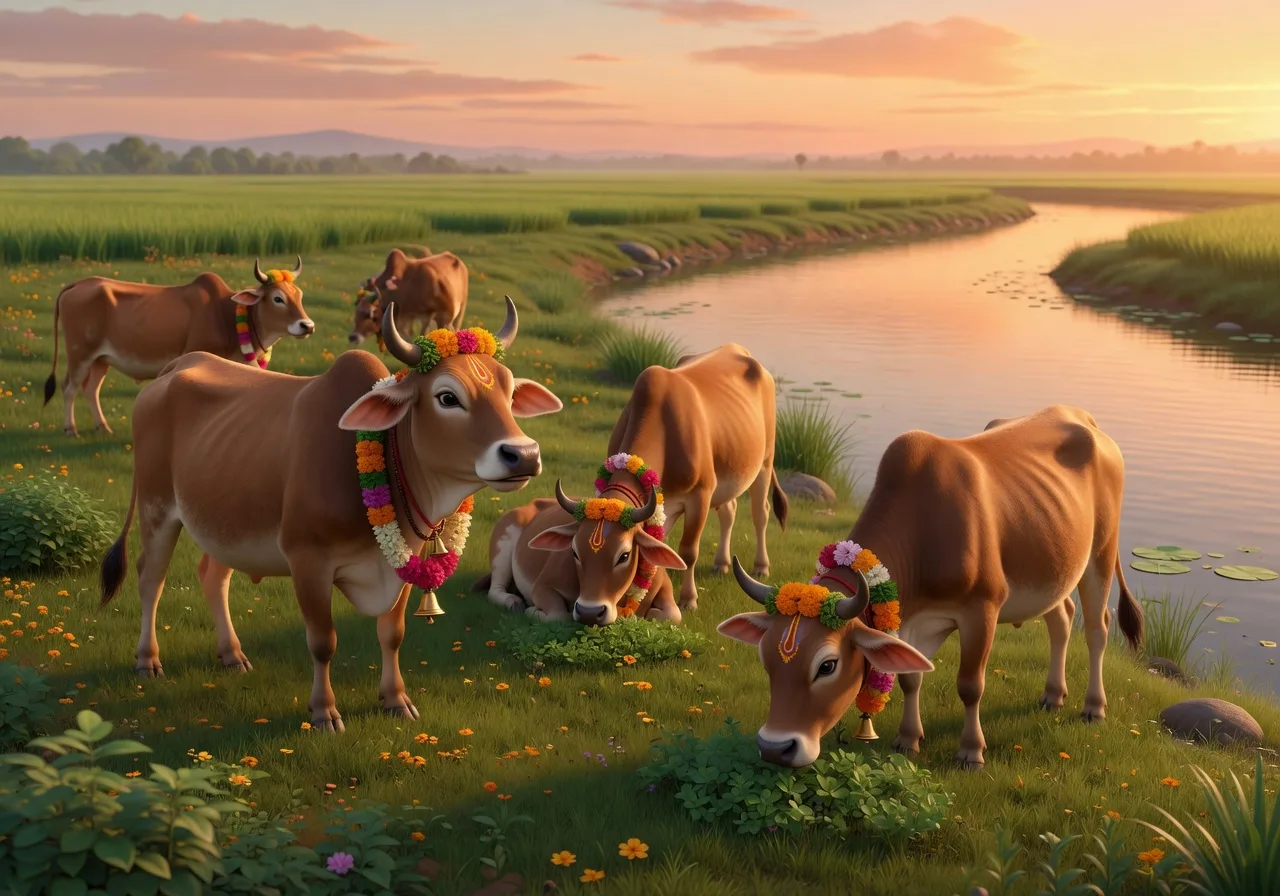
- Ignorance leads down, toward the animal kingdom.
- Passion keeps you human, reborn to chase the same desires again.
- Goodness lifts you to the heavens, perhaps as a demigod or a demigod's servant, for a long stay. But even heaven runs out. When the good karma is spent, you fall back to Earth and begin again.
There is a fourth level above all three, pure goodness (shuddha-sattva), the spiritual goodness of a soul linked directly with the Lord. That, not heaven, is the goal.
How do you read which mode you are in?
This is the practical heart of the lesson, and it is meant for honest self-analysis, never for judging anyone else. It is not an exact science, only an indication. Look down each column and ask, quietly, where do I mostly sit?
| In the matter of... | Ignorance (tamas) | Passion (rajas) | Goodness (sattva) | Pure goodness |
|---|---|---|---|---|
| Food | Stale, putrid, unclean, leftovers; meat, fish, eggs, liquor | Bitter, sour, salty, pungent, rich, dry, hot; causes pain and disease; onion and garlic | Fresh, nourishing, sweet, juicy; gives strength and long life; milk, grains, fruit, vegetables | Prasad, first offered to the Lord, then honoured |
| Charity | Given at a wrong time or to an unworthy person (a gambler, a drunkard) | Given for publicity and praise, or grudgingly | Given as a duty, right time and place, to a worthy person, wanting nothing back | Given only to please the Lord |
| Worship | Ghosts, spirits, sport | Film stars, self-made "gods" | The devatas, a partial idea of God | The supreme Lord himself |
| Sacrifice (yagya) | Off the scriptures, no prasad, no bhajan, no offering to the priest | Done proudly for material gain, a business deal | Done as a duty per scripture, no reward expected | Per scripture, under a guru, to please the Lord |
| Austerity | Harms self or others (a month of starvation) | Done for honour, "look how devoted I am" | Done with faith, clean and non-violent, gentle speech, controlled thoughts | Done with faith to please the Lord (Ekadashi to remember him more) |
| Work | Cheating, lazy, morose, "I'll do it tomorrow" | Greedy for the promotion and bonus, attached to the fruit | Enthusiastic, steady, unmoved by success or failure | Serving Krishna and guru in every circumstance |
| Renunciation | Dropping your duty out of illusion (Arjuna fleeing to the forest) | Dropping your duty out of fear or because it is hard | Doing your duty because it must be done, unattached to results | Doing your duty in God-consciousness, all for his service |
| Knowledge | Concerned only with eating, sleeping, mating, defending | Seeing the body as the self, ignoring the soul | Seeing, through scripture, that you are spirit, distinct from the Lord | Seeing yourself as his eternal servant |
| Action | Reckless, violent, against scripture | Driven by ego and desire, great effort for the self | Done by duty, without attachment, love, or hate; it purifies | Done only to satisfy God or guru |
| Time of day liked | The night, awake till 2 or 3 am | The daytime | The early morning, to chant and meditate | Any hour, always serving |
| Understanding | Calling the irreligious religious; cannot tell up from down | Confused, cannot reliably tell right from wrong | Discriminating clearly by scripture; knows what binds and what frees | Always fixed on the Lord, confirmed by scripture and guru |
| Determination | Cannot move past daydreaming, fear, and regret | Fixed on enjoyment and gain | Unbreakable, steadied by yoga over mind and senses | Never deviates, untouched by temptation |
| Happiness | Misery at the start, middle, and end (the addict) | Nectar at first, poison in the end (the fifth gulab jamun) | Poison at first, nectar in the end (chanting, hard then sweet) | Ever-increasing ecstasy, beyond anything worldly |
| Colour drawn to | Blue (yet blue is also Krishna's colour) | Red | Yellow | White |
| Animal felt close to | The monkey | The lion, the tiger; dogs and cats too | The cow, who gives peace of mind; the dolphin | Garuda, Hanuman, the Surabhi cow |
Read it gently. Liking the colour blue does not put you in ignorance, and the table is no weapon for sizing up others. It is a mirror. If you find yourself in ignorance, aim for passion. In passion, aim for goodness. In goodness, aim past it, for pure goodness.

Key terms from this lesson
| Term | Meaning |
|---|---|
| Guna | A "mode" or strand of material nature; literally also a rope |
| Sattva-guna | The mode of goodness: knowledge, cleanliness, calm |
| Rajo-guna | The mode of passion: desire, ambition, restless action |
| Tamo-guna | The mode of ignorance: delusion, laziness, sleep |
| Shuddha-sattva | Pure goodness; the spiritual platform beyond all three modes |
| Internal energy | The Lord and the spiritual world |
| External energy | The material world |
| Marginal energy | The jivas, the souls, who can fall to either side |
| Sat-chit-ananda | The soul's true nature: eternal, knowing, blissful |
| Prasad | Food first offered to the Lord, which lifts an act to the spiritual platform |
What to carry forward
- Three energies: internal (the Lord), external (matter), marginal (us).
- Three gunas run the material world: goodness, passion, ignorance.
- While the modes drive you, free will is mostly an illusion.
- Even goodness binds, through its own comfortable happiness.
- Ignorance leads to animal birth, passion to human, goodness to heaven, and only pure goodness home.
- Use the table as a mirror for yourself, never a measuring stick for others.
- Rise by shastra, guru, and sadhu, and ask the Lord for nothing but the chance to serve.
Previous lesson: ← Karma and reincarnation
Next lesson: The three aspects of Godhead →
Back to the full course index.
Frequently Asked Questions
Independent writer, jaapak.com
I built the Jaapak app. I write in simple Hindi on the Bhagavad Gita and the satsang tradition — so seekers don't struggle with the scripture.
Read all articlesAbout this article
The commentary is based on the general understanding of the Sanatan tradition and written in accessible language. No verbatim quotation of any modern commentator is used.