The Three Aspects of Godhead: Brahman, Paramatma and Bhagavan
Sanatana Dharma's three realizations of God, explained with the sun analogy: Brahman the impersonal effulgence, Paramatma the Lord in the heart, and Bhagavan
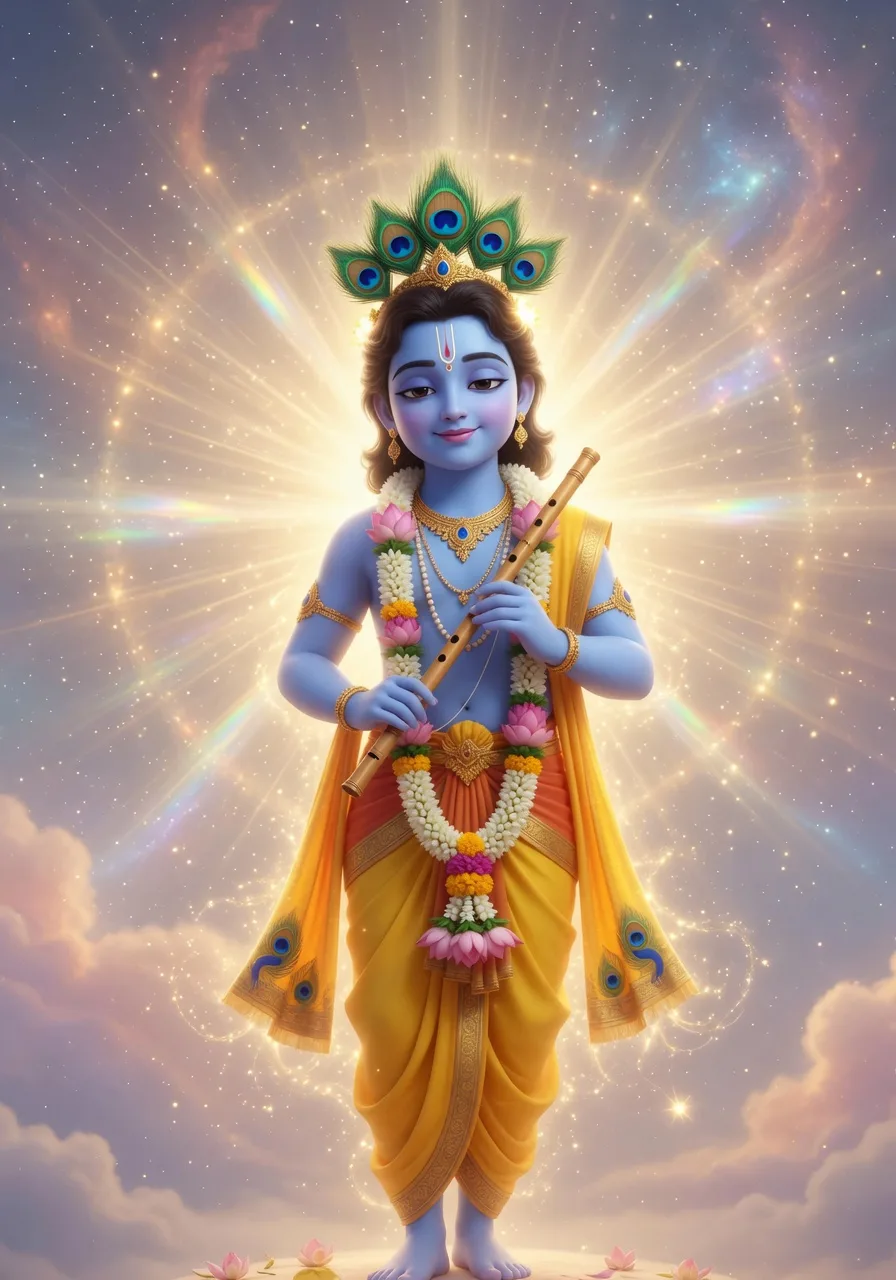
People realise God in three different ways, and the difference matters. One person meditates on a formless light. Another finds the Lord within their own heart. A third worships him as a person with a face and a name. All three are real, all three are the absolute truth, yet only one of them is the complete picture. This lesson lays out those three aspects, Brahman, Paramatma, and Bhagavan, using a single old analogy: the sun.
One God, many forms
A quick anchor first. Krishna is the absolute truth, and the name Krishna stands equally for Vishnu and Ram, one Lord in different forms. Brahma sings it in the Brahma Samhita (5.1): "Krishna, known as Govinda, is the supreme Godhead. He has an eternal, blissful, spiritual body. He is the origin of all, himself without origin, the prime cause of all causes." Some within Sanatana Dharma hold instead that Vishnu is the original from whom Krishna comes. There is no need to quarrel. Whether you call Krishna supreme or Vishnu supreme, both are the supreme. One God, many forms.
What are the three realisations of God?
Picture the sun. Three things come with it, and they map exactly onto the three aspects of God.
| Aspect | In the sun analogy | What it is | How complete |
|---|---|---|---|
| Brahman | the sunshine | the formless effulgence of the Lord | a partial realisation |
| Paramatma | the sun's surface | the Lord localised in every heart | higher, still not complete |
| Bhagavan | the sun-god himself (Surya) | the full personal God | the complete realisation |
Brahman: the light without a face
Brahman is the effulgence that streams from the Lord, the way sunshine streams from the sun. It is part of the absolute truth, but it is incomplete, because it is only the light, with no form behind it that you can see. Krishna says so himself in the Gita (14.27): "I am the basis of the impersonal Brahman, which is immortal, imperishable, eternal, and the constitutional position of ultimate happiness." Read that carefully. The Lord's personal form is the basis of the Brahman, just as the sun is the basis of its sunshine.
Many sincere spiritualists meditate on exactly this, on light, or on om, on the brahma-jyoti that pours from the Lord. They are genuine seekers, and what they touch is real. But it is a partial understanding of God, not the whole.
Paramatma: the Lord seated in the heart
The second aspect is Paramatma, the Lord localised in the heart of every living being. Vishnu expands himself to sit beside each one of us. In this material world it is Paramatma who keeps us company, which means every body holds two souls: you, the jiva, and the Paramatma, the Supersoul, traditionally measured at about the length of a thumb. In the sun analogy, if Brahman is the sunshine, Paramatma is the surface of the sun itself.
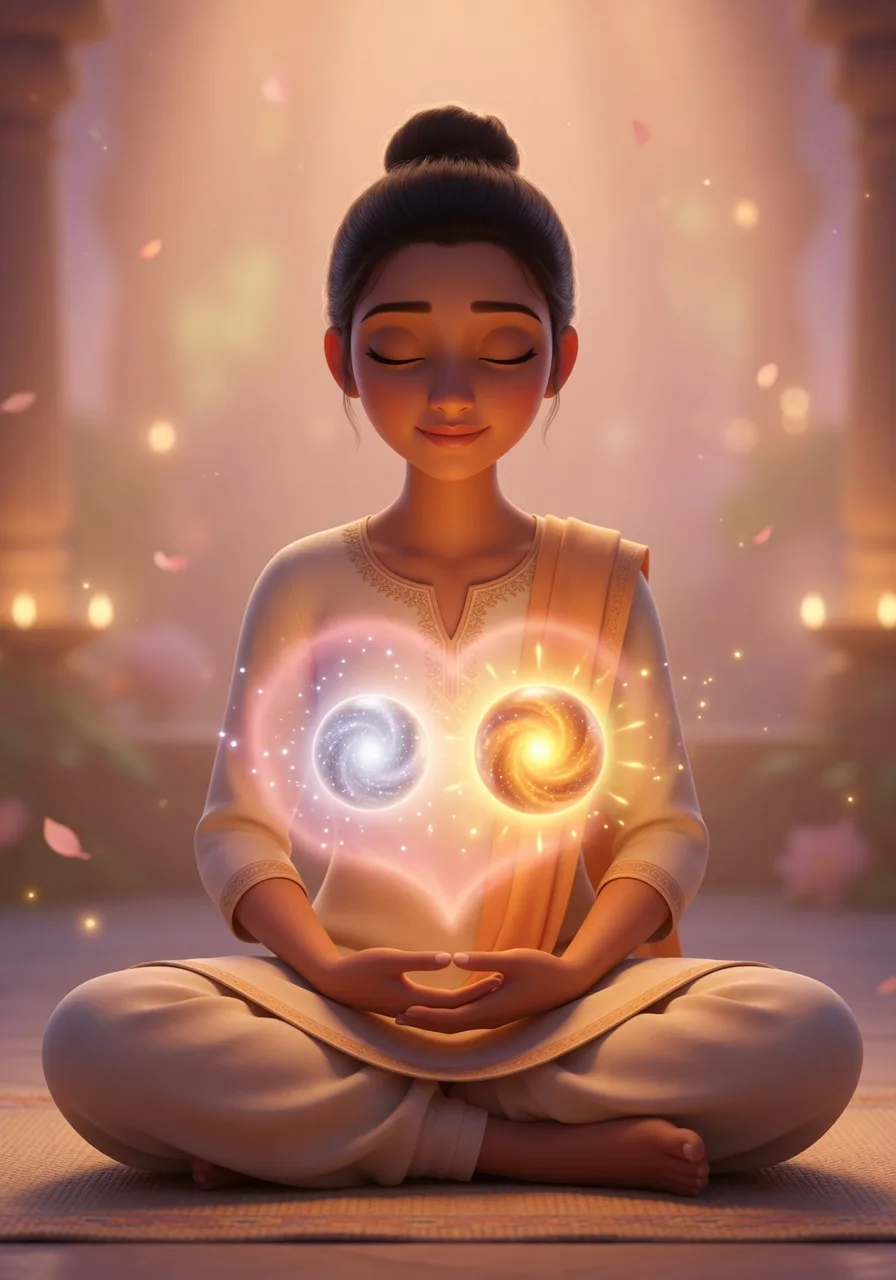
This too is the absolute truth, and a higher realisation than Brahman, because here a person focuses on the Lord himself rather than on his light. The yogis who meditate on the Lord within reach this. Yet it is still not the complete picture, and Paramatma is a feature for this material world, not the form we engage with in the spiritual one.
Bhagavan: the complete, personal God
Bhagavan is the full realisation, the personal feature of the Lord, the sun-god Surya himself in the analogy. Everything else flows from him. When people object, "you are shrinking God down to a person by giving him a form," the answer is the opposite: his forms are not one but unlimited, millions upon billions upon trillions, and though he is one, he expands without limit. This is not our invention. It rests on three principal scriptures, the Brahma Samhita, the Srimad Bhagavatam, and the Bhagavad Gita, with the Bhagavatam, the highest Purana and the natural commentary on the Vedas, the most authoritative of all.
Why is merging with God the wrong goal?
Here is where many paths go astray. Those who fix on Brahman usually want to merge with God, to become one with him, to become God. About 1,200 years ago Shankaracharya taught exactly this: that through meditation the soul can dissolve into the Lord's effulgence and become one with him.
But becoming one with God is not the highest realisation. There is a ladder, and Brahman is its lowest rung. Paramatma stands above Brahman, and Bhagavan above both. We do not want to become God, because we never can. God is always God, and we are always the jiva. Merging means dissolving into the effulgence and losing your individuality. It is not a void, it is part of the absolute truth, but there the soul is inactive, doing nothing. And that is not who we are. The soul is active by nature, always wanting to act, and when it is pure it wants to serve God, not to become him.
For this reason, meditating on light to merge with the Lord is called the last snare of Maya: the subtle wish to be God ourselves. And because the soul cannot stay inactive forever, a soul resting in that effulgence may simply fall back into the material world to be active again.
How does the one Lord expand?
The personal Bhagavan unfolds through a chain of forms.

Notice the two fourfold steps in that chain. Balaram expands into a first quadruple form, the chatur-vyuha of Vasudeva, Sankarshan, Pradyumna, and Aniruddha, and from Narayana a second quadruple expansion unfolds for the material creation. From its Sankarshan come the three Vishnus who oversee the cosmos, the universes streaming from the very pores of Maha Vishnu's skin. All of this is the Bhagavan conception. So one devotee may be drawn to Krishna, another to Balaram, another to Ramachandra, Vamanadev, or Nrisingha. Every one of these is part of the Bhagavan realisation, and a person devoted to a form other than Krishna falls short of nothing. (The avatars themselves come in many classes, the Lila, Purusha, Guna, Saktyavesa, Manvantara, and Yuga avatars, all rising from Sri Krishna, a subject for a later lesson.)
What relationships can you have with each aspect?
This is the deepest reason Bhagavan stands highest. With a person you can have a relationship, and through Bhagavan you can love and serve the Lord in one of five ways (rasas): as a neutral witness, like grass or a tree; as a friend; as a servant; as a parent; or as a lover. With Brahman, the bare effulgence, there is no relationship at all, which is why the formless absolute is so hard to relate to. With Paramatma the bond stays very formal. Only with Bhagavan does the relationship turn sweet.
Key terms from this lesson
| Term | Meaning |
|---|---|
| Brahman | The impersonal, formless effulgence of the Lord; the sunshine |
| Paramatma | The Supersoul, the Lord localised in every heart; the sun's surface |
| Bhagavan | The complete, personal God; the sun-god himself |
| Brahma-jyoti | The bodily effulgence of the Lord that is the Brahman |
| Jiva | The individual soul, distinct from the Supersoul beside it |
| Hladini shakti | The Lord's internal pleasure potency, embodied as Radha Rani |
| Chaitanya Mahaprabhu | Krishna in golden form, come to taste Radha's love |
| Last snare of Maya | The subtle wish to become God by merging into Brahman |
| Rasa | A relationship of love with Bhagavan: neutral, friend, servant, parent, lover |
What to carry forward
- God is realised three ways: Brahman (light), Paramatma (the Lord in the heart), Bhagavan (the full person).
- The sun analogy: sunshine, the sun's surface, and the sun-god himself.
- Brahman and Paramatma are real but partial; Bhagavan is the complete picture.
- Do not aim to merge and become God. The soul is meant to serve, not dissolve.
- The Supersoul witnesses, guides, protects, and sanctions all you do, and carries you in your hardest hours.
- No one fully understands the Lord, not even himself; Radha comes closest.
- Only with the personal Bhagavan can love ripen into a sweet relationship.
Previous lesson: ← The three modes of material nature
Next lesson: The yoga systems →
Back to the full course index.
Frequently Asked Questions
Independent writer, jaapak.com
I built the Jaapak app. I write in simple Hindi on the Bhagavad Gita and the satsang tradition — so seekers don't struggle with the scripture.
Read all articlesAbout this article
The commentary is based on the general understanding of the Sanatan tradition and written in accessible language. No verbatim quotation of any modern commentator is used.