Temple Worship and the Meaning of Arati
How to approach a Hindu temple and what arati really means. The temple as an embassy of the spiritual world, the etiquette of darshan, and how each arati
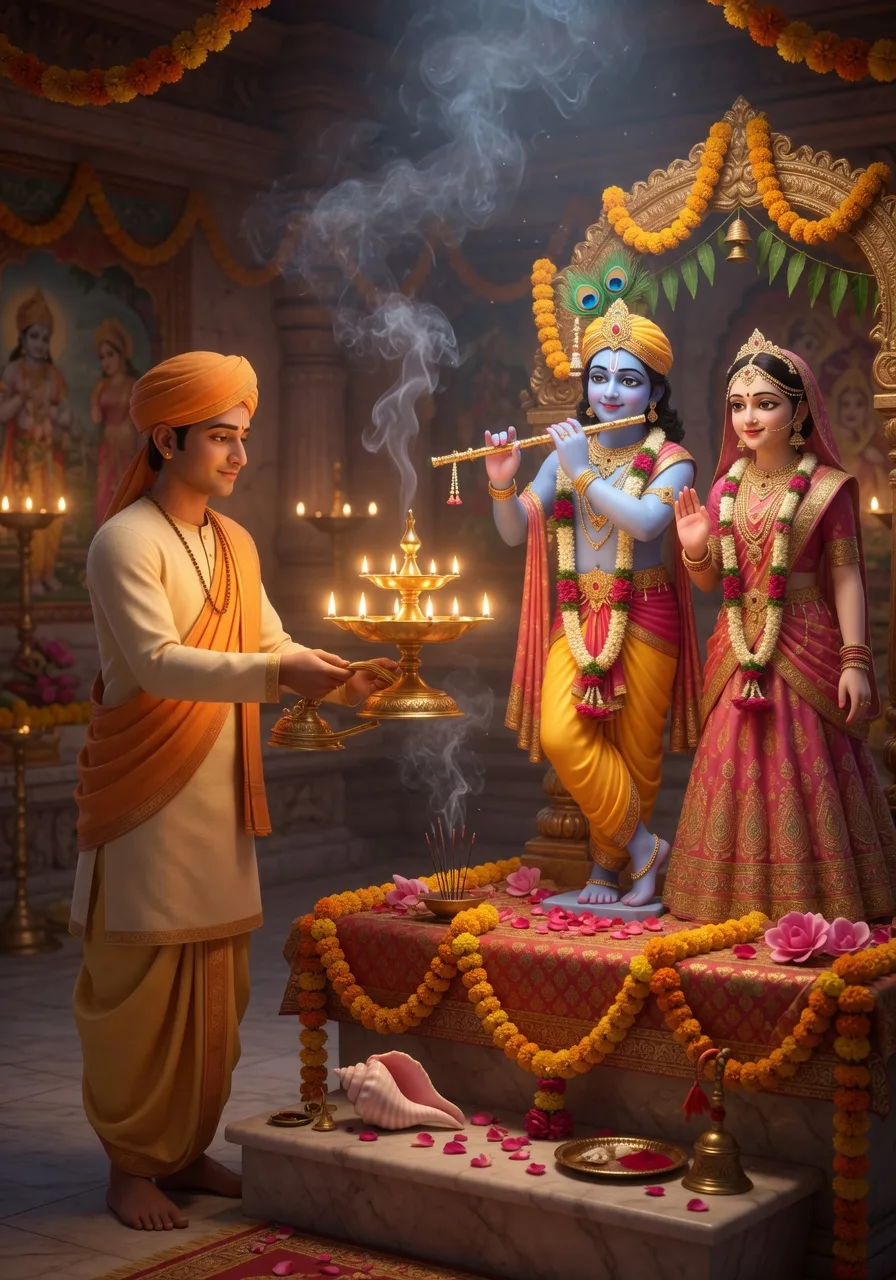
A temple is not a building we visit. It is a piece of the spiritual world set down in this one, and arati is not a routine of waving lamps. Every item on the tray hands one of the elements of our body back to the Lord. This lesson walks through both, how to approach a temple and stand before the deity, and what the whole ceremony of arati is quietly saying on our behalf.
Why is a temple called an embassy of the spiritual world?
Think of an embassy. India keeps an embassy in London, and the moment you step through its door you are no longer standing on British soil. You are on Indian ground, under Indian law. The officers inside are not subject to local rules, free even of the parking fines and speeding tickets the rest of us have to pay, and even their holidays follow the calendar of their home country. A temple works the same way. It is an embassy of the spiritual world planted in the material one, and once you are within it you are no longer in this world at all.
The boundary is not the gate. It is your consciousness. While you are still on the way, if your heart is leaning toward the temple in devotion, you have already crossed over and stepped into the spiritual world. That is why the mood we travel in matters as much as the visit itself.
How should we approach a temple?
Go with a heart full of devotion. If a bad mood is riding on you, set it down and shift into a good one before you arrive. A few inner attitudes carry the whole approach.
- Feel fortunate. Going to the temple is no small thing. It is enormous, and we are lucky to be allowed.
- Feel unqualified. I have no real right to enter. It is only the mercy of the Lord and his devotees that lets me in.
- Feel grateful. Thank everyone who made the visit possible, the parents who raised you, the devotees who invited you, and the devotees whose work built and maintains the temple. They deserve honour.
- Glorify and meditate. Praise the Lord's lotus feet, dwell on his form and his pastimes, and take in the beauty of the Lord and his consort.
- Keep to Krishna-katha. A temple is no place for gossip or politics. Speak only of the Lord while you are there.
- Bow. The moment you catch sight of the temple, and again when you see the Lord's feet, offer your pranams.

What is the etiquette inside a temple?
The outward customs all carry an inner meaning. None of them is empty.
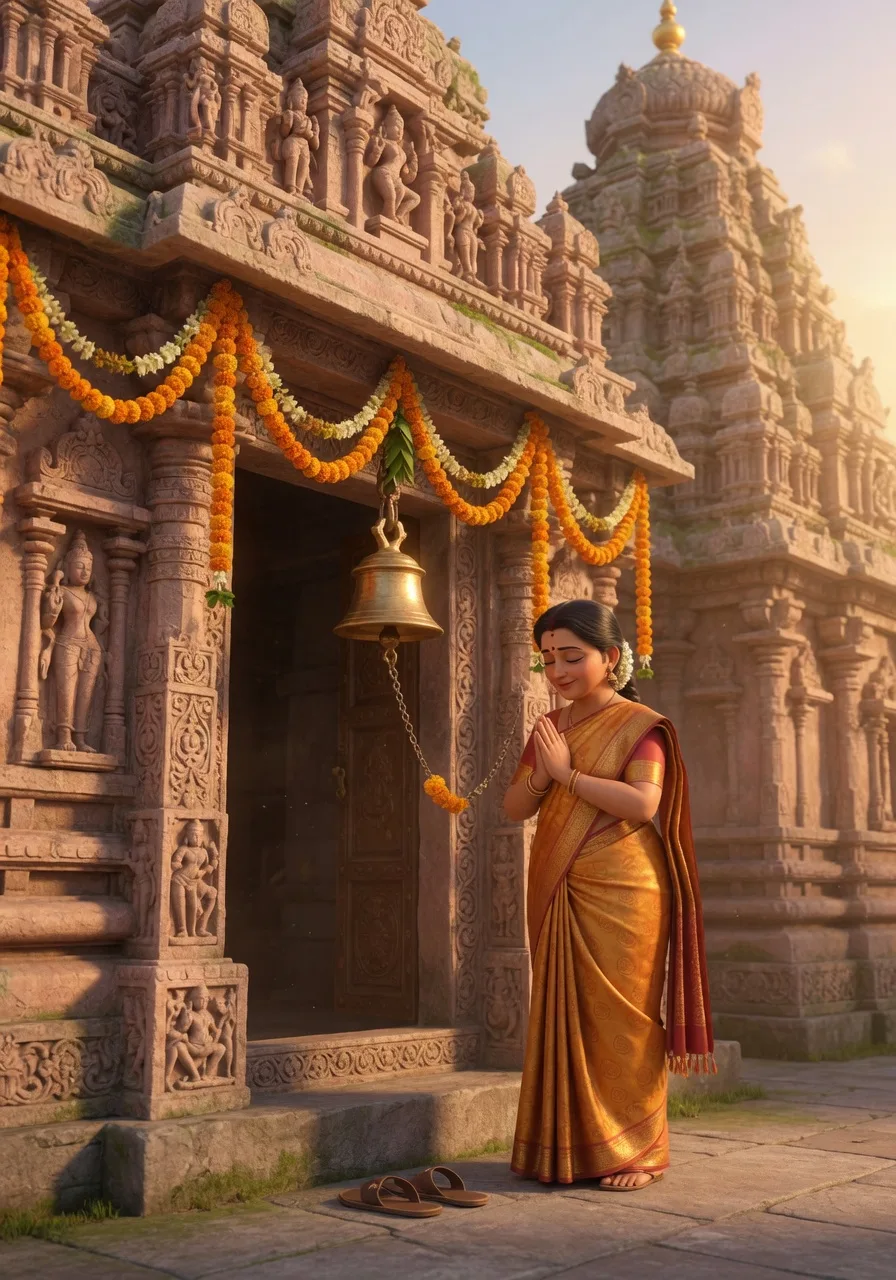
Pause at the gateway. Hindus stop outside the entrance and pray with the hands raised above the head before going in.
Remove your shoes. This keeps the dirt of the streets out, and it points to something deeper. In this tradition the feet are sacred, since we touch the Lord's lotus feet and touch the back of our own feet to take the blessing, and shoes are the one thing we cannot touch. The same habit is worth keeping at home, because we walk through more filth than we can imagine.
Ring the bell. Ringing the bell as you enter tells the Lord, humbly, that you have arrived. It is not a loud announcement of yourself. The sound is auspicious, welcoming the divine and driving off what is inauspicious.
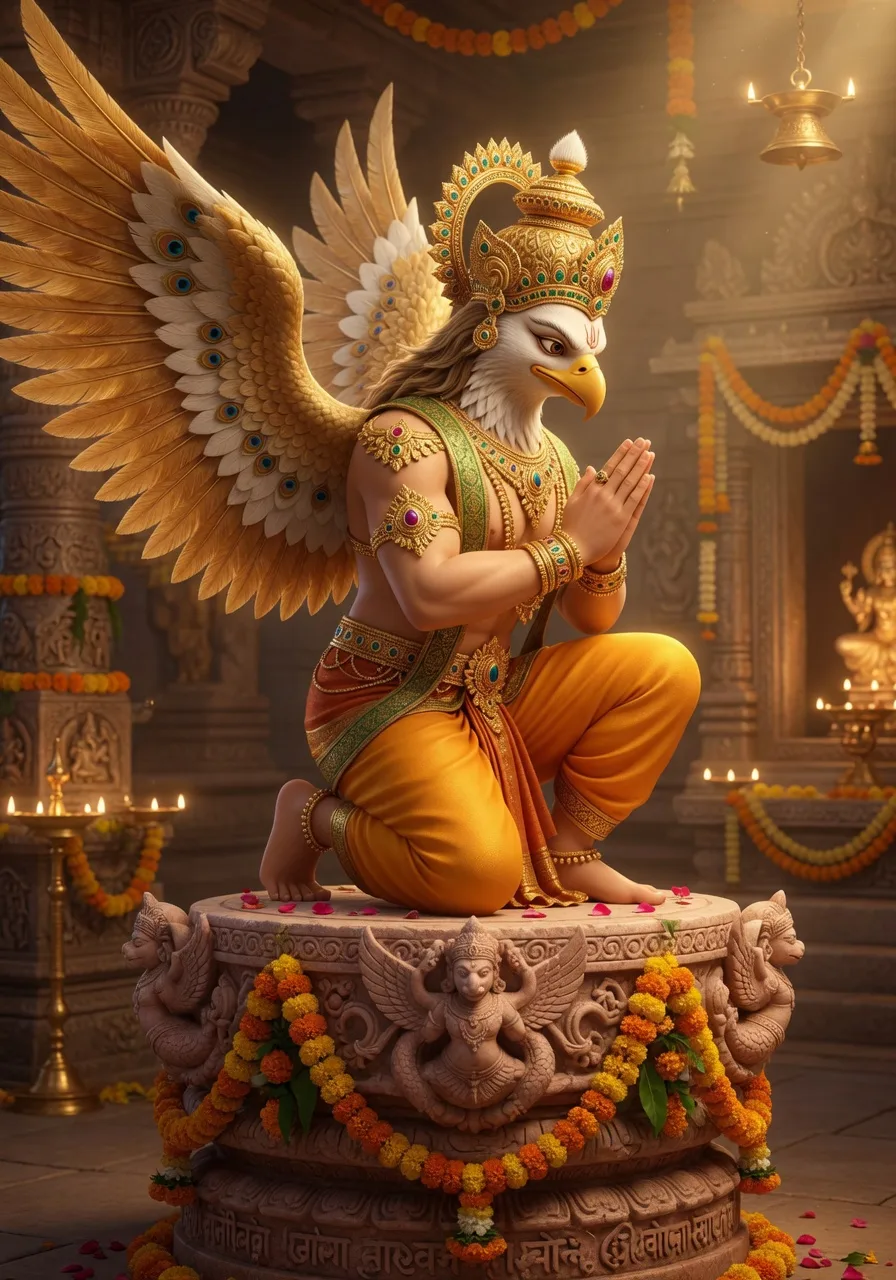
Bow to the guru on your right, the deities on your left. As you enter, offer obeisance to the guru on your right side and to the deities on your left. The reason is tender. A Vaishnava surrenders the heart to the supreme Lord, and the heart sits on the left, so turning the left side to the deities places the heart toward him, wanting only the Lord seated in its core. We also take care never to point our feet at the guru, or at Garuda, who usually stands at the back of the temple facing the Lord. That is why full obeisances are offered from the side rather than straight ahead, so the feet never point back at Garuda.
Offer full obeisances. Lying fully down before the Lord, the dandavat, is the offering of body, mind, and soul to him at once.
Circumambulate clockwise. Walk around the deities in a clockwise direction, pausing at each one with palms joined at the chest in Namaste. Place your offering before the deity or hand it to the attendant priest.
Receive with the right hand. A priest may pour water over your hands, a gesture of spiritual cleansing, so let him. He may give you prasad, the sanctified vegetarian food first offered to the deities. Prasad is holy, and it is eaten outside the temple, since eating in front of the deities while the curtains are open is not correct. Take anything the priest gives, and give anything, with the right hand only. The left hand is treated as unclean and the right hand as pure (shuddha).
Dress respectfully. Come to the temple well and modestly dressed rather than in shorts or hot pants, the women often in a sari or colourful clothes. Dressing with care is itself a way of pleasing the Lord.
What is arati, and why do we offer it?
In the temple the aratis are usually done by the pujaris, so we may not get the chance there. At home we have every right to it, and most devotees offer some form of arati to the Lord each day.
Here is the heart of it. In arati we are thanking the Lord for everything he has given, and each item answers to one of the elements that our body is made of. The body has two layers. The gross body is built from the five great elements, earth, water, fire, air, and ether. The subtle body is made of mind, intelligence, and ego. A full arati offers all eight back to the Lord, the whole of what we are, saying in effect: thank you for the facility to live in this world and in this body, and now I offer the body to you, so please come and live in it with me, that I may serve you.
The reference points for how the items are offered come from the Narada Pancharatra, a scripture given specifically to the worship of the deity. What follows is the way of the Gaudiya tradition, and other temples may differ in the details.
What does each arati item mean?
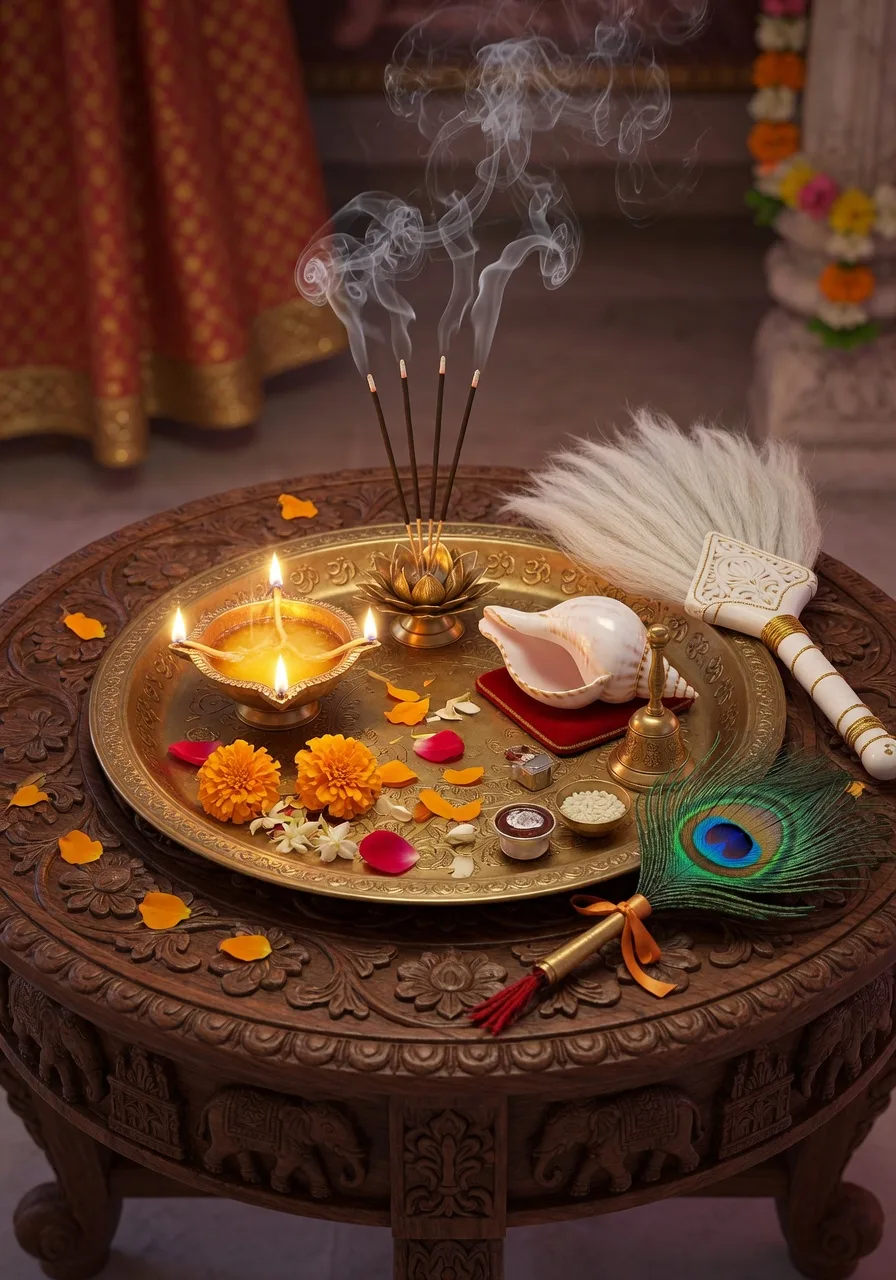
The ceremony begins with the blowing of the conch, which alerts the Lord that the arati is about to start and calls the devotees to come and watch. Then each item is offered, and each one stands for an element.
| Element | Offered with | What we are saying |
|---|---|---|
| Ether (the sky, the space we think in) | the blown conch and the bell | thank you for the ether you have given us |
| Air | incense, the chamara (yak-tail fan), and the peacock fan | thank you for the air we breathe, without which we cannot live |
| Fire | the ghee lamp | thank you for the fire element |
| Water | water held in a conch shell | thank you for the water element |
| Earth | a flower and a cloth | thank you for the earth element |
| Mind | the bhajan sung during arati | thank you for the mind that thinks, and let this song connect me to you |
| Intelligence | the focus on the meaning of each item | thank you for the intelligence I now turn toward you |
| Ego | the offering of obeisances | take my false ego, and give me my real one, for I am your servant |
A few of these deserve a closer look. The water in the conch shell is considered extremely pure, and after it is offered around the Lord a little is returned to the pot and then sprinkled over everyone present. Anyone who visits a temple has felt those potent drops thrown from the conch at the end of arati. The bhajan is more than the mind element, because singing the Lord's names and pastimes connects the singer directly to him. For that we should enter into the song, and it helps greatly to know not just the words but their meaning, which is why singing a bhajan and then reading its translation is such a good practice. The obeisance is the offering of the ego: "My dear Lord, take away my false ego and give me back my real ego, which is yours."
How is arati offered, and for how long?
Each item moves in a particular way. Incense is circled seven times around the body of the Lord. The ghee lamp is traditionally offered four times at the feet, twice at the navel, three times at the waist, and seven times around the whole body, though even seven circles around the body is enough, since the Lord knows what is being offered and is pleased by the love behind it. Water is offered seven times around as well. The chamara and the peacock fan are waved any odd number of times. The peacock fan belongs to summer and is set aside in winter, when it would be too cold for the Lord.
A typical arati tray holds the incense stand, the water pot, the ghee lamp, the conch and its stand, the achaman pot, the bell, and the flower holder, with a separate conch kept for blowing.
How long it takes is flexible at home. One devotee may take a full hour, offering very slowly, while another takes five minutes, and both are right. In the temple the full arati is far more regulated, with the standard offering running about twenty-five minutes at fixed times each day. Where a temple has several altars, a pujari stands at each, all offering the same items to their own deities in synchrony. In Vrindavan, for instance, there are three altars, Radha-Krishna, Krishna-Balaram, and Gaura-Nitai, each with its own pujari, each arati taking the full twenty-five minutes. The arati is offered not only to the main deities but to the gurus and devotees on the altar too, which is part of why it can run long.
What stands on a home altar?
A home altar can hold a good deal. Alongside deities of Krishna and Balaram, a household may keep a Shaligram shila from the Gandaki river, which is regarded as Lord Vishnu directly. This matters for a reason worth knowing. When a temple installs marble or metal deities, a ceremony called prana-pratishtha is performed to invoke the Lord's presence into the form. A Shaligram needs no such ceremony, because it is already the Lord himself. A Dwarka shila may be kept as Balaram, along with Jagannath, Baladev, and Subhadra, and Radha-Gopal, and on a second tier Tulasi Maharani and the line of gurus. The pujari offers the incense not only to the Lord but to the gurus and devotees as well. A good practice is to keep the altar near the centre of the home rather than tucked into a spare room, so that you cannot help but meet the Lord each time you come in.
Key terms from this lesson
| Term | Meaning |
|---|---|
| Arati | the ceremony of offering items to the deity, each standing for an element |
| Darshan | seeing, and being seen by, the deity in the temple |
| Dandavat | full prostrate obeisance, offering body, mind, and soul |
| Pradakshina | circumambulating the deity in a clockwise direction |
| Prasad | sanctified vegetarian food first offered to the Lord |
| Pujari | the priest who performs the worship and arati |
| Garuda | the eagle carrier (vahana) of Lord Vishnu, often on a pillar facing him |
| Prana-pratishtha | the rite that invokes the Lord's presence into a marble or metal deity |
| Shaligram | a sacred stone from the Gandaki, worshipped as Vishnu directly, needing no prana-pratishtha |
| Narada Pancharatra | the scripture that lays out how to worship the deity |
What to carry forward
- A temple is an embassy of the spiritual world, and your devotional mood, not the gate, is the real boundary.
- Approach feeling fortunate, unqualified, and grateful, speaking only of the Lord.
- Remove shoes, ring the bell, bow with the heart (left side) to the deities and the right to the guru, and receive everything with the right hand.
- Arati thanks the Lord by offering the five gross elements and the three subtle ones, the whole body, back to him.
- Conch and bell are ether, incense and fans are air, the lamp is fire, the conch-water is water, flower and cloth are earth, the bhajan is mind, focus is intelligence, and the bow is ego.
- The exact counts matter less than the love behind the offering.
- In this age the holy name is the central practice, while arati gathers the mind and heart toward the Lord.
Previous lesson: ← The yoga ladder
Next lesson: Festivals and the meaning of Ekadashi →
Back to the full course index.
Frequently Asked Questions

Independent writer, jaapak.com
I built the Jaapak app. I write in simple Hindi on the Bhagavad Gita and the satsang tradition — so seekers don't struggle with the scripture.
Read all articlesAbout this article
The commentary is based on the general understanding of the Sanatan tradition and written in accessible language. No verbatim quotation of any modern commentator is used.