The Scriptures of Sanatana Dharma: Vedas, Upanishads, Itihasas & Puranas
A clear map of the Sanatana Dharma scriptures: the four layers of the Vedas, Brahman, the Upavedas and six Vedangas, the Sutras, the Mahabharata and
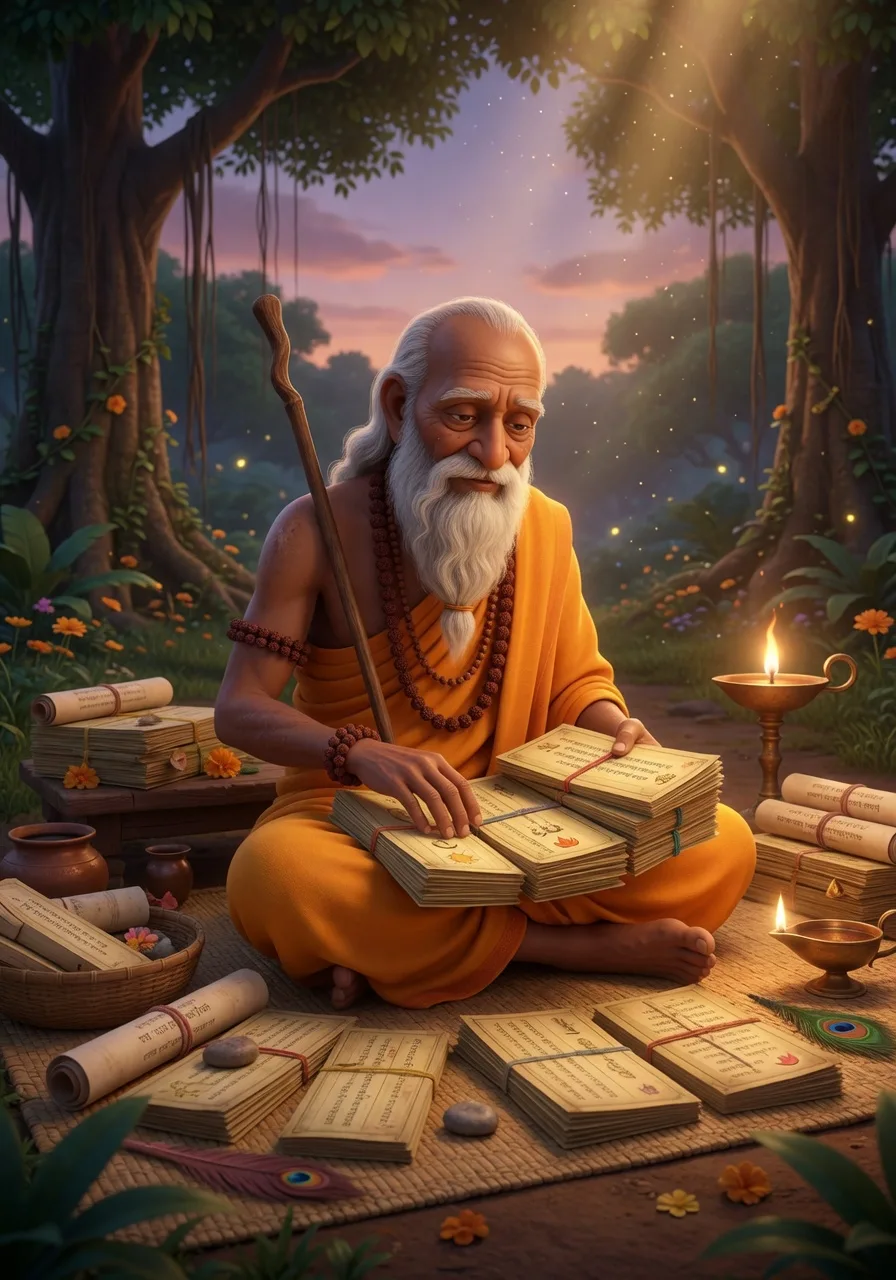
The scriptures of Sanatana Dharma are vast, and reading every one in a single life is not the point. The point is to know the map: which text does what, which layer speaks to rituals and which to liberation, and which two books are worth real study. This lesson walks the whole library at speed, from the Vedas down to the Puranas, and ends with the one scripture that takes a soul back home.
A quick recap: one God, many devatas
The last lesson set the ground. The real name is Sanatana Dharma, the land is Bharat, and none of these accounts is mythology. Here we pick up the thread.
There is one God. The Supreme expands himself into many avatars, and beyond those there are powerful beings called devatas, the demigods. Here is the part many people miss. The devatas are jivas, souls like you and me. They earned great power through past karma, and the Lord gave them their posts to help run the universe. Their power is borrowed, not their own. That is why a devata can be mistaken for the Supreme, yet never is the Supreme.
Krishna says this plainly in the seventh chapter of the Bhagavad Gita. People of small understanding, hungry for worldly things, take delight in the flowery words of the Vedas that promise power, riches, and a seat in heaven. When such a person worships a devata for a small, temporary fruit, the Lord as Paramatma, the supersoul in the heart, steadies that faith. It is one step up, because the person now looks to a higher power than himself. But whatever a devata grants, it was the Lord who gave it first. So worshippers of devatas reach the planets of devatas, and worshippers of the Supreme reach the spiritual world. For a soul who has truly turned towards that highest goal, the Vedic duties of demigod worship fall away. A self-realised person has no material desire left to chase.
What are the layers inside the Vedas?
Each Veda is not a single book. It has four layers, moving from outer ritual to inner realisation.
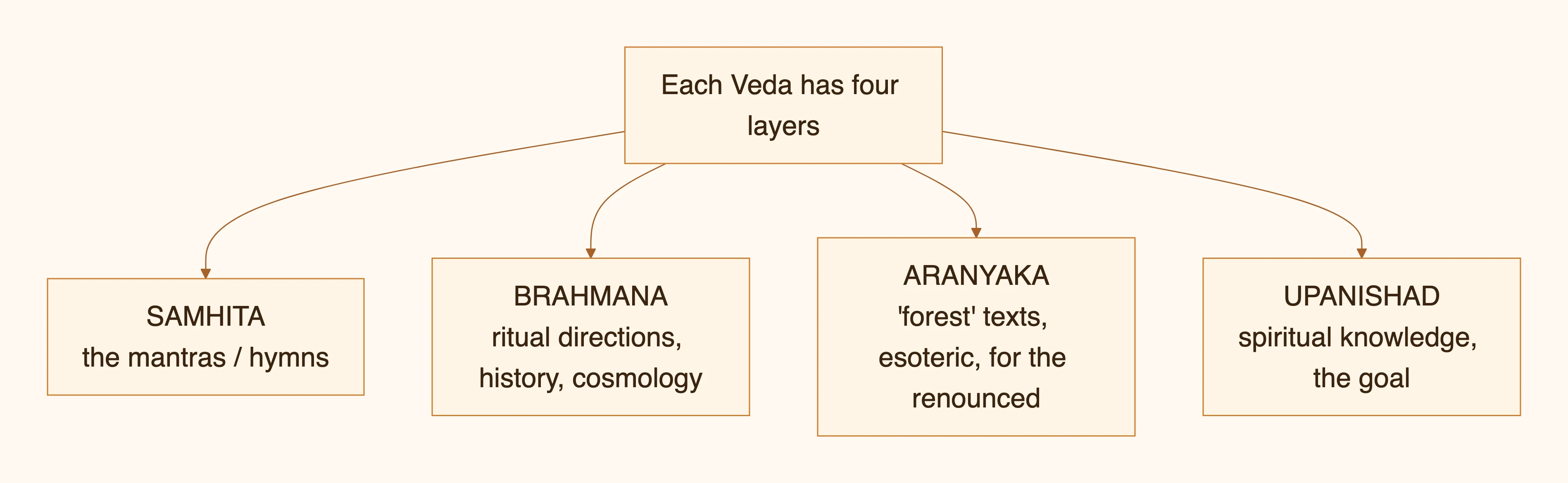
- Samhita. The mantras themselves, the hymns held in each Veda.
- Brahmana. Compositions that accompany the Samhita mantras, with extra directions a priest needs to perform a sacrifice correctly. They also carry history, cosmology, and the legends that explain why a ritual is done, giving the priest more substance to work with.
- Aranyaka. The "forest" writings, considered secret and even dangerous for the uninitiated. They reveal more of the esoteric meaning of ritual than the Brahmanas. They were meant only for priests and for kshatriyas, warriors who had renounced worldly life and retired to the solitude of the forest, which is what the name points to. They include which mantra to use, how to sit, and at what hour of the morning to practise.
- Upanishad. Made for steady spiritual progress. Where the rest of the Veda pushes demigod worship for material needs and only hints at realisation, the Upanishads explain how to drop worldly attachment and surrender to God. The word means "to sit down near, below the feet". A student sits close to the guru's feet and listens with full determination. There are 108 principal Upanishads and around a hundred lesser ones, more than 200 in all. Eleven sit at the top: Isha, Kena, Katha, Prashna, Mundaka, Mandukya, and a few more. The Mandukya is the one often quoted on the nature and size of the soul.
What is Brahman?
Brahman is the formless aspect of God. It has no shape, no material qualities, no material personality, only spiritual quality. People often picture it as the effulgence, the sunshine of God rather than the sun itself.
Some followers stop here. They hold Brahman as the final state and hope to merge into it for liberation. The Srimad Bhagavatam calls this a partial view. The Upanishads do speak of the Absolute in this impersonal way, with no form, yet they also begin to point further: the Supreme reality has a form, is a person, and keeps a divine abode. The Gopala Tapani Upanishad puts it in plain words. Sri Krishna takes no birth and knows no old age. He stays forever in his youth, a changeless sixteen, shining more gloriously than the sun, fond of the divine cows of Goloka Vrindavan, ever happy among the cowherd boys, tending the cows. That is one glimpse the Upanishads give of the Absolute with a face.
What are the Upavedas?
The Upavedas "follow the Vedas" and attach to the four main Samhitas. They show how completely the Vedas reach into ordinary life:
- Arthaveda covers economics, and the science of defence, war, and politics.
- Gandharvaveda covers music, dance, and singing.
- Ayurveda is the science of medicine, treated almost as a spiritual science.
Most of the Upavedas are lost. Ayurveda is the lucky survivor. Travel through Bharat and you still find it practised widely, a natural and holistic way of keeping the body in order.
What are the six Vedangas?
The Vedangas are the "limbs of the Veda" (anga means limb). Six in number, they support and protect the study of the Vedas. Without them, a mantra loses its force.
| Vedanga | What it guards |
|---|---|
| Shiksha | Correct pronunciation |
| Chandas | Meter, the rhythm a mantra must keep |
| Vyakarana | Sanskrit grammar |
| Nirukta | The meaning of Vedic words |
| Jyotisha | Vedic astrology |
| Kalpa | Ritual procedure, ceremonies like marriage and the sacred thread |
A mantra chanted out of meter, or mispronounced, simply will not land. The Vedangas keep that precision alive.
Where does Shruti end and Smriti begin?
Everything so far, the Vedas with their four layers, the Upavedas, and the Vedangas, is Shruti, the knowledge that does not change. And Shruti has a limit. It deals mostly with the weight of material existence, the bondage of souls in birth and death. It says little about the spiritual world itself, about the bliss and the pastimes of Goloka, Ayodhya, and Vaikuntha.
That higher subject is left to Smriti: the Sutras, the Itihasas, the Tantras, the Pancharatras, and the Puranas.
What are the Sutras and Itihasas?
The Sutras clarify the Vedic principles so a person can build a good life now and a good next life. They lay out logical codes for ritual and worship, written above all for householders, to help families regulate and spiritualise daily life. Most are lost. One seed survives in them, the very start of spiritual life: I am spirit, the soul.
The Itihasas explain the rituals of the Vedas and the dense philosophy of the Vedanta Sutras through real history, through the stories of great sages and devatas. Two stand at the centre.
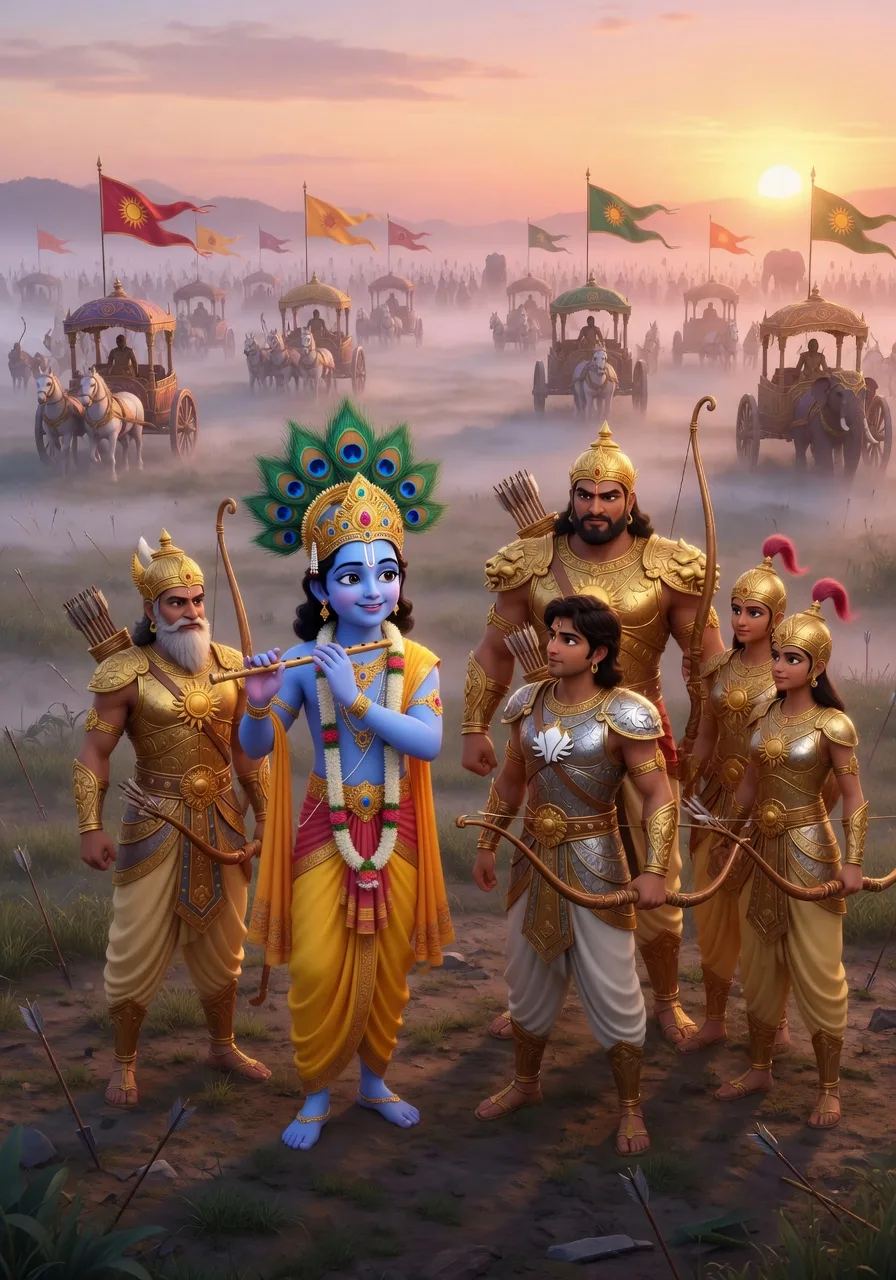
The Mahabharata was written by Srila Vyasadeva. The name means "great war", and it reads like our own lives, because a life is a battlefield of obstacles. The Pandavas suffered more than the Kauravas. They lost their father early, were harassed, and were nearly killed many times. They won in the end because Krishna stood on their side. That is the lesson: life is a battlefield, and with Krishna beside us we get past every obstacle. The epic runs to about 100,000 verses, the longest poem there is, divided into eighteen sections. It holds the history of Bharat, and the old saying fits: if it is not in the Mahabharata, it is not to be found. It covers the deeds of the Pandavas, Krishna's dealings, creation, the lineage of sages, dharma, politics, military strategy, the right conduct of a king and his people, and the path of devotion to God. The Mahabharata also carries the Bhagavad Gita, the very essence of how to live in this world without catching its madness.
The Ramayana runs to 24,000 verses, written by Valmiki. It tells the pastimes of Lord Ramachandra and his eternal consort Sita Devi, and it teaches morality and how to live well in an imperfect world.
What are the 18 Puranas?
The Puranas assist the Vedas and hold a great deal on how to rise spiritually. Each treats five core subjects, some up to ten: the creation of the world, its destruction, its re-creation, the lineage of the devatas and the Manus, and the histories of the solar and lunar dynasties (Krishna appears in one line, Rama in the other), along with the deeds of the Lord and the sages. There are 18 major Puranas and 18 secondary ones.
The 18 are sorted by the three modes of material nature. The Purana itself is not "in" a mode. The sorting tells you which Purana lifts a person sitting in that mode up to the next stage.
| Mode | Puranas | Sample subjects |
|---|---|---|
| Tamas (ignorance) | Matsya, Kurma, Linga, Shiva (Vayu), Skanda, Agni | Skanda is one of the largest at 81,000 verses (Vishnu, Shiva, holy places, Parvati); Kurma covers the tortoise avatar and the glory of Kashi; Linga centres on Shiva's worship; Agni on the avatars, Ganga, and astrology; Matsya on creation, fasting, and the pastimes of Shiva and Parvati |
| Rajas (passion) | Brahma, Brahmanda, Brahma-Vaivarta, Markandeya, Bhavishya, Vamana | Brahma holds the pastimes of Rama and stories of Krishna, with Surya and the birth and marriage of Parvati; Brahmanda covers the kalpas, the days of Brahma, holy places, planetary descriptions, and the Manus; Brahma-Vaivarta is famous and often quoted, with 129 chapters on the pastimes of Radha and Krishna and the appearance and marriage of Tulasi; Markandeya is a dialogue between the sages Markandeya and Jaimini; Bhavishya foretells the future of Kali Yuga, now mostly lost, naming coming incarnations and their parents; Vamana tells how the Lord took three steps of land from Bali Maharaj and freed him |
| Sattva (goodness) | Vishnu, Narada, Bhagavata, Garuda, Padma, Varaha | Vishnu covers the Lord, the descendants of Dhruva and Priyavrata, and the marriage of Vasudeva and Devaki; Narada shares the pastimes of that great devotee; Garuda traces the soul's journey through the heavens after death; Padma holds stories of Krishna in Vrindavan and Rama in Ayodhya; Varaha tells how the boar avatar rescued Bhumi Devi |
The six in goodness are the ones recommended to read. And one of them stands above the rest.
Which two scriptures should you actually study?
Two. Not skim, but study and absorb.
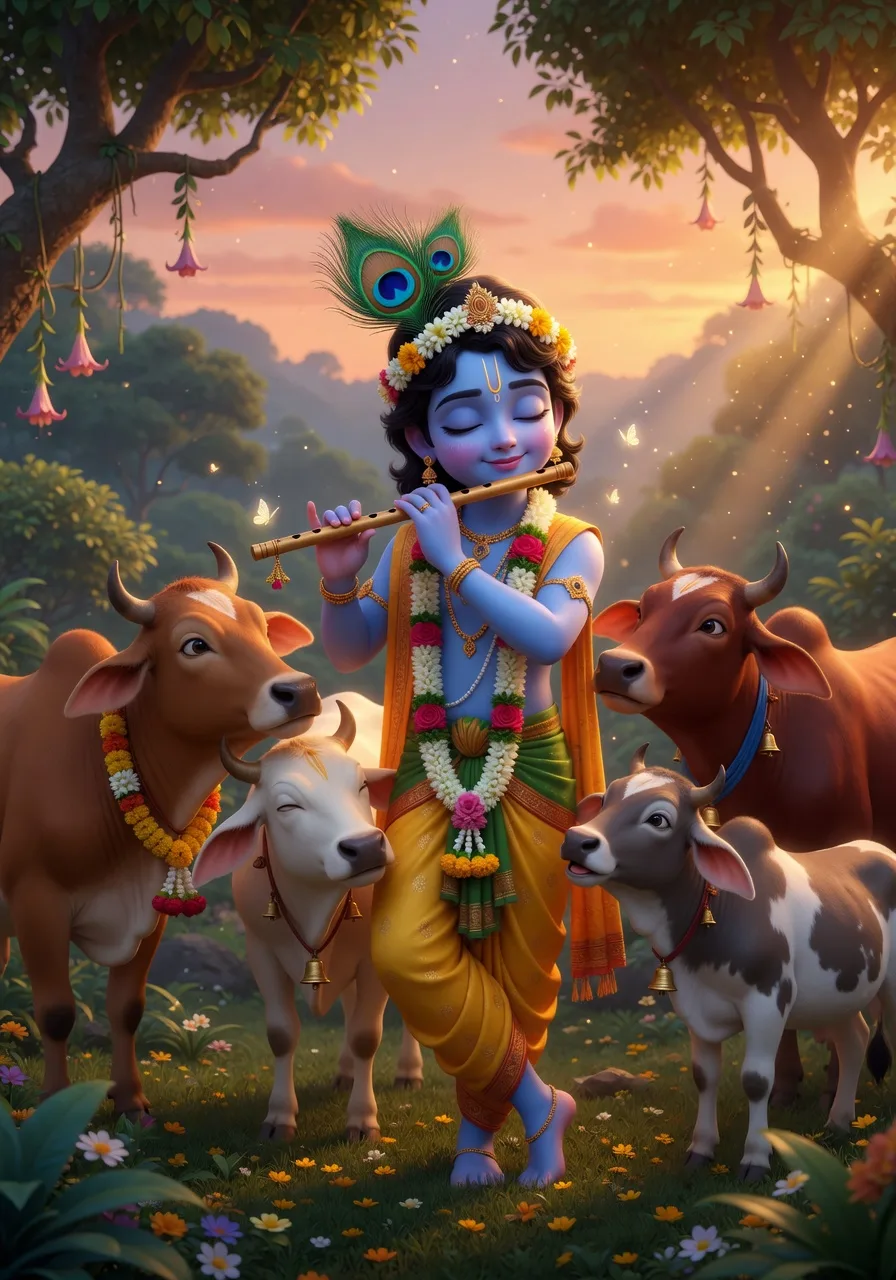
The first is the Bhagavad Gita, the road map for how to live in this world. The second is the Bhagavata Purana, the Srimad Bhagavatam, which teaches how to die in this world and return to the spiritual one.
The Bhagavatam is listed under goodness, yet it sits beyond material goodness, in pure spiritual goodness. It runs to 18,000 verses. It is Vyasadeva's own commentary on all of Vedanta. It brings every aspect of the Absolute Truth to light, above all the personal nature of Krishna, and it stands as the final conclusion of Vedic understanding. It does not dwell on the worship of other devatas or on temporary material rewards, the way parts of the other Puranas do. In that sense it rises past every other view in Vedic literature.
This scripture is not lost. His Divine Grace A.C. Bhaktivedanta Swami Prabhupada translated it, and it sits free to read online. Read the Gita to live well. Read the Bhagavatam to leave well.
Key terms from this lesson
| Term | Meaning |
|---|---|
| Samhita | The mantra layer of a Veda |
| Brahmana | The ritual-direction layer, with history and cosmology |
| Aranyaka | The "forest" layer, esoteric, for the renounced |
| Upanishad | The spiritual-knowledge layer; "sitting near the guru's feet" |
| Brahman | The formless aspect of God, pure spiritual effulgence |
| Upaveda | Applied knowledge attached to the Vedas (Ayurveda, etc.) |
| Vedanga | The six "limbs" that protect Vedic study |
| Sutra | Logical codes that spiritualise household life |
| Itihasa | "History"; the Mahabharata and Ramayana |
| Purana | "Ancient"; 18 major texts that enhance the Vedas |
| Bhagavata Purana | Srimad Bhagavatam; the crown scripture, how to return home |
| Paramatma | The supersoul, the Lord seated in every heart |
| Goloka Vrindavan | Krishna's eternal spiritual abode |
What to carry forward
- Devatas are empowered souls, not the Supreme. Whatever they give, the Lord gave first.
- Each Veda runs from ritual (Samhita) to realisation (Upanishad).
- Brahman, the formless, is real but partial. The Supreme also has a form and an abode.
- Ayurveda is the great surviving Upaveda.
- Shruti maps the material; Smriti opens the spiritual.
- The Mahabharata says life is a battlefield, winnable with Krishna beside you.
- Read the Puranas of goodness, and crown your study with two books: the Gita to live, the Bhagavatam to leave.
Previous lesson: ← What is Sanatana Dharma?
Next lesson: The Vedic conception of time →
Back to the full course index.
Frequently Asked Questions
Independent writer, jaapak.com
I built the Jaapak app. I write in simple Hindi on the Bhagavad Gita and the satsang tradition — so seekers don't struggle with the scripture.
Read all articlesAbout this article
The commentary is based on the general understanding of the Sanatan tradition and written in accessible language. No verbatim quotation of any modern commentator is used.