Samskara: The Sacraments of a Lifetime
The samskaras of Sanatana Dharma, the rites of passage that purify a life from before birth to after death: Garbhadhana, Jatakarma, Upanayana, Vivaha, and
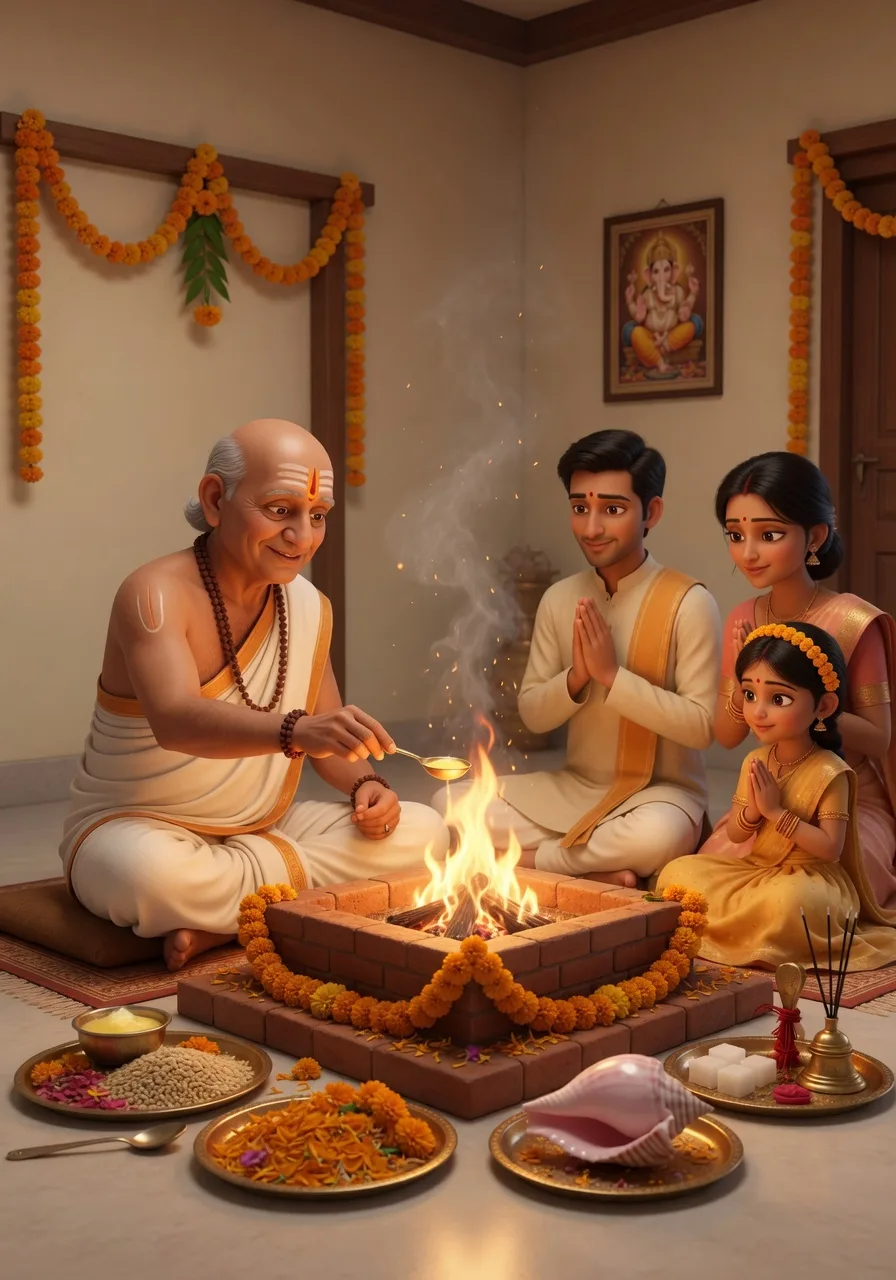
We say a child has "good samskaras," meaning something fine has been impressed on them. That is close to the real sense of the word. A samskara is both an impression left on the mind and a ceremony that places a good impression there, performed at the turning points of a life. They are not mere formalities. They are meant to purify a person and to carry them well from one stage of the journey to the next. This lesson walks through the five samskaras still kept today, from before birth all the way to after death.
What does the word samskara mean?
At root, a samskara is a mental impression. Every action we perform deposits a subtle mark in the field of the mind, and an action done with full attention leaves a far deeper mark than one done carelessly. Repeat an action and the impression deepens, and that is exactly how a habit forms. The stronger the habit, the less control we have over the mind when we try to act against it, which is why bad habits are easy to fall into and hard to climb out of. Some of these impressions are carried from past lives, and they explain why certain things come to us so naturally. They can also be carried forward into the next life.
This is why spiritual life is best begun very young, even within the womb. The samskara ceremonies are designed to set a favourable frame of mind for stepping from one phase of life into the next. They were considered essential for the twice-born classes, and traditionally the neglect of a rite could cost a person that standing. The deeper point is that these rites shape behaviour, and it is behaviour, not birth, that decides where a person truly stands.
What are the five samskaras?
Some traditions count ten rites of passage, some sixteen, some more, but five are widely kept today.
| Samskara | When | What it does |
|---|---|---|
| Garbhadhana | before conception | purifies the consciousness of the parents |
| Jatakarma | birth and infancy | welcomes and protects the new child |
| Upanayana | boyhood, age 8–12 | the sacred thread and second birth |
| Vivaha | adulthood | marriage |
| Antyeshti | death | the final rites for the departed soul |
Garbhadhana: purifying the womb before conception
The first samskara begins before a child is even conceived, and it is the one most completely forgotten today. Its aim is to sanctify the consciousness of both husband and wife before they try to beget a child, because scripture explains that the kind of soul that enters the womb is shaped largely by the mental state of the two parents at that moment. The soul takes shelter in the father's seed and, with the mother's ovum, grows itself a particular kind of body, so the state of both parents leaves its mark on the child to come. While conceiving, then, the mind should be sober and devotional.
The Mahabharata shows this vividly. When Vyasa was asked to beget heirs through the two widowed queens, the first queen shut her eyes in fright at the sight of the unkempt forest sage, and her son Dhritarashtra was born blind. The second turned pale with fear, and her son Pandu was born pale. Asked to try once more, the queens sent a maidservant in their place, and she received Vyasa with full respect and composure, so her son Vidura was born one of the wisest men of the age. The Srimad Bhagavatam gives another case: the mind of Kashyapa Muni was disturbed when he conceived, and his two sons Hiranyaksha and Hiranyakashipu came out immensely powerful but mixed with anger.
The child in the womb can already hear and understand. The proof is Prahlada Maharaja, who in Satya Yuga heard Narada Muni instructing his mother while he was still in her womb, and was born a great devotee. Where parents wish for a particular result, there are even precise observances for it, but the heart of this samskara is simply that a child begins to be formed in the consciousness of its parents.
Jatakarma: welcoming the child
When the baby is born, a series of ceremonies welcomes it into the world.
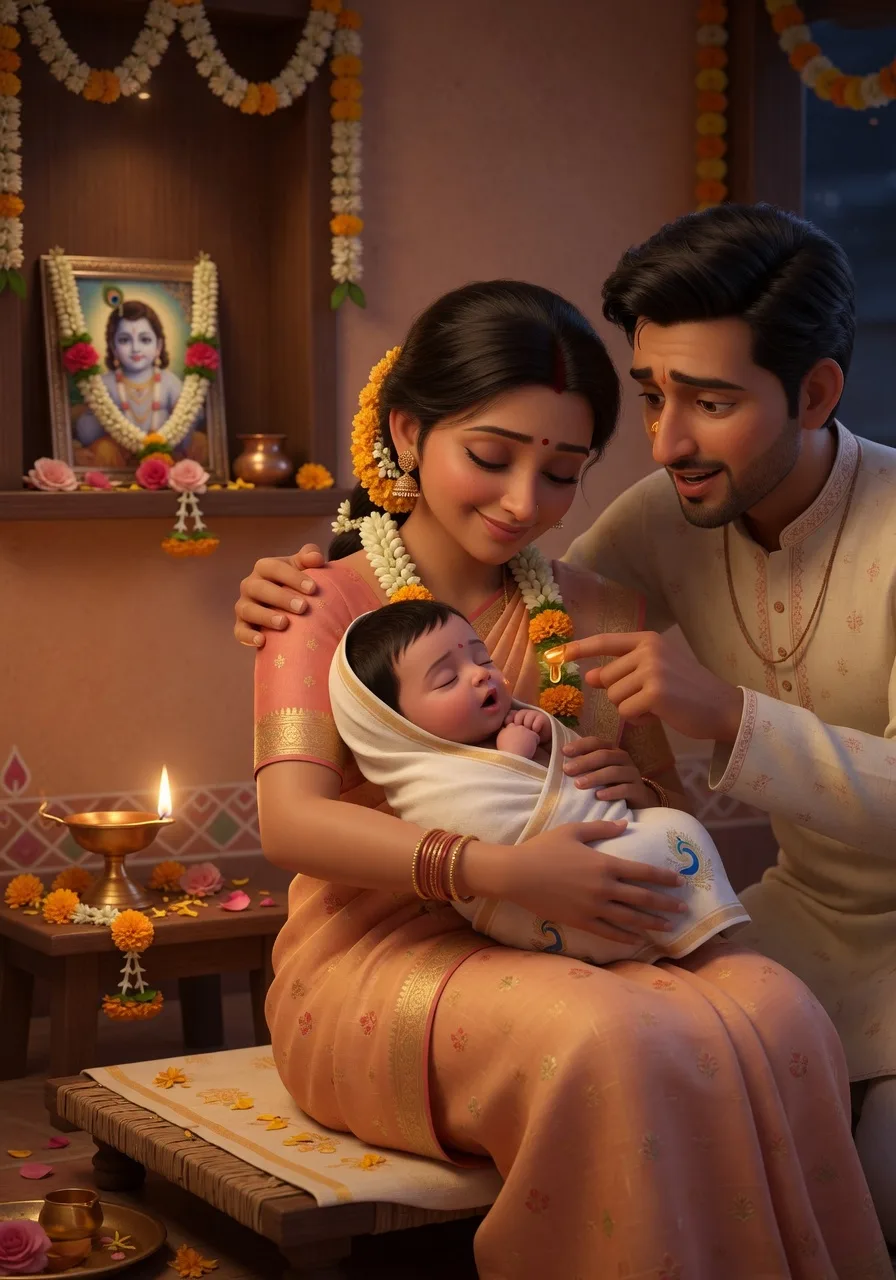
At birth itself the father places a little ghee and honey on the baby's tongue and whispers the name of God into its ear. The name-giving, Nama-karana, follows on the sixth or the eleventh day, when the baby is dressed in new clothes and the family astrologer reads the horoscope, the name traditionally chosen from the moon's position and the child's rashi at birth, with songs, sometimes a fire sacrifice, and the feeding of devotees.
The first outing, around five or six weeks, takes the child to see the sun, then the temple deity, and the moon in the evening. Until then mother and child usually stay home, since childbirth is a hard and traumatic passage and the mother needs to recover her strength. The first grains, Annaprashana, come with teething at about six months, when the child moves on from milk and mashed fruit. A fire sacrifice is performed, and the Lord is invited into the fire and then invited to reside as that same digestive fire in the child's stomach. At the first haircut, the Mundan, the newborn hair, considered impure, is shaved away, and this first shave may be given to any infant before six months. Boys, though, have a further ceremony between the ages of one and three at which a small tuft, the sikha, is left at the back of the head. It sits over the soft spot at the crown, the point from which an advanced yogi can draw the life-air up from the stomach, through the heart and the throat, and release himself at death, so it is kept protected. This is why a boy's head is shaved while a girl's, with no sikha to leave, usually is not.
A note on custom. After a birth, and after a death, a family traditionally keeps away from the temple for a few weeks, a period of ritual impurity, called pingu after a birth and sutak after a death. A sensible reading of it is practical: a newborn is fragile, and a household moving through the crowd could carry sickness home, while a death was often caused by disease that should not be spread.
Upanayana: the sacred thread and the second birth
Upanayana marks a boy's formal entry into his varna, and with it he becomes "twice-born." The first birth is from the parents, and the second is from the guru, for at this rite the boy accepts a spiritual teacher as his father and the Vedas as his mother. The word itself means "sitting close by," the boy taking shelter of the guru. It is usually done between the ages of eight and twelve, and traditionally the boy then left for the teacher's ashram, the gurukul, as even Ramachandra and his brothers did, to study the Vedas and build character while living simply.
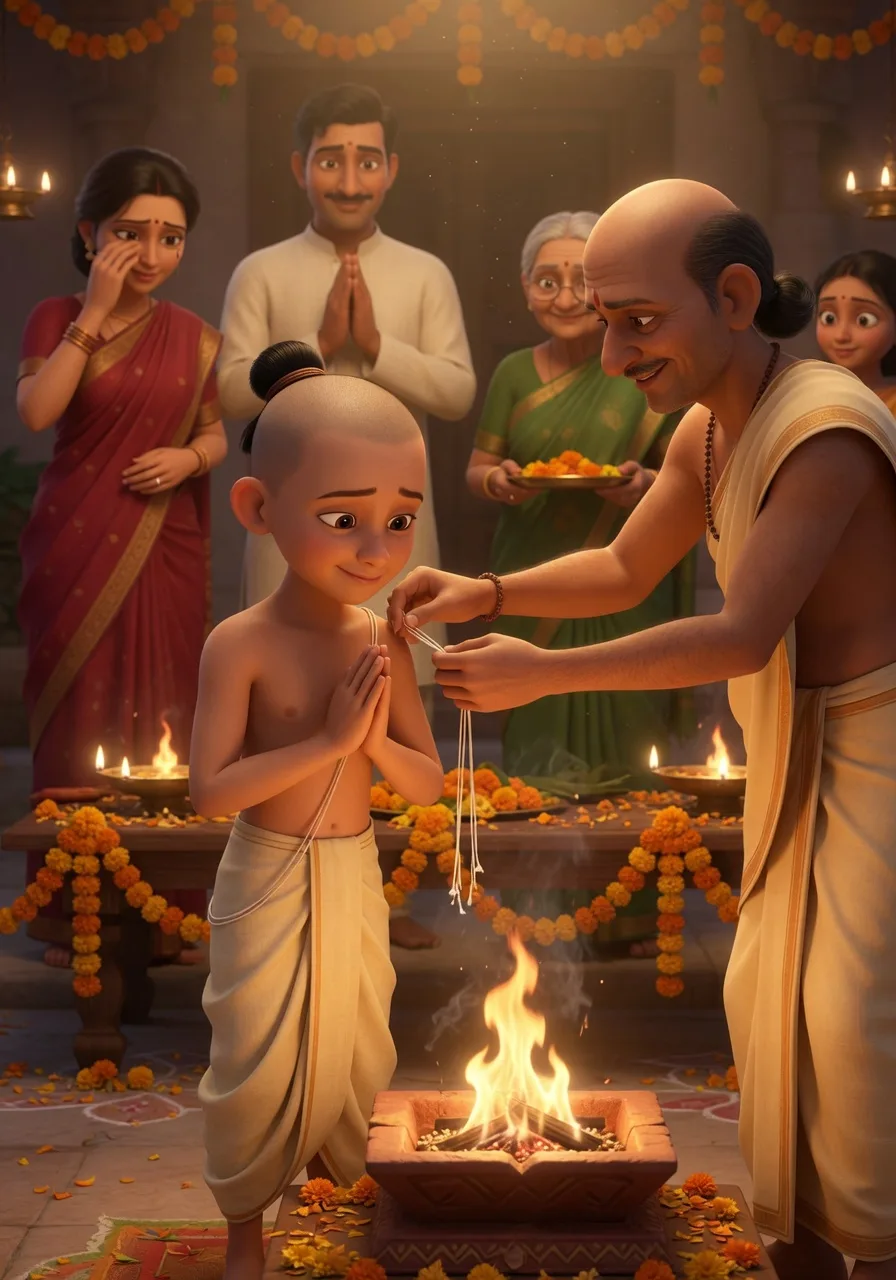
The ceremony shaves the hair, bathes the boy, and dresses him in new clothes. He begs a little alms from his mother, a fire sacrifice is offered, and he is given the janeu, the sacred thread, which is then worn for life, replaced at intervals but never taken off until the new one is in place. From the priest or guru he hears the Gayatri mantra, receives a spiritual name to mark his second birth, and undertakes to chant the Gayatri three times a day, at dawn, noon, and dusk. The Vedas prescribe that the Gayatri is chanted silently, and there is no benefit in saying it aloud. He vows to study the Vedas, serve his teacher, and keep certain vows including celibacy, and the rite closes with a gift, dakshina, to the teacher. A separate samskara once marked the start of formal education, and the two are often combined now. In practice today the thread is kept mainly within particular communities, or taken up by those who will serve as priests.
Vivaha: marriage
Marriage is for many people the most important samskara of all. The couple stays together for life, or until the husband takes the renounced order, and divorce has no place in it, a word that does not appear in the Vedic scriptures. Matches were arranged by the elders and weighed by astrology, and for all that modern attitudes dismiss the practice, such marriages tend to hold together at least as well as love-matches, and often better. A bride was usually matched within the same varna and the same jati, the occupational group, for compatibility, and scripture allowed a woman to marry into a higher varna though not a lower.
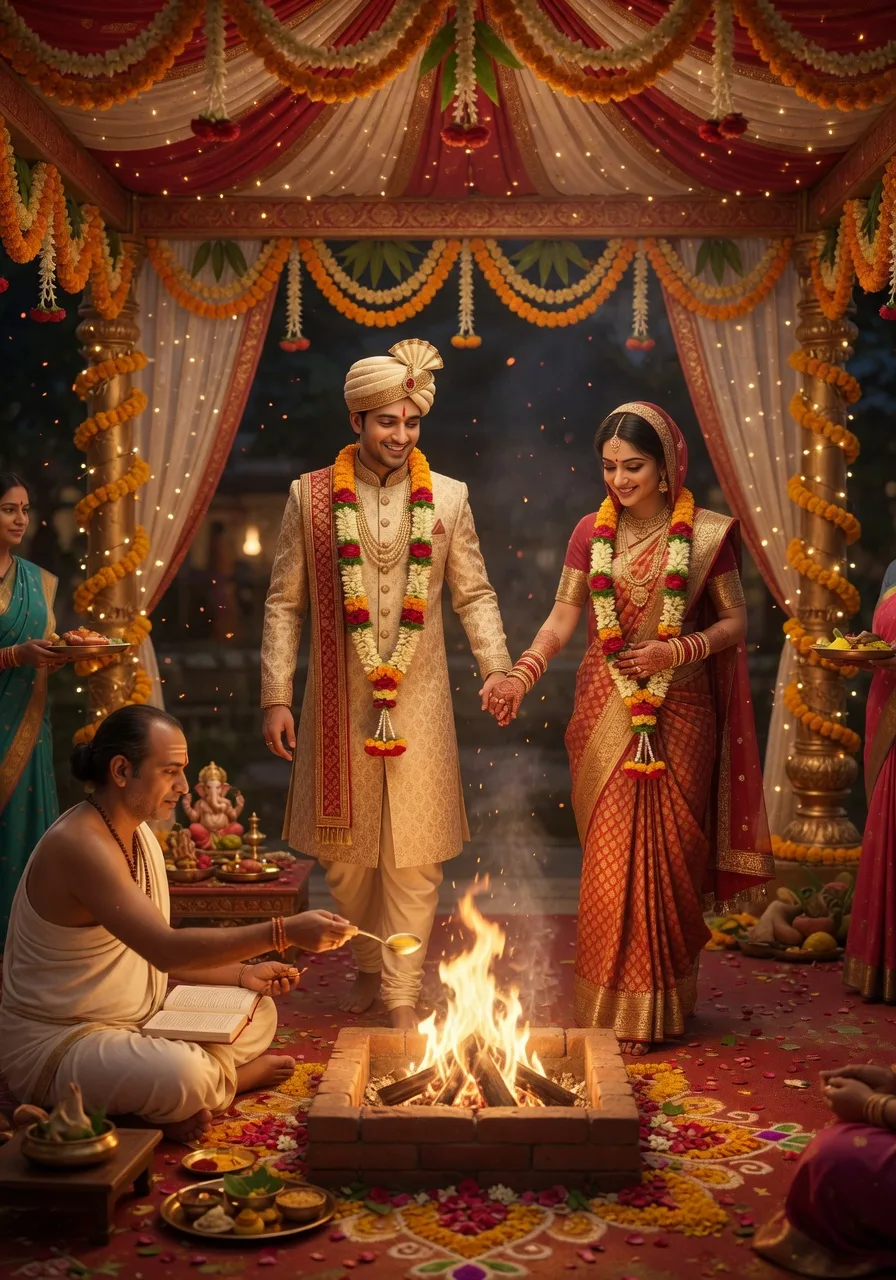
The ceremony is long and varies by region, but its common threads are these: the bridegroom is welcomed, the couple exchange flower garlands, the daughter is given in marriage, hands are joined over the sacred fire, the couple circle it and take the seven steps together toward the Lord, the groom marks the bride's hair-parting with kumkum and ties the mangalsutra, and the elders give their blessings. In some traditions the couple make four rounds of the fire rather than seven steps, and the wife leads the final round, the one time she walks ahead of her husband. Two cautions come down with it. Girls were once married very early to protect them, and where that has slid into neglecting and uneducating them, it has become genuine exploitation, bad for the women and for society. And the dowry, anciently a token of a father's affection and the bride's own personal property since at least Krishna's time, was so badly abused that it was outlawed in 1961. Whatever is given still belongs to the bride, for her protection.
Antyeshti: the last rites
The final samskara comes at the death of the body, though the soul itself never dies, and in a sense the whole of life with its stages and rites is a preparation for this passage. The body is almost always cremated. Only the bodies of small children and of saints, considered already pure, are buried. Burning helps the departed soul let go of its attachment to the body it has left and move on quickly, for a soul often lingers, held back by attachment to the body and to grieving relatives. That is why we are told not to weep too much at a death, since our grief can hold the soul back.
The rites are done as soon as possible, within hours in Bharat. The body is washed by the relatives, dressed in fresh cloth, and decked with flowers, a drop of Ganga water and a Tulsi leaf placed in the mouth, and carried to the cremation ground to the sound of bhajans, usually to Rama. The eldest son lights the pyre, or failing him a daughter or grandchild, or best of all a brahmana priest, while verses on the eternity of the soul, from the second chapter of the Bhagavad Gita, are recited. About three days later the eldest son gathers the ashes and places them in the Ganga or another sacred river.
A period of mourning of about thirteen days follows, during which the family stays ritually impure, keeping away from religious functions and certain foods, the time set aside to release grief at home so that no unspent sorrow lingers. These rites, though, are more for the departed than for the bereaved, easing the soul's passage to a better existence. For these days the family leaves out food and water for the soul, which needs them on its journey, sometimes offering them through cows and crows. The thirteen days carry a meaning: twelve of them stand for a whole year, a day for a month, the time the soul takes to pass through the gates on its way to Yamaraja, whom it reaches on the thirteenth day, marked by a feast in its honour. The most essential offering, the Shraddha, is made on the first anniversary of the death, when balls of cooked rice are offered to the Lord and through him to the departed soul.
Key terms from this lesson
| Term | Meaning |
|---|---|
| Samskara | a purifying rite of passage, and the mental impression it leaves |
| Garbhadhana | the rite purifying the parents' consciousness before conception |
| Jatakarma | the birth and infancy rites welcoming a child |
| Nama-karana | the name-giving ceremony on the sixth or eleventh day |
| Annaprashana | the first-grains ceremony at about six months |
| Upanayana | the sacred-thread initiation, the "second birth" |
| Janeu | the sacred thread of the twice-born, worn for life |
| Vivaha | the marriage samskara |
| Antyeshti | the funeral and last rites |
| Shraddha | the offering made for the departed soul, yearly on the anniversary |
What to carry forward
- A samskara is both an impression on the mind and a rite that places a good one there, and our habits and character are built from such impressions.
- It is behaviour, shaped by these rites, and not birth, that decides where a person stands.
- Five samskaras are kept today, from Garbhadhana before conception to Antyeshti at death.
- The parents' consciousness at conception shapes the soul that comes, and the child in the womb already hears.
- Upanayana gives a "second birth" from the guru, with the sacred thread and the Gayatri mantra.
- Marriage is a lifelong bond, and the dowry, abused into illegality, was always meant as the bride's own protection.
- The last rites serve the departed soul more than the mourners, easing its year-long passage onward.
Previous lesson: ← Varnashrama dharma
Next lesson: The ten avatars of Vishnu →
Back to the full course index.
Frequently Asked Questions
Independent writer, jaapak.com
I built the Jaapak app. I write in simple Hindi on the Bhagavad Gita and the satsang tradition — so seekers don't struggle with the scripture.
Read all articlesAbout this article
The commentary is based on the general understanding of the Sanatan tradition and written in accessible language. No verbatim quotation of any modern commentator is used.