Markandeya and the Baby on the Banyan Leaf: A Vision of the Lord's Maya
Srimad Bhagavatam, Canto 12, Chapter 9: the immortal sage Markandeya asks to see the Lord's illusory energy, survives the cosmic flood of dissolution, and

The ninth chapter of the twelfth canto of the Srimad Bhagavatam tells one of the strangest and most beautiful stories in all of scripture. A sage asks the Lord for a single, unusual favour, to be shown the illusory energy that makes the whole world look the way it does. The Lord grants it, and what follows is a journey through the end of the universe and back, ending at the feet of an infant asleep on a leaf. This lesson follows that journey, chapter in hand.
Who is Markandeya, and what did he ask for?
Markandeya is one of the deathless sages, a soul who, by the Lord's grace, lives on across vast stretches of time. After an age of fixed meditation he had offered beautiful prayers to the Supreme Lord, and the Lord came to him in the form of Nara-Narayana. The name carries a quiet sweetness, since nara means man, so Narayana is named as the friend of man, our own friend. The Lord told Markandeya that he had perfected his life through steady meditation on the Supreme Soul and through undeviating devotion and austerity, and he offered the sage any benediction he could wish for.
What Markandeya asked back is the heart of the matter. He said that the Lord removes all distress for the devotees who surrender to him, and that being allowed to see him was already the only benediction he wanted. He asked for nothing else. This is the mood of a real devotee, and the scriptures place it beside the prayers of Dhruva Maharaja before Narayana and of Prahlada before Narasimha, who likewise wanted nothing for themselves. Even great demigods like Brahma reach their high posts simply by gazing on the Lord's lotus feet once their minds have ripened in yoga.
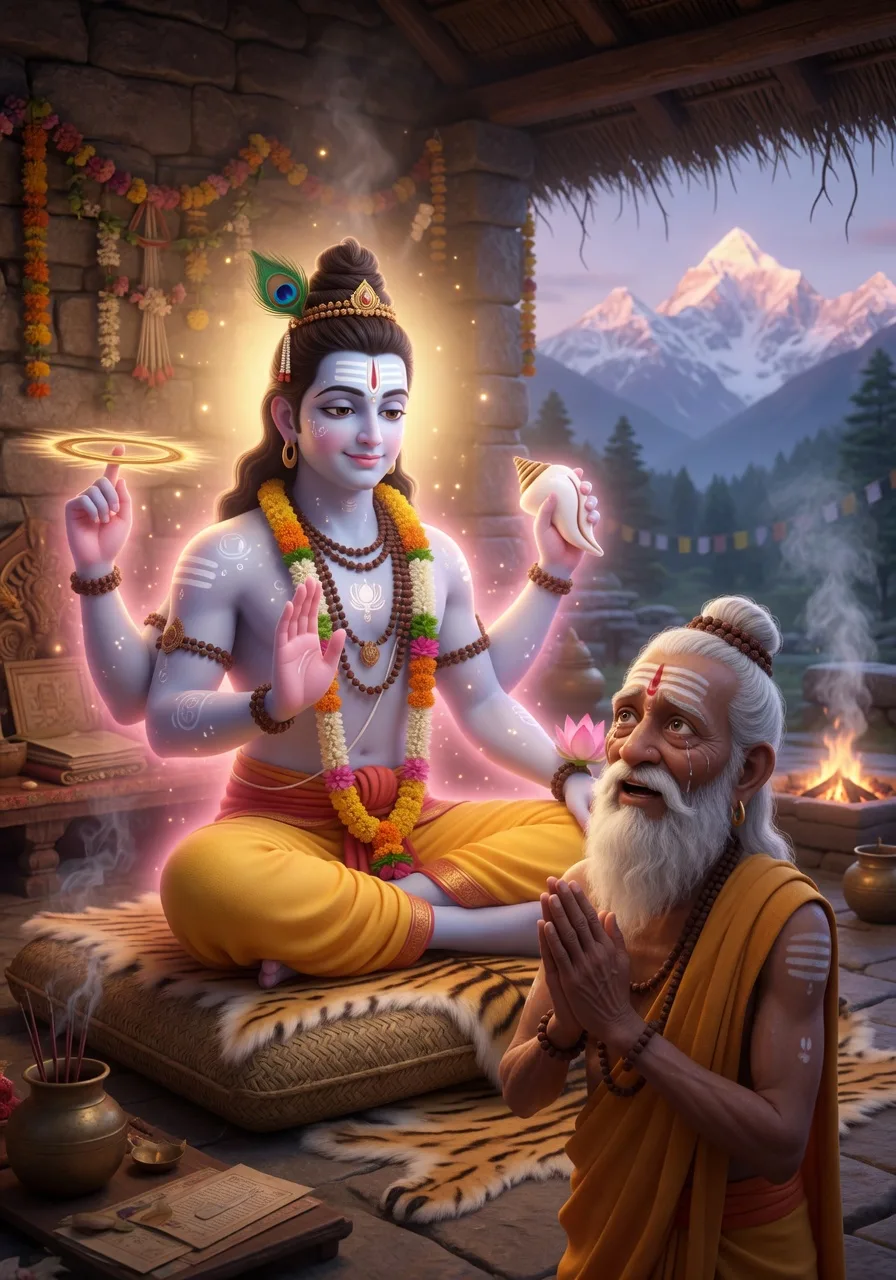
Yet a devotee may still have a request, not for his own pleasure but out of sheer wonder at the Lord. So Markandeya asked for something almost no one asks for. He wished to see the Lord's illusory potency, his Maya, the power under whose influence the whole world, and even the demigods who rule it, take this endlessly varied material reality to be the final truth. Very few devotees ever want to see Maya at all. Markandeya was curious, and he asked. The Lord, present as Nara-Narayana, answered simply, "So be it," and departed for his abode at Badari.
The waters of devastation
Now the sage was in for the journey of many lifetimes. Holding always to his wish to see the Lord's illusory energy, Markandeya stayed in his hermitage in constant meditation. Sometimes the waves of love for the Lord rose so high in him that he forgot to perform his regular worship at all.
One day, as he was offering his evening worship on the banks of the river Pushpabhadra, a great wind rose out of nowhere. Fearsome clouds gathered with lightning and rolling thunder, and heavy rain crashed down on every side. The four great oceans rose and swallowed the surface of the earth, and in those waters moved terrible sea monsters, fearful whirlpools, and a low ominous rumbling. The sage watched every being in the universe, himself among them, tormented by the rising flood, and he grew bewildered and afraid as the water of devastation drowned the three worlds.
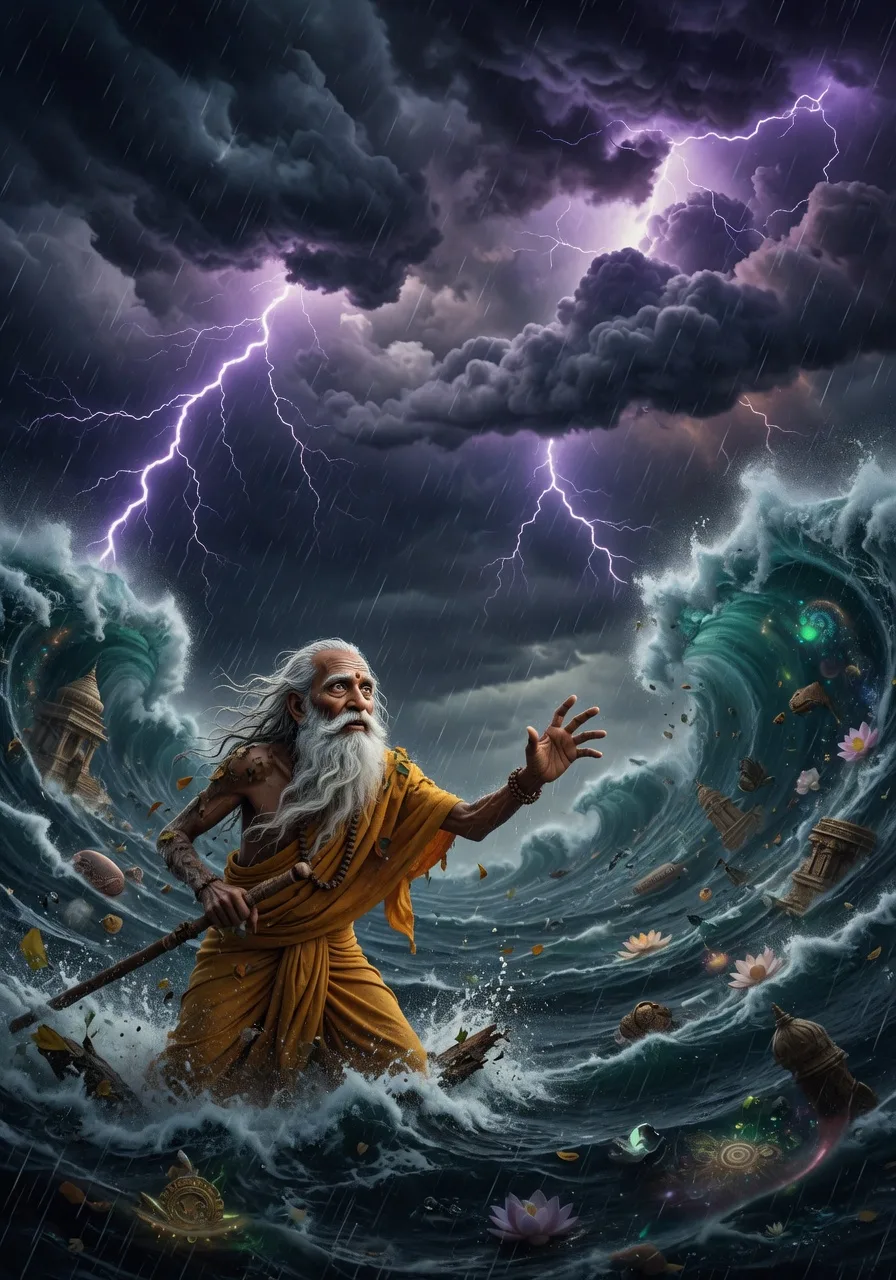
For countless millions of years Markandeya moved about, utterly alone, in that endless water. This was the beginning of the very thing he had asked to see. Maya had come, and the Lord was showing it to him through his own power of annihilation, the dissolution that ends a day of creation.
The infant on the banyan leaf
Once, wandering across the waters, the sage came upon a small island, and on it stood a young banyan tree heavy with blossoms and fruit. On one branch of that tree, cradled within a single leaf, lay an infant boy, and the light of his body was swallowing up the surrounding darkness.
The scripture lingers over the child, and it is worth lingering too. His complexion was a deep blue, the colour of a flawless emerald. His lotus face shone with a wealth of beauty. The lines on his throat were like the marks on a conch shell. He had a broad chest, a finely shaped nose, lovely eyebrows, and ears that curved like pomegranate flowers. The corners of his eyes were reddish, like the whorl at the centre of a lotus, and his coral lips lent a faint red glow to a smile that poured out nectar. As he breathed, his fine hair trembled, and the soft folds of skin moved on his small belly. Then, with his graceful fingers, the infant took hold of one of his own lotus feet, drew a toe into his mouth, and began to suck it.
As Markandeya looked on the child, every trace of his weariness fell away. So great was his joy that the lotus of his heart opened wide along with his lotus eyes, and the hairs of his body stood on end. Unsure who this wonderful infant could be, the sage drew near.
It is worth pausing on how he came to this. Markandeya reached the Lord entirely from within, in his own heart, through nothing but his devotion and the focus of his meditation. The ancient sages had none of the means we now take for granted, no easy flood of information at their fingertips, and still they attained a peace and a nearness to the Lord that few of us touch. Where there is real bhakti, the Lord himself supplies whatever knowledge the devotee needs.
The universe inside the child
Just then the infant inhaled, and on that breath he drew the sage into his own body, as easily as a breath might draw in a mosquito. Inside, Markandeya was astonished to see the entire universe standing exactly as it had been before the annihilation, whole and unharmed. He saw the sky and the heavens and the earth, the stars, the mountains, the oceans, the great islands and continents stretching in every direction. He saw the living beings, the forests and countries, the rivers, cities, mines, villages, and cow pastures, and the daily and spiritual duties of the various divisions of society. He saw the basic elements of creation with all that comes from them, the whole universal form, and he saw time itself, the force that turns the ages within the long days of Brahma. He saw the Himalayan mountains, the river Pushpabhadra, and his own hermitage standing just as he had left it.
And as he beheld all of this, the infant exhaled, and the breath carried the sage back out of his body and cast him once more into the ocean of dissolution.
The smile, and the way home
There in the water he saw it all again, the banyan tree on its little island and the infant lying within the leaf. The child turned and glanced at him from the corner of his eyes, with a smile soaked in the nectar of love, and through his eyes Markandeya took that child into his heart. But when the sage ran forward to embrace him, the Lord vanished from sight. In the same instant the banyan tree, the vast water, and the whole dissolution of the universe vanished as well, and Markandeya found himself sitting in his own hermitage, exactly as before, as though none of it had happened.
We make this journey too, in our own small way, through the eyes of the Bhagavatam. For Markandeya it stretched across millions of years in the drowning waters, and it must have been a terror to live through, yet he had asked to see it, and the Lord saw his wish fulfilled and then gently set him back where he began.
What the vision teaches
A few things stand out from this strange and tender chapter.
The first is that the Lord honours a devotee's pure desire even when it is hard. Markandeya wanted to understand Maya, and the Lord did not merely describe it to him but walked him through the end of the world to show it, and kept him safe the whole way. The flood that would have ended any other being could not touch the one who had taken shelter in the Lord.
The second is the form the Lord chose. He did not appear here as the four-armed Narayana the sage expected, but as a tiny child sucking his toe on a leaf, glowing in the middle of universal ruin. The description matches Krishna himself, and yet even a sage as great as Markandeya could not place who the infant was, because no one expects to meet the Supreme Lord as a baby, least of all amid the waters of dissolution. There is a deep tenderness in that choice. The same Lord who holds the whole universe inside one breath is willing to meet his devotee as something small enough to love without fear.
Key terms from this lesson
| Term | Meaning |
|---|---|
| Markandeya | a deathless sage who asked to see the Lord's illusory energy |
| Maya | the Lord's illusory potency that makes the material world seem the final reality |
| Nara-Narayana | the Lord's form as the friend of man, who appears to Markandeya |
| Pralaya | the dissolution of the universe, the cosmic flood Markandeya witnesses |
| Banyan leaf | where the infant Lord rests upon the waters of devastation |
| Universal form | the entire cosmos that Markandeya sees within the body of the child |
| Six Manus | the vast span of cosmic ages through which Markandeya lives |
What to carry forward
- Markandeya, a deathless sage, wanted nothing for himself and asked only to keep seeing the Lord, then made one bold request, to behold the Lord's Maya.
- The Lord granted it by sending the flood of dissolution, in which the sage wandered alone for millions of years, kept safe through it all.
- On the waters he found an infant Lord glowing on a banyan leaf, sucking his toe, and every weariness left him.
- Drawn in on the child's breath, he saw the whole universe restored within him, including time itself.
- Exhaled back out, then granted a last loving glance, he reached to embrace the Lord and woke in his own hermitage.
- The Lord honours a devotee's sincere wish, and the soul sheltered in him is untouched even by the end of the world.
- The Supreme Lord who contains all universes will still meet his devotee as a small child, intimate and without fear.
Previous lesson: ← Values and culture
Next lesson: Gaumata, the sacred cow →
Back to the full course index.
Frequently Asked Questions
Independent writer, jaapak.com
I built the Jaapak app. I write in simple Hindi on the Bhagavad Gita and the satsang tradition — so seekers don't struggle with the scripture.
Read all articlesAbout this article
The commentary is based on the general understanding of the Sanatan tradition and written in accessible language. No verbatim quotation of any modern commentator is used.