Is There a God? Ishvara, Atheist Arguments & the Six Opulences of Bhagavan
The Sanatana Dharma answer to 'is there a God': the common atheist arguments and their replies, the case for a creator, the Gita's definition of God, the six
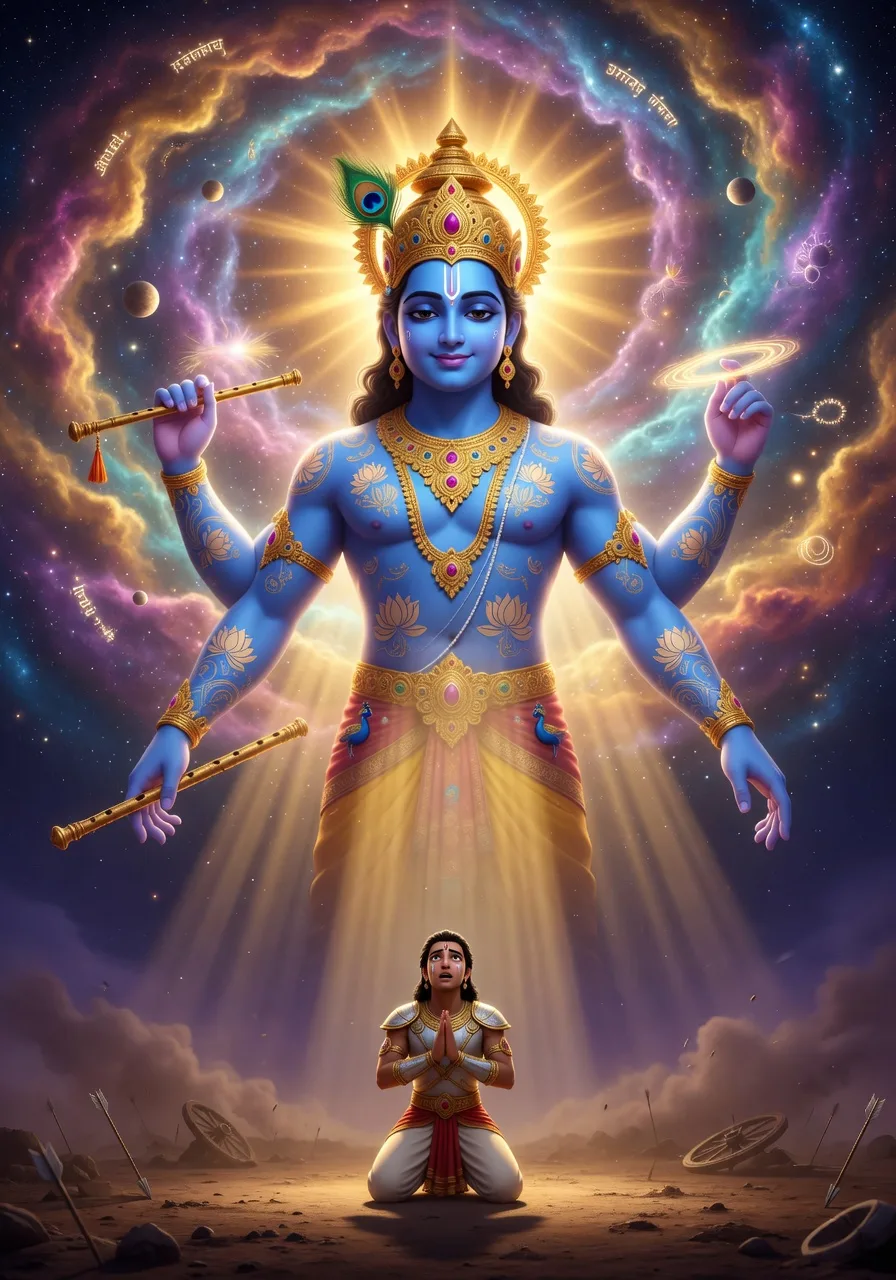
Most people in a temple already believe in God. So why test the question at all? Because faith built only on feeling is easy to shake. This lesson walks through the arguments atheists raise, answers each one from reason and from the Bhagavad Gita, builds the positive case for a creator, and then gives the scriptures' own definition of God, ending with the test for telling a real avatar from the many who claim the title. Sharpen this and you steady not only your own faith but other people's, and the Lord prizes that work. Krishna says no one is dearer to him than the one who explains this secret of God to his devotees.
What do atheists argue, and do the arguments hold?
The modern case against God rests on a few claims. Each one looks solid until you push on it.
| The atheist argument | The reply |
|---|---|
| "The universe came from nothing. Nothing is unstable, so something had to appear." | This barely makes sense. Instability in "nothing" is already smuggling in a law and a cause. |
| "We can't see God, so he does not exist." (Krishna describes this mind in Gita 16.8) | Our senses are tiny. You cannot see past the wall behind you either, yet the room beyond it is real. |
| "Everything happened by chance." (the Big Bang) | Even leading scientists doubt this. See below. |
| "We have explained every phenomenon, so there is no need for God." (Gita 16.9) | Explaining how a tsunami follows an earthquake does not explain who set the laws in motion. |
| "If God exists, why is there so much suffering?" | A fair question with a real answer. See the barber below. |
| "God was invented to scare people into being moral." | Then examine the claim honestly rather than assume it. |
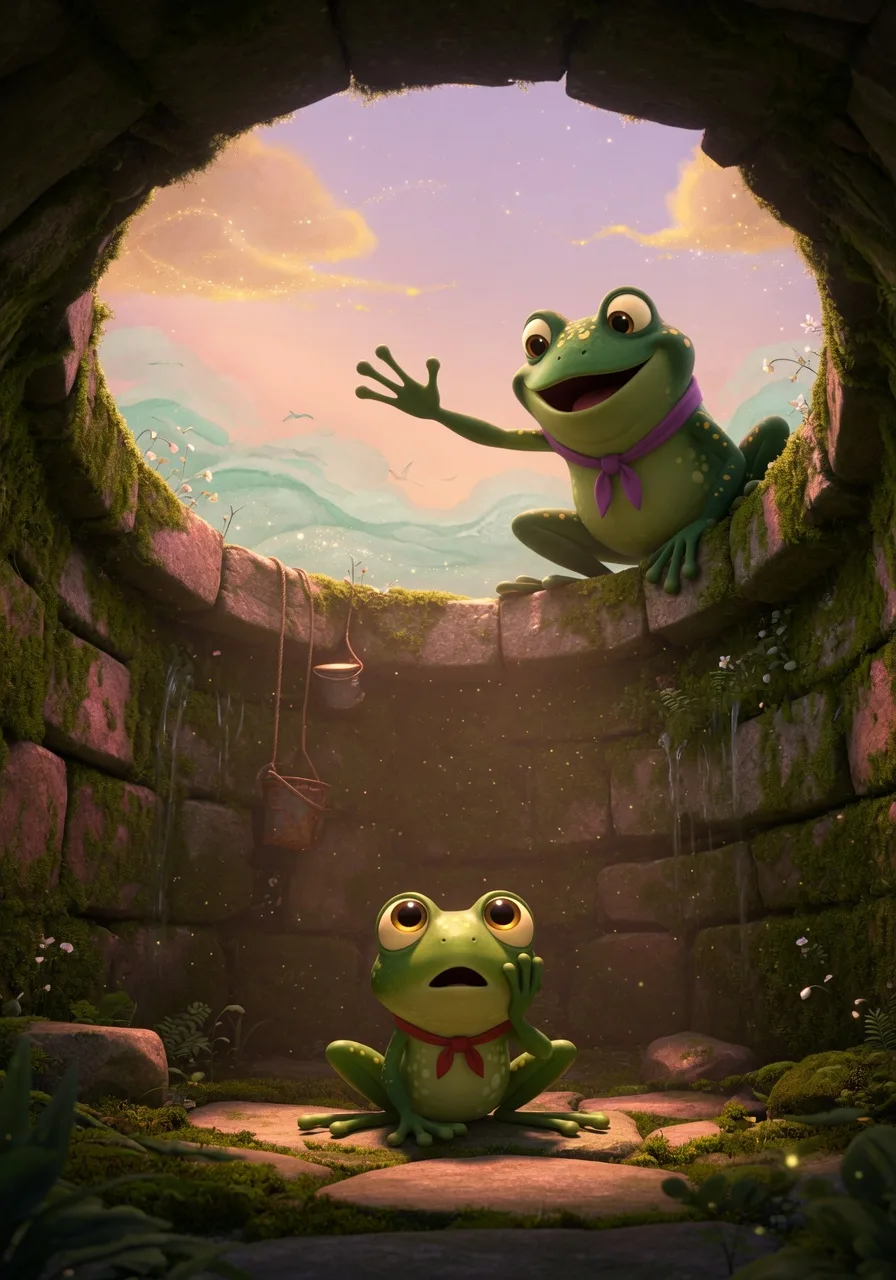
Are we the frog in the well?
A frog who lived in a well met a frog from the ocean. "How big is your water?" asked the well-frog. "Enormous," said the ocean-frog. "Ten times this well? A hundred times?" "Millions of times bigger." The well-frog simply could not believe it. We are often that well-frog. We cannot see past our small existence, so something far greater feels impossible. That limit is in us, not in the truth.
What do the scientists themselves say about "chance"?
The "everything by chance" story has loud doubters inside science.
- Jacques Monod, the Nobel-winning French biologist, wrote that everything in the universe is "the fruit of chance and necessity," and that "a totally blind process can by definition lead to anything, it can even lead to vision itself." The logic collapses on itself.
- Charles Darwin built the theory of evolution, yet in a letter he admitted, "To suppose that the eye could be formed by natural selection seems, I freely confess, absurd in the highest degree."
- Fred Hoyle, the astronomer who coined the phrase "Big Bang" as a mockery, said the chance of life arising on its own is like "throwing a six on dice five million times in a row," or like "a tornado tearing through a junkyard and assembling a Boeing 747." It does not happen.
If God exists, why is there suffering?
A man in a Calcutta barber shop argued there is no God, because a real God would not allow suffering. Later the barber pointed to people in the street with long, unkempt hair and beards and said, "There are no barbers in this world." The man objected, "But you are a barber." The barber smiled. "Exactly. There are barbers, but those men never came for a haircut. In the same way there is a God, but people do not approach him, and that is why there is suffering."
The tennis champion Arthur Ashe, the first Black man to win Wimbledon, fell gravely ill and was asked whether he blamed God: why pick you for this disease? He answered with a count. Fifty million children start playing tennis, five million learn it well, half a million turn professional, fifty thousand reach the circuit, five thousand reach a Grand Slam, fifty reach Wimbledon, four reach the semifinal, two the final. "When I held that cup, I never asked God, 'Why me?' So today, in my pain, I will not ask God, 'Why me?'" The soul, in truth, never suffers. Approach God and the suffering shows itself as temporary.
What is the positive case for a creator?
Tearing down weak arguments is only half the work. The stronger half is simple.
Creation points to a creator. Leonardo did not throw paint at a canvas and find the Mona Lisa staring back. Every painting has a painter, every building a builder, every car a maker. Look at the order in a single living cell, in the atom, in the cosmos. Where there are laws, there is a law-maker. Order does not arrange itself.
Newton made the point with a model. He once built a beautiful replica of the solar system. A colleague asked who made it. "No one," Newton joked, "the parts simply came together." The colleague refused to believe it. Newton then said the real lesson: if a small model demands a maker, how much more does the real solar system. His own words: "This most beautiful system of the sun, planets, and comets could only proceed from the counsel and dominion of an intelligent and powerful Being."
Even an atheist feels the doubt. Stephen Hawking wrote that the universe "is not arbitrary at all, but obeys certain well-defined laws," and that "it seems reasonable to suppose there may be some unifying principle." The order keeps pulling honest minds back toward a hand behind it.
You see the beads, not the thread. Krishna says in the Gita (7.7), "O conqueror of wealth, there is no truth superior to me. Everything rests upon me, as pearls strung on a thread." You see the pearls beautifully arranged and never notice the thread holding them. You do not see God's hand behind creation. That is not proof it is missing.
And the urge to worship never leaves us. There is always a tendency to worship something. In an age of phones and selfies, the easiest object of worship becomes the self. Only a willing, steady worship of God turns that urge outward where it belongs.
So what exactly is God?
People define God in many ways, and several are true as far as they go. God is light, the effulgence of the spiritual sky. God is force. God is everything. Even "you and I are God" holds a grain of truth, since each of us is a tiny controller, though never the ultimate one.
The Bhagavad Gita gives a precise definition across several verses:
| God is... | Reference |
|---|---|
| The source of the spiritual and material worlds | Gita 10.8 |
| Complete in himself | Gita 10.12 |
| The supreme controller | Gita 18.61 |
| The supreme proprietor and enjoyer | Gita 5.29 |
| All-knowing (omniscient) | (the Gita throughout) |
The Vishnu Purana sharpens this into a single word, Bhagavan, defined by six opulences held in full:
| The six opulences of Bhagavan |
|-------------------------------|
| Full wealth |
| Full strength |
| Full fame |
| Full beauty |
| Full knowledge |
| Full renunciation |
Anyone who claims to be God can be measured against this list. Most claims fall away at once.
Krishna does something rare. He openly declares his own divinity in the Gita. Usually God hides it. Ram came as an ordinary man, and only his deeds and the scriptures reveal the supreme Lord behind him. For the dark age of Kali, Krishna left no doubt. Arjuna affirms it too (Gita 10.12), and so do the great sages led by Narada Muni.
One God, or many gods?
Both, read correctly. There is one God with a capital G, and many gods with a small g, the demigods or devatas (Gita 10.2). Picture a country. A queen appoints a prime minister, who appoints a cabinet for the treasury, defence, and the home office. To run the whole universe, the supreme Lord appoints his "prime minister," Brahma, in charge of creation, and many officers under him: the sun-god, the moon-god, Indra for the rain. These are posts, filled by the most capable beings in the universe and appointed to keep order on the Lord's behalf.
Who are Brahma, Vishnu and Shiva?
The Trimurti are not three equal Gods.
- Vishnu is the Supreme Personality of Godhead, an expansion of Krishna. (If you hold Krishna to be an expansion of Vishnu instead, no quarrel. Both are the one Supreme, in different forms.)
- Brahma is a jiva, an ordinary living entity raised to the highest post in the universe. Any soul can in principle reach the office of Brahma, though it takes enormous spiritual merit.
- Shiva stands in a category of his own. When Vishnu wishes to touch this material world, especially for the work of destruction, he transforms into Shiva. No jiva can ever become Shiva. The position is unique. Vishnu has no direct contact with the material world otherwise, so he takes the form of Shiva to act within it. Shiva and Vishnu are therefore very close and yet distinct.
Brahma himself, the topmost living being, sings the verdict in the Brahma Samhita: Ishvarah paramah Krishnah sac-cid-ananda-vigrahah, anadir adir govindah sarva-karana-karanam. Krishna, known as Govinda, is the Supreme Godhead, with an eternal and blissful spiritual body, the origin of all, himself without origin, the cause of all causes.
How do you tell a real avatar from a fake?
In Bharat there is almost an "incarnation of God" on every street corner. The scriptures give clear tests, and a genuine avatar meets them.
- Predicted in scripture, in advance. Kalki is foretold for the end of Kali Yuga. Buddha was foretold and has come. Krishna and Chaitanya Mahaprabhu were foretold. The Padma Purana names Chaitanya directly: Kaler prathama-sandhyayam, gaurango mahitale, bhagirathi-tate ramye, bhavishyami sachi-sutah, "I shall take birth as the son of Sachi, in a golden form, on the bank of the Bhagirathi Ganga, in the first part of Kali Yuga." Fifty or sixty such references point to this hidden incarnation, who appeared just over 500 years ago.
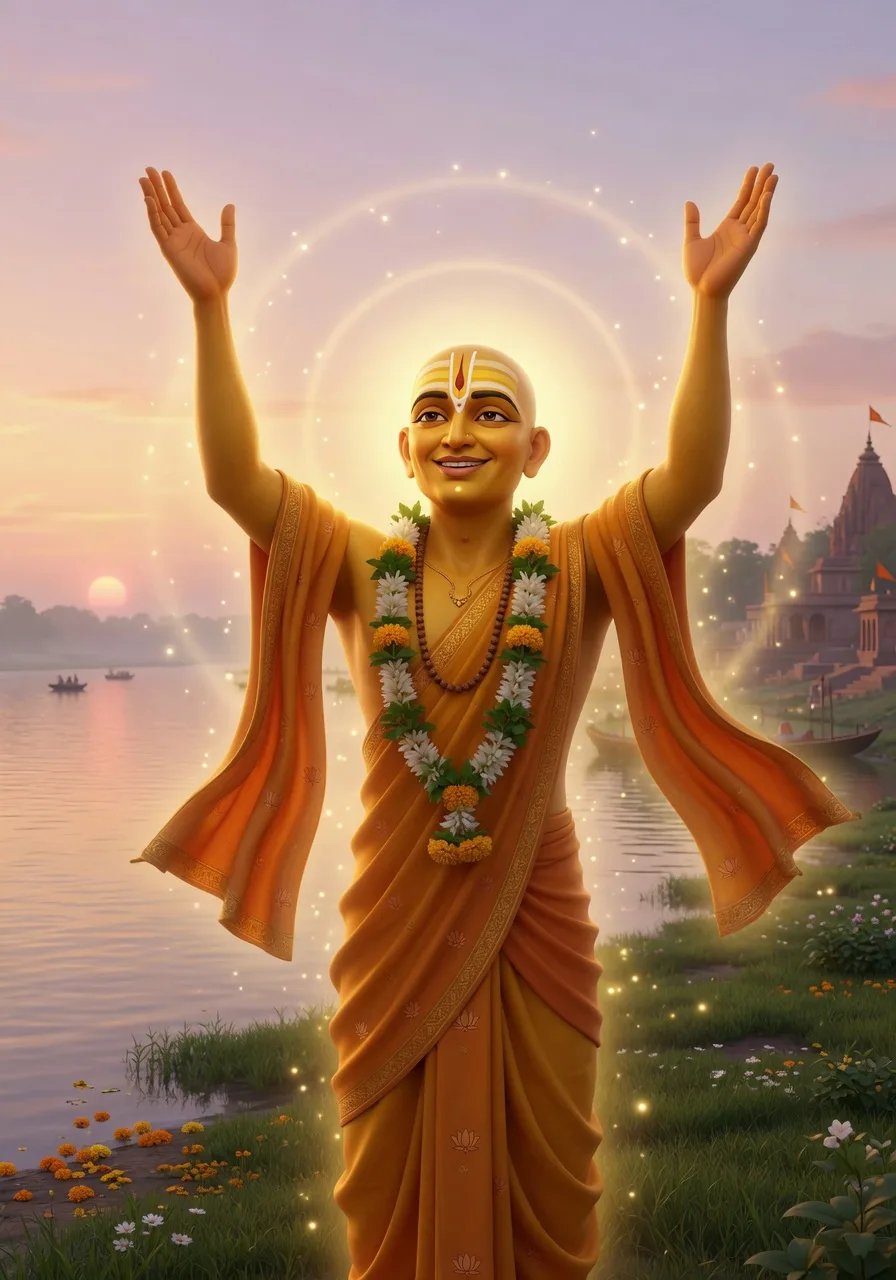
- Extraordinary pastimes that attract everyone, like Krishna lifting Govardhan Hill.
- Divine knowledge given, as Krishna gave the Bhagavad Gita.
- The universal form (Virat Roop) on request. Krishna showed it to Arjuna when asked. A street-corner "avatar" cannot. Nobody can, except the supreme Lord.
- A real mission. A true avatar descends with a purpose, not to relax and exploit the simplicity of followers.
- Marks on the body, special symbols on the palms and soles, as the holy books describe of Krishna's lotus feet.
The Srimad Bhagavatam settles the source: Krishnas tu Bhagavan svayam. Krishna is the origin of all the avatars, God himself.
Is Krishna only a Hindu God?
No. "Krishna" is one name of the one supreme Lord, and the same Lord answers to Allah and to Christ. One God, known by different names, the way water carries a different word in every language. Krishna means all-attractive. Allah means all-powerful. Ask whether Allah is also all-attractive, and the answer is yes, so the same God may rightly be called Krishna. What we must not do is confuse the Lord with his demigods, who are his powerful servants and his devotees. We respect them, and we keep them in their place. The name Krishna holds every quality of God in full, the highest conception, as the Brahma Samhita describes.
Key terms from this lesson
| Term | Meaning |
|---|---|
| Ishvara | God, the supreme controller |
| Bhagavan | God defined by six full opulences: wealth, strength, fame, beauty, knowledge, renunciation |
| Devata | A demigod; an empowered officer running part of the universe |
| Trimurti | Brahma, Vishnu, Shiva |
| Virat Roop | The universal form, which only the supreme Lord can display |
| Avatar | A descent of God; a real one meets the scriptural tests |
| Krishnas tu Bhagavan svayam | "Krishna is God himself," the source of all avatars |
| Chaitanya Mahaprabhu | The golden avatar foretold in the Padma Purana, appeared ~500 years ago |
What to carry forward
- Atheist arguments sound strong until tested. Test them, and your faith stops being mere sentiment.
- We are often the frog in the well, unable to picture the ocean.
- Order needs a law-maker. Even Newton and a doubting Hawking felt the pull.
- God is defined by six full opulences, the mark of Bhagavan.
- One God, many devatas. Brahma is a post a jiva can reach; Shiva's position no jiva can.
- A true avatar is foretold in scripture, shows the universal form, and comes with a mission.
- Krishna, Allah, Christ, one God by many names.
- Do not aim for the heavens. Aim past them, by serving the Lord.
Previous lesson: ← The Vedic conception of time
Next lesson: Who are we? The atma →
Back to the full course index.
Frequently Asked Questions
Independent writer, jaapak.com
I built the Jaapak app. I write in simple Hindi on the Bhagavad Gita and the satsang tradition — so seekers don't struggle with the scripture.
Read all articlesAbout this article
The commentary is based on the general understanding of the Sanatan tradition and written in accessible language. No verbatim quotation of any modern commentator is used.