The Glories of Srimad Bhagavatam: The Final Chapter
Srimad Bhagavatam, Canto 12, Chapter 13: the concluding chapter on the glories of the Bhagavatam, the eighteen Puranas and their verse counts, why the
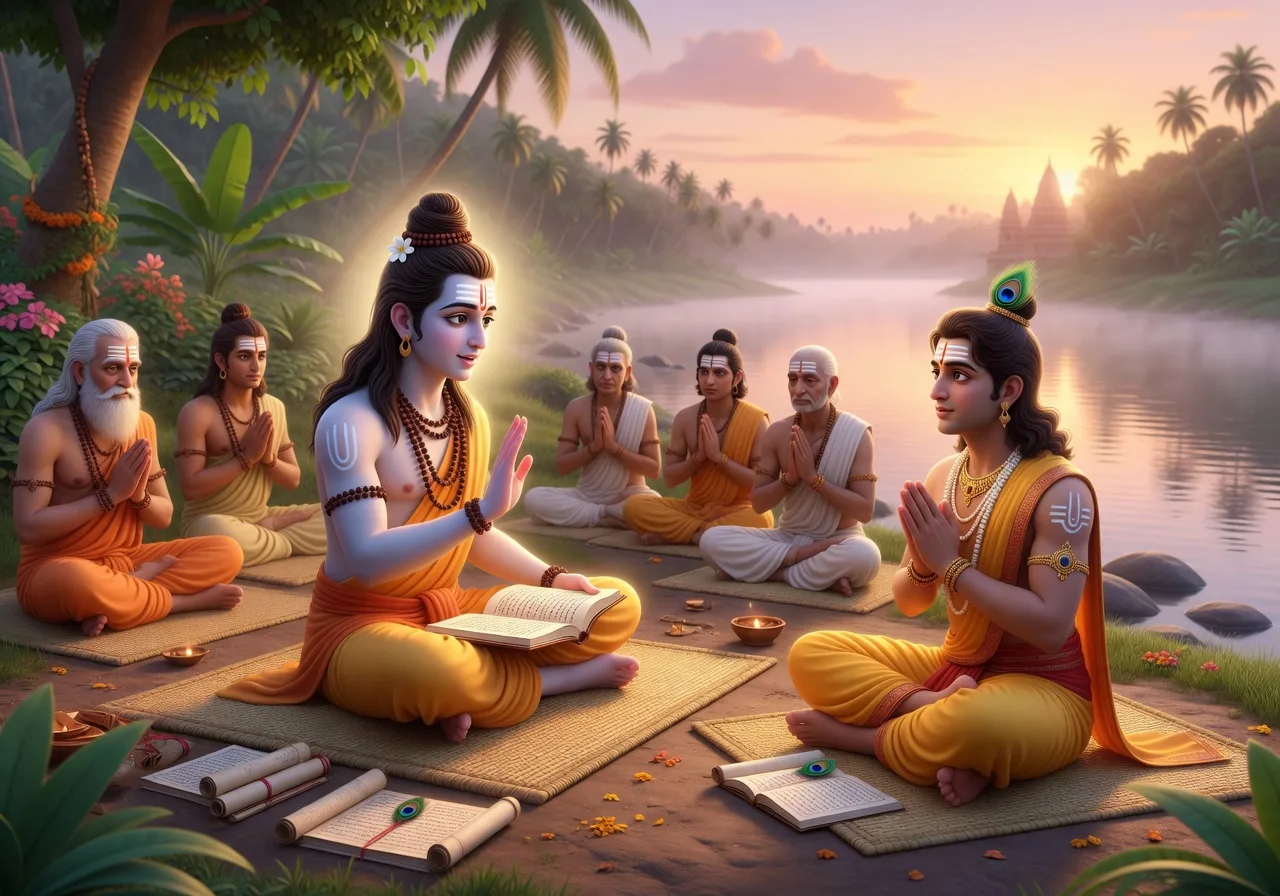
We come now to the very last chapter of the Srimad Bhagavatam, the thirteenth of the twelfth canto. It is a short chapter, and it does what a closing chapter should. It steps back and tells us what the whole book has been, where it stands among the scriptures, how to give it as a gift, and what comes to the one who hears it and chants it. This lesson follows that ending, and in doing so it gathers up the whole of the Bhagavatam.
Lord Kurma's sleep, and the breathing of the ocean
The chapter opens with a benediction, and it is a strange and lovely one. Suta Goswami bows to the Lord whom Brahma, Varuna, Indra, Rudra, and the Maruts praise with hymns and Vedic recitation, and he recalls a small detail from the churning of the ocean. When the Lord came as Kurma, the tortoise, to bear the great Mandara mountain on his back, the sharp stones of that whirling mountain scratched his shell, and the scratching made him drowsy. There is a tenderness in the picture. The Lord took that form partly because of an itch that needed relief, and the churning, turned by the demigods and demons, scratched his back so pleasantly that he grew sleepy.
The blessing is that we be protected by the very winds of the Lord's breathing as he dozed. And there is a thread from that moment to this one, for ever since, the tides of the ocean have imitated the Lord's slow inhaling and exhaling, coming in and going out. When you hear the waves roll in and slide back, so soothing that people fall asleep to the sound, you are hearing an echo of the Lord breathing in his rest.

The eighteen Puranas, and why this one is enough
Suta Goswami then sets out the size of each of the Puranas, because the question naturally arises, must one read them all? There are eighteen, and together they hold four hundred thousand verses.
| Purana | Verses (approx.) |
|---|---|
| Brahma | 10,000 |
| Padma | 55,000 |
| Vishnu | 23,000 |
| Shiva | 24,000 |
| Srimad Bhagavatam | 18,000 |
| Agni | 15,400 |
| Brahma-vaivarta | 18,000 (rich in Krishna's pastimes) |
| Linga | 11,000 |
| Varaha | 24,000 |
| Skanda | 81,000 |
| Markandeya | 9,000 |
| Kurma | 17,000 |
| Garuda | 19,000 |
| Brahmanda | 12,000 |
The answer to the question is freeing. The one to read is the one we have just been through. The Srimad Bhagavatam is the summary of the whole of the Vedas and of all the Puranas, the one Purana untouched by the three modes of nature, wholly transcendental, fixed in pure devotion and standing outside the pull of the gunas. This is why a devotee can rest with the Bhagavatam and not worry about the rest, because this one book contains everything the others hold.
What the Srimad Bhagavatam is
The book has a beginning we have already met. Narayana spoke it to Brahma when Brahma, frightened by the vastness of material existence, sat upon the lotus that had grown from the Lord's navel. From its first line to its last, the Srimad Bhagavatam does two things at once. It turns the heart away from material life, and it pours out nectarean accounts of the pastimes of Lord Hari, accounts that bring ecstasy to saints and demigods alike.
It is called the essence of all Vedanta philosophy, because its subject is the Absolute Truth, the one reality without a second. And here is a subtle point worth holding. That Absolute Truth is not wholly other than us, since we too are spirit and the Truth is spirit. The difference is one of scale and standing. The Absolute Truth is unlimited and independent, while we are small, limited, and dependent on him. The goal the Bhagavatam sets is the one thing that marks it off from every other scripture: not liberation alone, not knowledge alone, but exclusive loving devotional service to that Supreme Truth.
Why it is called the spotless Purana
The chapter does not hold back in praising the book. As long as that great ocean of nectar, the Bhagavatam, has not yet been heard, the other Puranic scriptures shine in the assembly of devotees, but once a person has tasted the mellows of the Bhagavatam, no other literature can pull at them again. The chapter gives a row of comparisons to fix its rank.
Just as the Ganga is the greatest of all rivers, Lord Vishnu the supreme among deities, and Lord Shambhu the greatest of Vaishnavas, so the Srimad Bhagavatam is the greatest of all the Puranas. (Srimad Bhagavatam 12.13)
It is the spotless Purana, dearest of all to the devotees of the Lord. It reveals the pure, supreme knowledge that belongs properly to the paramahamsas, the topmost swanlike souls, and yet here that knowledge sits within our reach, which is no small wonder. It lays open the way to become free from the reactions of all material work, a way woven of knowledge, renunciation, and devotion together. Whoever seriously tries to understand it, who hears it rightly and chants it with love, becomes completely free.
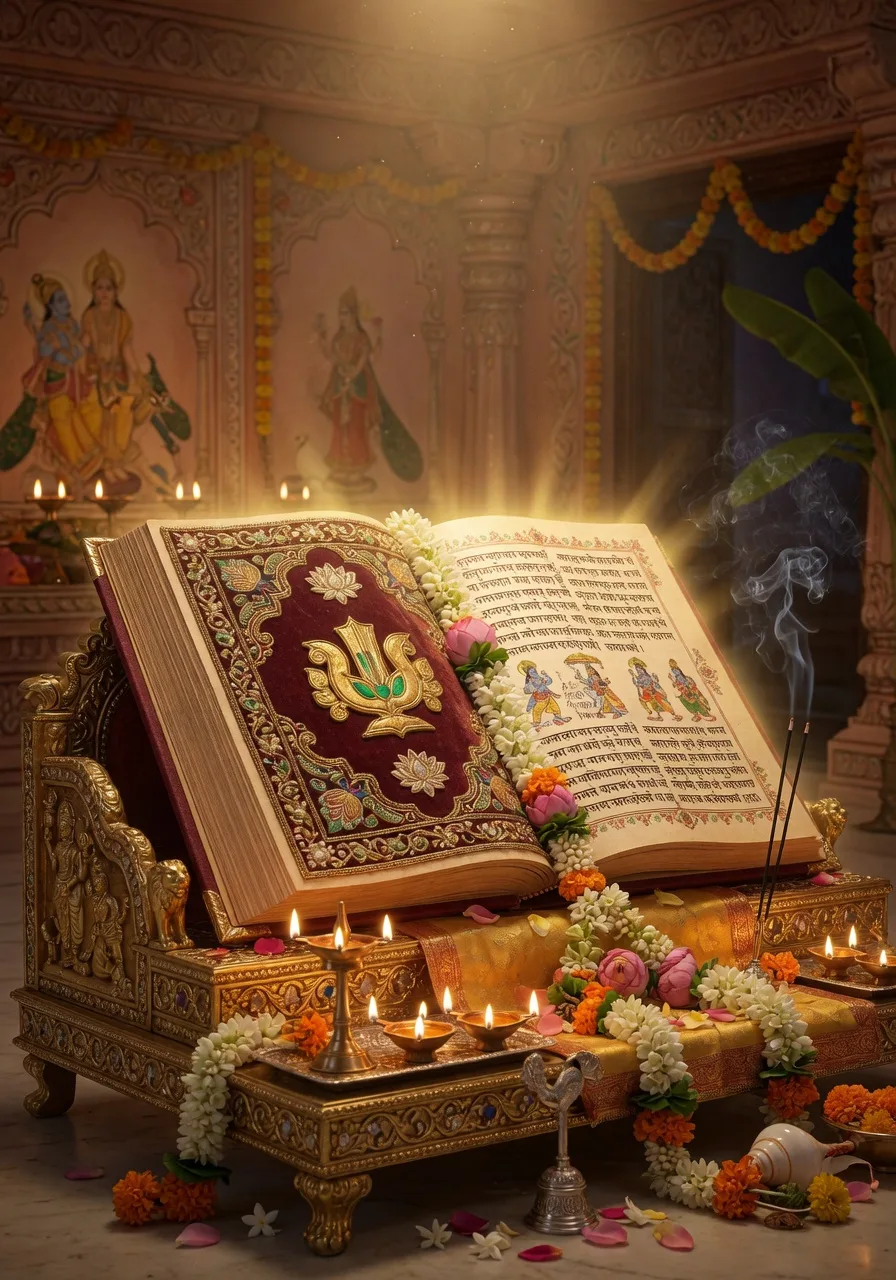
For this reason the chapter gives a precise instruction on offering the book. If, on the full moon day of the month of Bhadra, a person sets the Srimad Bhagavatam on a golden throne and gives it away as a gift, they reach the supreme transcendental destination (Srimad Bhagavatam 12.13.13). That full moon is the appearance day of Lord Balarama, and it is held to be the finest day of the year to share this scripture.
The chain that carried it down
A scripture is only as trustworthy as the line of teachers who hand it on, and the Bhagavatam names its own. It came down unbroken from the Lord himself.
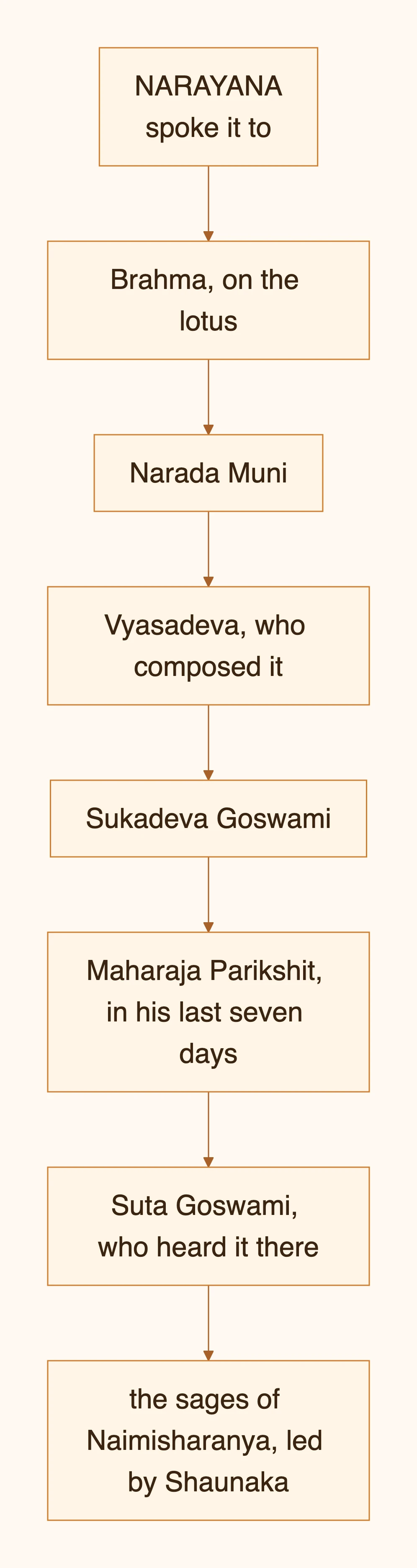
Having glorified the book, Suta Goswami turns to meditate on Lord Narayana as the original Absolute Truth, perfectly pure, free of all sorrow, and deathless. Then he bows to his own guru, Sukadeva Goswami, the greatest of yogis, and calls him non-different from the Absolute Truth. The line puzzles at first. How can a teacher be non-different from God? The answer is the same one the tradition gives for the guru everywhere. As the guru is non-different from the Supreme Lord in his function of carrying the Lord's word and mercy, so Sukadeva is non-different from Krishna. They are distinct persons and yet one in this, the truth the philosophers call being one and different at the same time. At the close Suta Goswami offers his respects, with full devotion, to the Supreme Person, Lord Sri Hari, who takes away every misery.
How the Bhagavatam came to be written
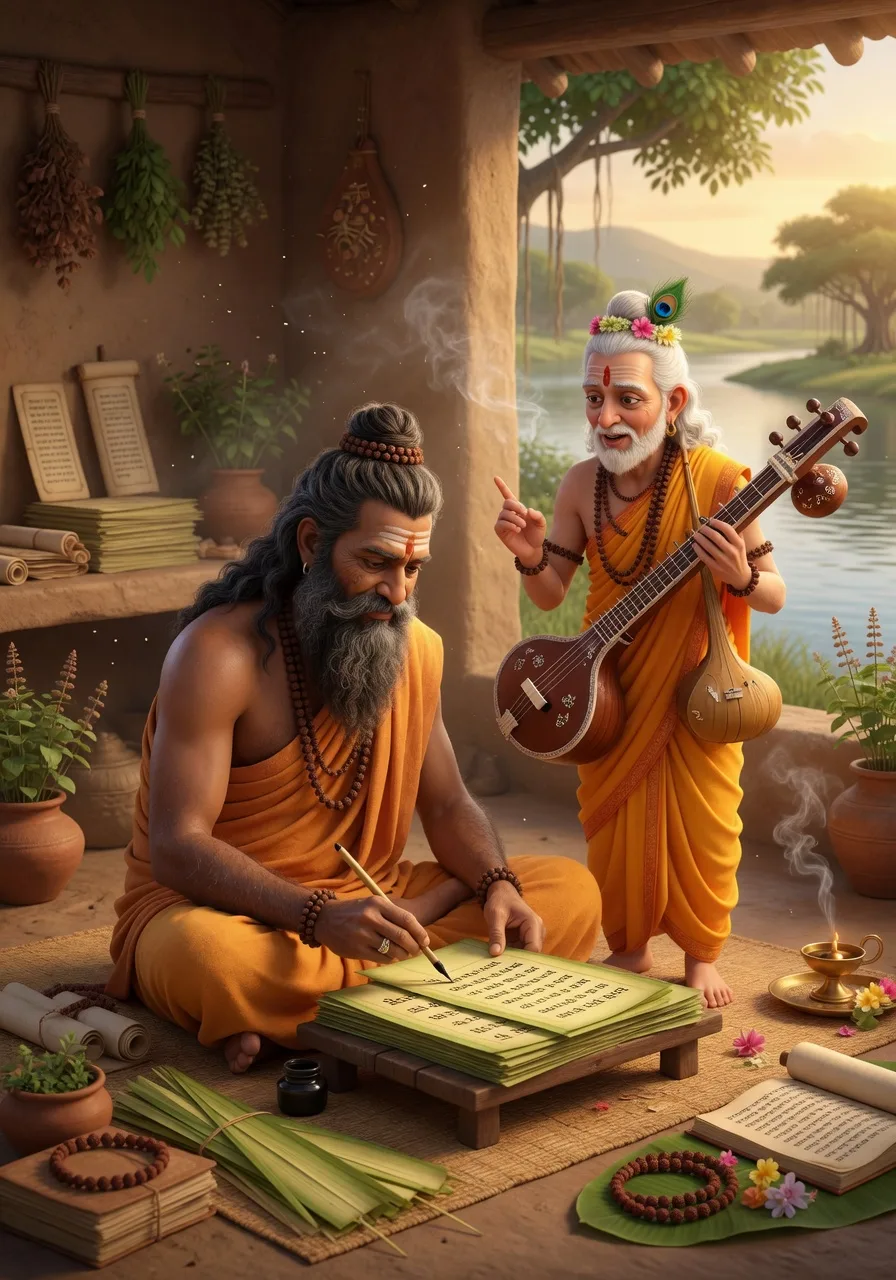
There is a human story behind the book, and it is worth telling. Vyasadeva had already written the Vedas, divided them, and composed the many Puranas and Upanishads, an output beyond imagining. And still he sat in despair, hollow and unsatisfied, not knowing why. It was Narada Muni who named the lack. For all that Vyasa had written, he had not yet truly glorified Krishna. So Vyasa took up his pen once more and wrote the Srimad Bhagavatam, and he gave a great part of it to Krishna directly, a full ninety chapters of the tenth canto to Krishna alone, with most of the other cantos turning toward him as well.
The book reached us through one more grace. When Maharaja Parikshit was cursed to die in seven days, he sat down on the bank of the Ganga and asked the one question that matters, what a person about to die should do. Sukadeva Goswami answered him with the whole Bhagavatam, and because Parikshit asked, we have it. The king drank it in for hours each day, returning again and again to the pastimes of Dhruva Maharaja. What the Lord first gave Brahma as four short verses was unfolded, through this chain, into the vast and tender narration we hold today.
The Bhagavatam as the body of the Lord
There is a beautiful way to picture the whole work. The Srimad Bhagavatam is compared to the body of Lord Krishna, the early cantos his legs and thighs, the middle ones his abdomen and chest, the later ones his arms, his face, his brows. And this gives the right way to read it. When we take darshan of the Lord in the temple, we are taught to begin at his feet and let the eyes travel slowly upward. The Bhagavatam asks for the same patience. Many readers leap straight to the tenth canto for the sweet pastimes of Krishna, but the proper path is to begin at the first canto and the second, the feet, and to climb from there. Read in order, the book carries you up the body of the Lord himself.
And read it fully. The Bhagavatam is among the rarest of scriptures, sought for years by those who longed for a true copy, and because it now sits so easily at our fingertips we are tempted to take it lightly, which is the one mistake to avoid. Read not only the translations but the purports as well, where most of the meaning waits.
What the devotees carried away
When the long study of the Bhagavatam ended, those who had heard it spoke of what had lodged in their hearts, and their answers are a lesson of their own.
One returned again and again to Vritrasura. Though he knew he was about to die, and though it took Indra a full year to bring him down, he never stopped thinking of the Lord for an instant. That is the example to hold, to stay fixed on the Lord with full faith even in the face of death.
Another carried away the story of Markandeya, the deathless sage, struck by how he lived through the flood of dissolution and survived on the love the Lord showed him. And more than any single tale, several felt how every canto, chapter, and verse circles back to the same one thing, loving service to Krishna, until it settles in the mind that this is the highest and nothing can compare to him. Another said the lectures had turned a childhood of ritual into understanding, that going to the temple on Shivaratri or lighting lamps at Diwali was no longer blind habit but made sense at last, once it was clear who the Supreme Lord is and who the demigods are. Faith is not meant to be sentiment followed in the dark. It is meant to be known.
Others spoke of small wonders from the book, of how even Lord Shiva instructs his devotees to worship Krishna as the Supreme, and of a curious pastime in which Krishna, to keep Shiva from fighting on, simply made him yawn. And one, near the end, spoke only of longing, of waiting through the daily chanting and darshan for the day the Lord would come and carry the soul home. That longing is where the whole book has been leading.
Key terms from this lesson
| Term | Meaning |
|---|---|
| Srimad Bhagavatam | the spotless Purana, summary of all the Vedas, eighteen thousand verses |
| Suta Goswami | the narrator who heard the Bhagavatam and spoke it at Naimisharanya |
| Sukadeva Goswami | the sage who narrated the Bhagavatam to Parikshit |
| Maharaja Parikshit | the king who, cursed to die in seven days, asked and received the Bhagavatam |
| Parampara | the unbroken chain of teachers carrying the scripture from Narayana down |
| Paramahamsa | the topmost, swanlike devotee, to whom this pure knowledge belongs |
| Bhadra Purnima | the full moon of Bhadra, Balarama's appearance day, best for gifting the book |
What to carry forward
- The final chapter of the Bhagavatam steps back to glorify the whole book, opening with Lord Kurma's sleep and the ocean that breathes in imitation of him.
- There are eighteen Puranas and four hundred thousand verses, but the Srimad Bhagavatam, of eighteen thousand, is the summary of them all.
- The Bhagavatam is the essence of Vedanta, and its one distinguishing goal is exclusive loving devotion to the Supreme Truth.
- It is the spotless Purana, greatest as the Ganga among rivers, and gifting it on Bhadra Purnima leads to the supreme destination (12.13.13).
- It came down unbroken from Narayana through Brahma, Narada, Vyasa, Sukadeva, and Parikshit to Suta and the sages of Naimisharanya.
- Vyasa wrote it to glorify Krishna at Narada's word, and Parikshit's question on the eve of death is the reason we have it.
- The book is the body of the Lord, so read it from the first canto upward, as darshan begins at the feet, and the one fixed on the Lord like Vritrasura is never lost.
Previous lesson: ← Gaumata, the sacred cow
Next lesson: The Bhagavad Gita in summary →
Back to the full course index.
Frequently Asked Questions
Independent writer, jaapak.com
I built the Jaapak app. I write in simple Hindi on the Bhagavad Gita and the satsang tradition — so seekers don't struggle with the scripture.
Read all articlesAbout this article
The commentary is based on the general understanding of the Sanatan tradition and written in accessible language. No verbatim quotation of any modern commentator is used.