Gaumata: Why the Cow Is Called Our Mother
The sacred cow in Sanatana Dharma: the seven mothers, Kamadhenu the wish-fulfilling cow, the demigods within her body, Krishna as Govinda and Gopal, cow
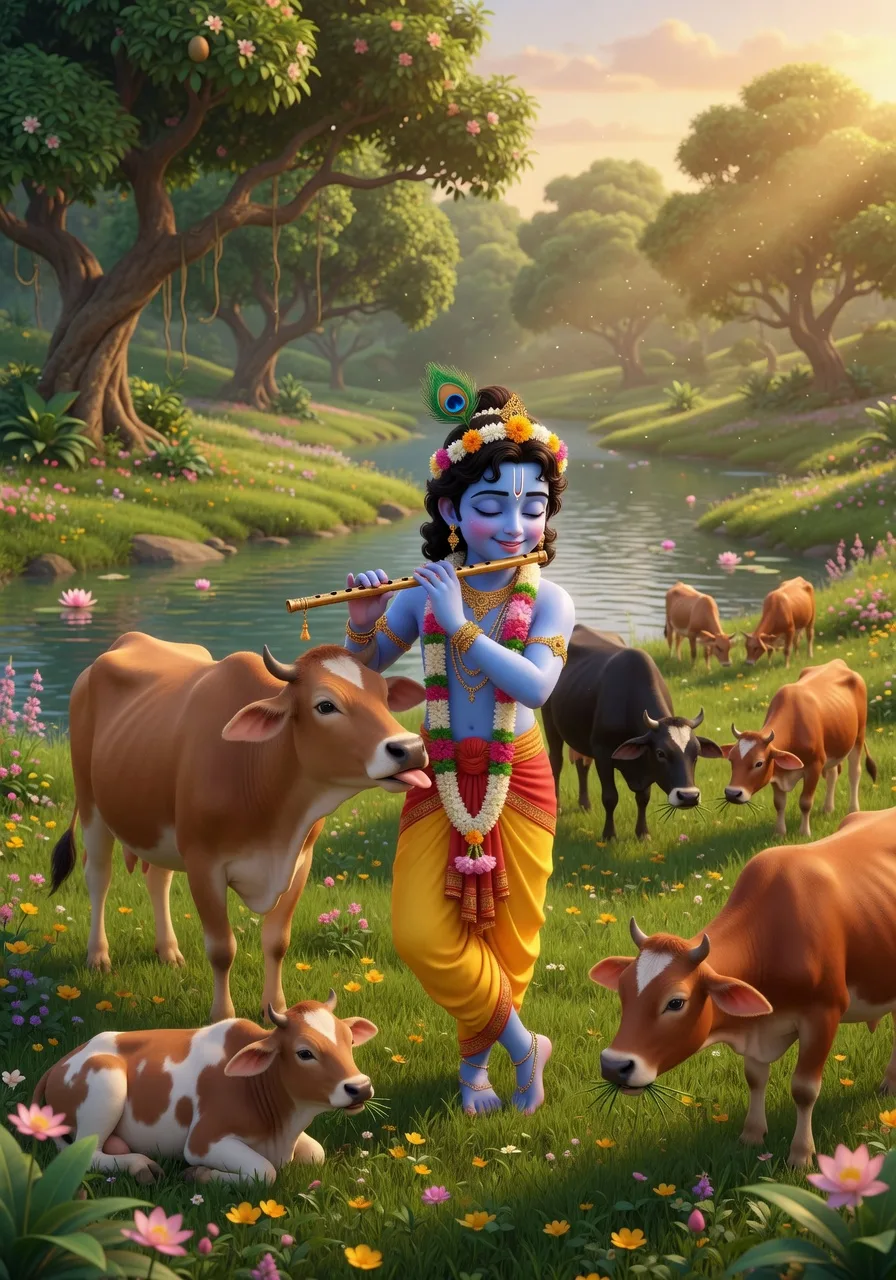
When you tell people that you regard the cow as your mother, the question comes back almost at once, and it is a fair one. Why a cow? It is asked in schools, by friends, by anyone meeting the idea for the first time, and there are very good answers to it. This lesson gathers them. We start with the seven mothers that Sanatana Dharma names, then turn to the one this lesson is really about, Gaumata, the cow, and why she stands so close to God.
The seven mothers
Sanatana Dharma counts not one mother but seven. The sage Chanakya set them out in a well-known verse, and the cow is among them.
| The seven mothers | Who she is |
|---|---|
| Your own mother | the mother who bore you |
| The guru's wife | the wife of your spiritual teacher |
| The Brahmin's wife | the wife of a learned Brahmana |
| The king's wife | the queen of the land |
| The nurse | the one who nursed you into the world |
| Mother Earth | the earth that holds and feeds us |
| Gaumata | the cow |
It is worth noting that Ganga, dear as she is, is not one of these seven. The list is fixed, and the cow has her place on it. The rest of this lesson is given to her.
Krishna and the cow are never apart
Start with the Lord himself. In the tenth chapter of the Bhagavad Gita, Krishna names the best of every kind of thing as a sign of his own presence. Among the saintly Brahmanas he is Bhrigu Muni, among saintly kings he is Manu, among the sages of the demigods he is Narada, and when he reaches the animals he says that among cows he is Kamadhenu, the cow of plenty (Bhagavad Gita 10.28). He counts himself among the cows. His very names say the same. He is Govinda, the one who pleases the cows, a name given to him by Surabhi, the chief cow herself, on the day he lifted Govardhan Hill to shield the people of Vraja from the wrath of Indra. And he is Gopal, the protector of the cows.
This is no accident of his time on Earth. In his own eternal home he is a cowherd boy. That home is called Goloka, and the word itself tells the story, since go means cow and loka means planet, so Goloka is the planet of the cows, where he keeps countless transcendental Surabhi cows. Cows and Krishna have always been together. When he came down to Earth five thousand years ago he brought a likeness of that realm with him, and spent his childhood tending cows and calves and playing with his friends in the pasture. His life was a living lesson in how much cows matter to human society, in the plain good of caring for them, and in the worth of an agrarian economy built on the partnership of people and cows.
Kamadhenu, the mother of all cows
Every cow in this world traces back to one. The scriptures say that all cows descend from Kamadhenu, also called Surabhi, the mother of all cows, a miraculous cow of plenty who lives in the spiritual world and yields whatever is desired. The Brahma Samhita gives a glimpse of her home, where it worships Govinda, the primeval Lord and first progenitor, who tends the cows in abodes built of spiritual gems, surrounded by millions of wish-fulfilling trees, served with love by hundreds of thousands of goddesses of fortune (Brahma Samhita 5.29). Tending the cows is the Lord's own occupation. It is what he does and what he lives for.
Kamadhenu first appeared in this world at the churning of the cosmic ocean, that famous joint effort of the demigods and the demons from which so many treasures rose, a churning so great that about seven incarnations of the Lord took part in it. She was among the first to emerge. The demigods presented her to the seven sages, the Saptarishis, and in time she came into the keeping of the sage Vashishtha. The scriptures say that simply by saluting the cow one gains all righteousness and wealth, and that she is worthy of worship by everyone, for all that is sacred can be found in her.
She is known in five forms, named Nanda, Sunanda, Surabhi, Sumana, and Sushila, and by other names too, Subala and Maitrika, and like her daughter Nandini she can grant any wish to a sincere seeker. The Gavopanishad promises that to bow to her and walk around her in respect is to circle the whole earth with its seven islands, and all the demigods besides.
The cow as a map of the sacred
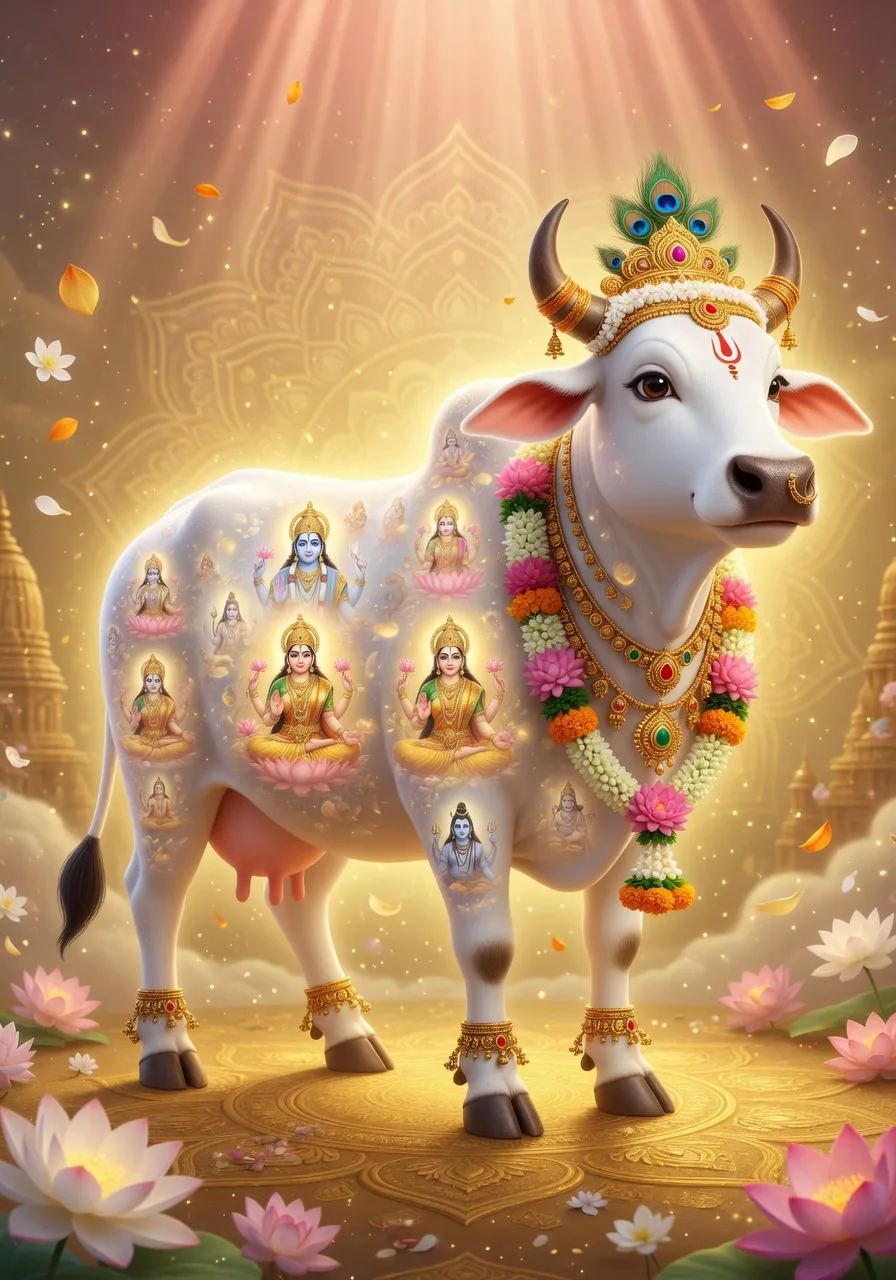
There is a famous painting of Gaumata in which every part of her body holds a deity, and it is not mere art. The scriptures teach that the thirty-three crore devatas, the entire host of demigods, reside within her body. Her form is a map of the sacred.
| Part of the cow | What it holds |
|---|---|
| The four legs | the four Vedas, and the four pillars of Dharma: austerity, cleanliness, compassion, truthfulness |
| The teeth | the four goals of human life: kama, artha, dharma, moksha (desire, prosperity, duty, liberation) |
| The face and eyes | the sun and the moon |
| The shoulders | Agni, the god of fire |
| The horns | Brahma at the tip, Vishnu in the middle, Shiva at the base |
There is a lovely detail about the goddess Lakshmi. She came to Kamadhenu and asked where she could reside, since every part seemed already taken, and Kamadhenu gave her a home in her cow dung. Hence the old saying that Lakshmi dwells in cow dung, gomaya vasate Lakshmi. Of all the eight million four hundred thousand species, only the cow's dung is pure.
Krishna's childhood among the cows
The Lord's foster father, Nanda Maharaja, kept nine hundred thousand cows, and when Krishna was two years and five months old he was given charge of the calves, taking them out to graze, never too deep into the forest. The Bhagavatam lingers on these days. In its tenth canto, every one of its ninety chapters touches Krishna's pastimes, and one of them paints him standing in the pasture counting his cows on a string of jewelled beads, wearing a garland of tulasi, one arm slung over the shoulder of a dear cowherd friend, while his flute draws even the does of the forest to sit beside him.
The counting itself is a wonder. Cows come in four colours, white, red, black, and yellow, and each colour has twenty-five subdivisions, which makes a hundred, with eight more groups besides, so Krishna counts a hundred and eight kinds of cow on a string of a hundred and eight jewels. He knows every one by name. He calls "Dhavali" and a white cow comes forward, then Hamsi, Chandini, Ganga, Mukta, and the rest, each at the sound of her own name. Sometimes he plays a particular tune on the flute for a particular group. And the cows so love to hear him call their names that they turn a little naughty and slip away from the herd just to make him call out "Surabhi" once more.
The cows come in many breeds. The traditional Gir cow of Bharat gives milk that is wonderfully thick and nourishing, richer than that of the Western breeds, and the humped Indian cows are even said to draw in the sun's warmth through the hump on their backs.
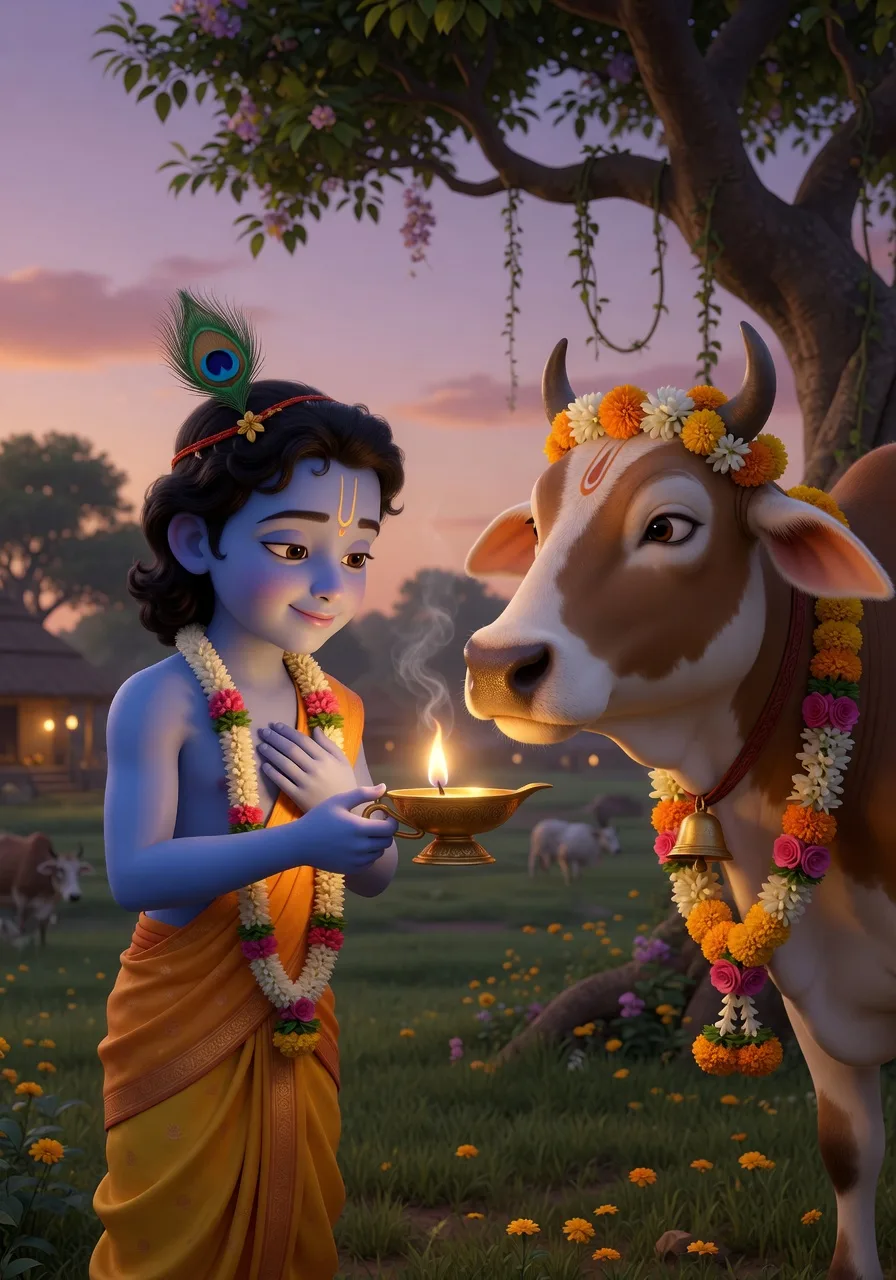
Cows are tender toward him and he toward them. In the old paintings a cow is forever licking his hand or resting at his feet, and he lies down among them. He fed the infant Balarama milk straight from the cow, and after the killing of the demoness Putana the baby Krishna was bathed in cow urine to purify him, as the Bhagavatam records. Every day Krishna would perform arati to Gaumata, offering her lamps as one offers them to the Lord. It is said that only Krishna and the cows wear peacock feathers on their heads.
The cows who crushed the pebbles
One story holds the whole relationship in miniature. On the festival of Gopastami, the day Krishna first took the cows out to graze in the fields, Mother Yashoda told him he could go but must wear shoes in the forest. Krishna answered that he would gladly wear shoes, but only if she first had shoes made for all the cows too. With nine hundred thousand cows, that came to over three million shoes, and Yashoda, defeated and smiling, told him not to worry and just to go.
But the cows had heard. When they saw that Krishna walked barefoot, they could not bear that he might feel the slightest discomfort, so in the dead of night they went out into the forest and crushed all the sharp pebbles into soft sand. To this day there are places in Vrindavan called Raman Reti, the soft sands, where the cows are said to have done this for their Lord.
Brahma's test, and our true parent
There is a deeper pastime worth telling. Lord Brahma once doubted whether this cowherd boy enjoying a picnic with his friends could really be God, and to test him he stole away all the calves and all the cowherd boys and hid them for a year. Krishna simply expanded himself into every one of those calves and every one of those boys. When Brahma returned, expecting empty pastures, he found them full, and understood at last who he was dealing with.
In that year something quiet and telling happened. The mother cows felt an even greater surge of love for their calves than before, and the cowherd parents felt it for their children, because every calf and every child was now Krishna himself. Balarama noticed the strange overflow of affection and asked about it, and Krishna told him the truth. The lesson sits underneath the wonder. Our bond with Krishna runs deeper than our bond with our own parents, because he is our original parent, our supreme father, and the whole of spiritual life is the slow work of reconnecting with him.
Cow protection and Brahminical culture
The great teachers have written at length on why cow protection matters so much. Krishna as Govinda leans toward two things above all, the Brahmanas and the cows, and this points to a truth: human prosperity rests more on these two than on anything else, on Brahminical culture and on cow protection. Where they are missing, the Lord is never satisfied. Protecting cows and upholding Brahminical culture turn a society toward God consciousness, and that is what makes a civilisation succeed. Without cow protection the culture cannot stand, and without the culture the very aim of life goes unmet. One cannot rise spiritually without both.
This care runs right through the tradition. The bull is honoured as the father of society, for he draws the plough and helps bring the grain, and the cow as the mother, for her milk nourishes the family. That milk, though, must never be taken at the expense of her calf, who comes first. When Krishna's father Vasudeva, a Kshatriya, met his foster father Nanda, a Vaishya, the talk turned to the welfare of the cows, who were protected exactly as one protects one's children. It is the Kshatriya's duty to protect the citizens and the Vaishya's to protect the cows, and the cows are held to be as important as the citizens themselves. The Gita names this plainly when it says that farming, cow protection, and trade are the natural work of the Vaishya (Bhagavad Gita 18.44). And it is said that before a person dies they should give a cow in charity to a worthy soul, an act that protects them after death.
The sage who became a Brahmana
The power of the holy cow shows in the old contest between the sage Vashishtha and the king Vishvamitra. The king came to Vashishtha's hermitage with his entire army, and the sage offered to feast them all. Vishvamitra scoffed, asking how a poor hermit could possibly feed an army, but Vashishtha only said not to worry, and his cow Surabhi, the same one from the churning of the ocean, produced a feast of staggering abundance. The king was seized with envy and demanded the cow for himself, insisting that as king everything in the land was his. Surabhi refused to go, and standing with the sage she routed the king's whole army. From that defeat Vishvamitra drew a strange and humbling conclusion, that the power of Brahminical purity was greater than any throne, and that there was no use being a mere Kshatriya. He gave up his kingdom to become a sage, and in the end, after a long and hard road, he succeeded.
The cow's care for people is not mere sentiment, and modern science has begun to catch up with it. A 2017 paper by the neuroscientists Lori Marino and Christine Allen, titled "The Psychology of Cows," found cows to be bright and emotional individuals, and farmers often describe how their cows return affection. There are accounts of a cow rushing to defend a person she saw being struck, and an older story of a man who fed a cow each day until, one morning, she came far earlier than her habit and in doing so disturbed a thief in his house, and so protected him. The cow gives back the love she is given.
The five gifts: panchagavya
The cow blesses us with five things together called panchagavya, the five products of the cow: her dung, her urine, her milk, her yogurt, and her ghee. Each is precious. The dung, against every expectation, is pure and even absorbs heat, the urine carries healing power, and the milk and its products nourish and sanctify. These five appear in worship of every kind, and they are required when a deity is installed in a temple, at the rite of murti pratishtha. The same five are taken at the close of the Kartika vow, in the observance called Bhishma Panchaka. Cow dung is so esteemed that in Bharat the walls of houses are coated with it to keep insects away, and the sacred fire pit is smeared with it to make the ground auspicious, and modern science has confirmed what tradition long held, that cow dung is remarkably pure.
The weight of cow slaughter
If the cow is our mother, the harm done to her is grave. Just as no decent person would injure or kill the mother whose milk they drank, the Vedas treat the killing of a cow, whose milk we take, as the killing of one's own mother, and the same holds for the bull. The sin is severe. The Vedas say that for every hair on the cow's body, one who takes part in such killing must take birth as an animal and be killed in turn. Chaitanya Mahaprabhu, who came as the combined form of Radha and Krishna just over five hundred years ago, taught cow protection as well. In the Chaitanya Charitamrita he says, with the humility of one who is never forced to take birth at all, that in his previous appearance he was born among cowherds as Krishna and gave protection to the cows and calves, and that by such pious deeds he had now become the son of a Brahmana. In his own pastimes he once explained to a magistrate who had tried to stop the chanting that those who kill and eat cows are condemned to suffer in hell for as many thousands of years as there are hairs on the bodies of the cows they consume. It is heavy karma. The vast modern slaughter industry is a real tragedy, and even the land of Krishna has not been free of it, having at times exported great quantities of beef.
How to reconnect with Gaumata
Living in cities, cut off from fields and animals, most of us never think about cows at all. Yet the Lord we claim to worship cannot live without them. He tends them daily, lives among them, weeps for them. There is a story that in Dwaraka, far from the pastures of Vrindavan, Krishna would cry out "Surabhi!" in the middle of the night, and his queen would ask who Surabhi was, not knowing that he was forever thinking of the cows and how to protect them. What a gap there is, then, between the worshipper and the worshipped, when God cannot live without cows and his devotee never spares them a thought.
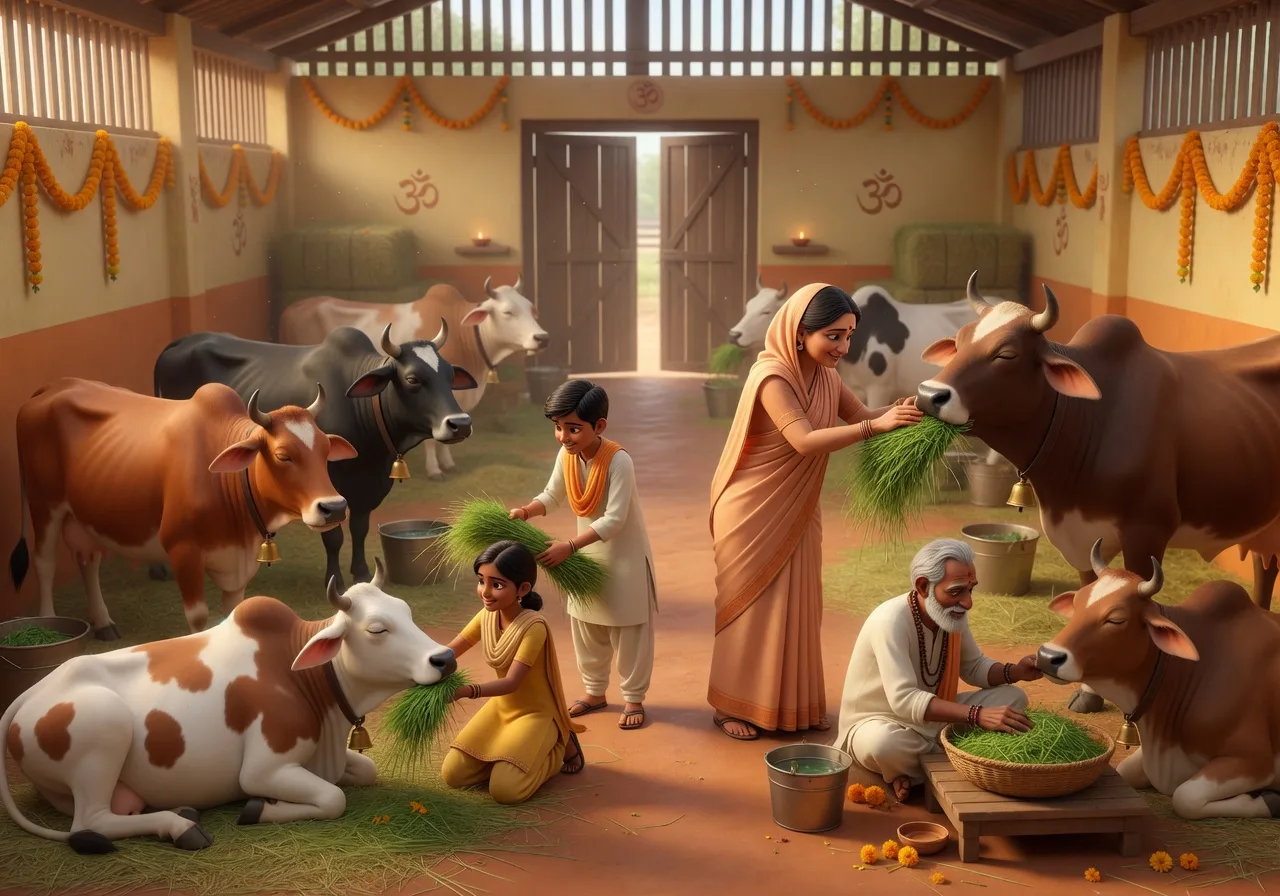
So the practice is to bring some remembrance of Gaumata back into daily life. Feed her if you can, even a handful of hay, and the act leaves a person feeling strangely whole. Where that is not possible, thank her in the mind, remember her, remember the bond between Krishna and the cow, and a connection is made with one who stands very near to God. Beyond remembrance there is action. One can adopt a cow, buy one, gift one, or support a gaushala, a cow sanctuary, of which there are many in Bharat, where cows are sheltered and fed and looked after well. The honour paid to the cow is not ours alone, for she is revered across many cultures. An Iranian scholar has written on her importance, Christianity carries some word against her slaughter, and a tribe in Sudan worships cows and treats them as equals.
As for becoming vegan, that is a personal choice, and there is nothing wrong in it. The cows in many places are genuinely mistreated, and to raise awareness of that is good. But the better course, where one can, is to keep offering the cow's milk to the Lord, so that even a cow who suffers gains the benefit of her milk being used in his service. And if a person is vegan already and still prays for the protection of the cows, that prayer alone delights Krishna, who loves them beyond measure.
Key terms from this lesson
| Term | Meaning |
|---|---|
| Gaumata | the cow, honoured as one of the seven mothers |
| Kamadhenu / Surabhi | the wish-fulfilling cow of the spiritual world, mother of all cows |
| Govinda / Gopal | Krishna as the pleaser and protector of cows |
| Goloka | "the planet of the cows," Krishna's own realm |
| Panchagavya | the five products of the cow: dung, urine, milk, yogurt, ghee |
| Gaushala | a cow sanctuary where cows are sheltered and cared for |
| Gopastami | the festival of Krishna first taking the cows to graze |
| Raman Reti | the soft sands of Vrindavan, made by the cows for Krishna |
What to carry forward
- Sanatana Dharma names seven mothers, and the cow, Gaumata, is one of them.
- Krishna is never apart from cows. He is Govinda and Gopal, a cowherd in his own realm of Goloka, and among cows he is Kamadhenu.
- All cows descend from Kamadhenu, who rose at the churning of the ocean, and the whole host of demigods is said to dwell within the cow's body.
- Cow protection and Brahminical culture are the twin supports of a God-centred society, and the Gita makes cow protection the natural work of the Vaishya (18.44).
- The bull is the father of society and the cow its mother, the calf comes before the milk, and a cow given in charity protects the giver after death.
- The cow gives five sacred products, the panchagavya, used in all worship, while the killing of a cow is among the heaviest of sins.
- The Lord cannot live without cows, so a devotee keeps Gaumata in mind daily, feeds, remembers, and protects her, and offers her milk in the Lord's service.
Previous lesson: ← Markandeya and the baby on the banyan leaf
Next lesson: The glories of Srimad Bhagavatam (final chapter) →
Back to the full course index.
Frequently Asked Questions

Independent writer, jaapak.com
I built the Jaapak app. I write in simple Hindi on the Bhagavad Gita and the satsang tradition — so seekers don't struggle with the scripture.
Read all articlesAbout this article
The commentary is based on the general understanding of the Sanatan tradition and written in accessible language. No verbatim quotation of any modern commentator is used.