Festivals and the Meaning of Ekadashi
The festival year of Sanatana Dharma, from Janmashtami to Diwali, and the meaning of Ekadashi: the pastime behind it, why we avoid grains, the inner sense of
Sanatana Dharma keeps a festival almost every week, and behind each one is the appearance of the Lord or one of his devotees. The festivals are full of colour and feasting, yet their real purpose is quiet, to draw us close to the person being celebrated and to win their blessing. This lesson walks through the festival year, and then settles on the one austerity worth keeping in this age, Ekadashi, its pastime, its inner meaning, and the surprising science behind it.
Why do we celebrate festivals?
A festival day marks the appearance of the Lord, or of one of his great devotees. We do not call it a birth, because God does not take birth. He always existed, exists now, and always will. When he "appears," he chooses to enter this world, and that day becomes a cause for joy.
On most festival days we fast, and the reason is worth understanding. Fasting is a small austerity, a tapasya, and its point is not the hunger. By spending less time in the kitchen and at the table, we free up time to remember the Lord, to please him, and to thank him. The Lord is joyful by nature, full of ananda, and he wants us joyful too. So every festival is a chance to recommit, to rejuvenate, and to pray to become better at remembering him. That inner purpose, drawing close to the Lord and his devotees and seeking their blessing, is the heart of every festival. The colour and the feasting grow out of it.
A walk through the festival year
The year is full. Here are the major days and what each one marks.
| Festival | Roughly when | What it celebrates |
|---|---|---|
| Janmashtami | August | the appearance of Lord Krishna |
| Radhastami | August/September | the appearance of Srimati Radharani |
| Ganesh Chaturthi | August/September | the appearance of Lord Ganesh |
| Navaratri | spring and autumn | nine nights leading to Ram Navami, and to Diwali |
| Diwali (five days) | October/November | Rama's return to Ayodhya, and much more |
| Tulsi Vivaha | November (Kartik) | the wedding of Tulsi and Shaligram |
| Gita Jayanti | December | the day Krishna spoke the Bhagavad Gita |
| Maha Shivaratri | February | the night of Lord Shiva |
| Holi and Gaura Purnima | March | Prahlada's deliverance, and Chaitanya's appearance |
| Ram Navami | spring | the appearance of Lord Ramachandra |
| Sita Navami | a month after Ram Navami | the appearance of Sita Devi |
| Hanuman's appearance | spring | the appearance of Lord Hanuman |
| Guru Purnima | summer | the appearance of Vyasadeva, and honouring the guru |
| Balarama Purnima | August | the appearance of Lord Balarama |
Janmashtami and Radhastami
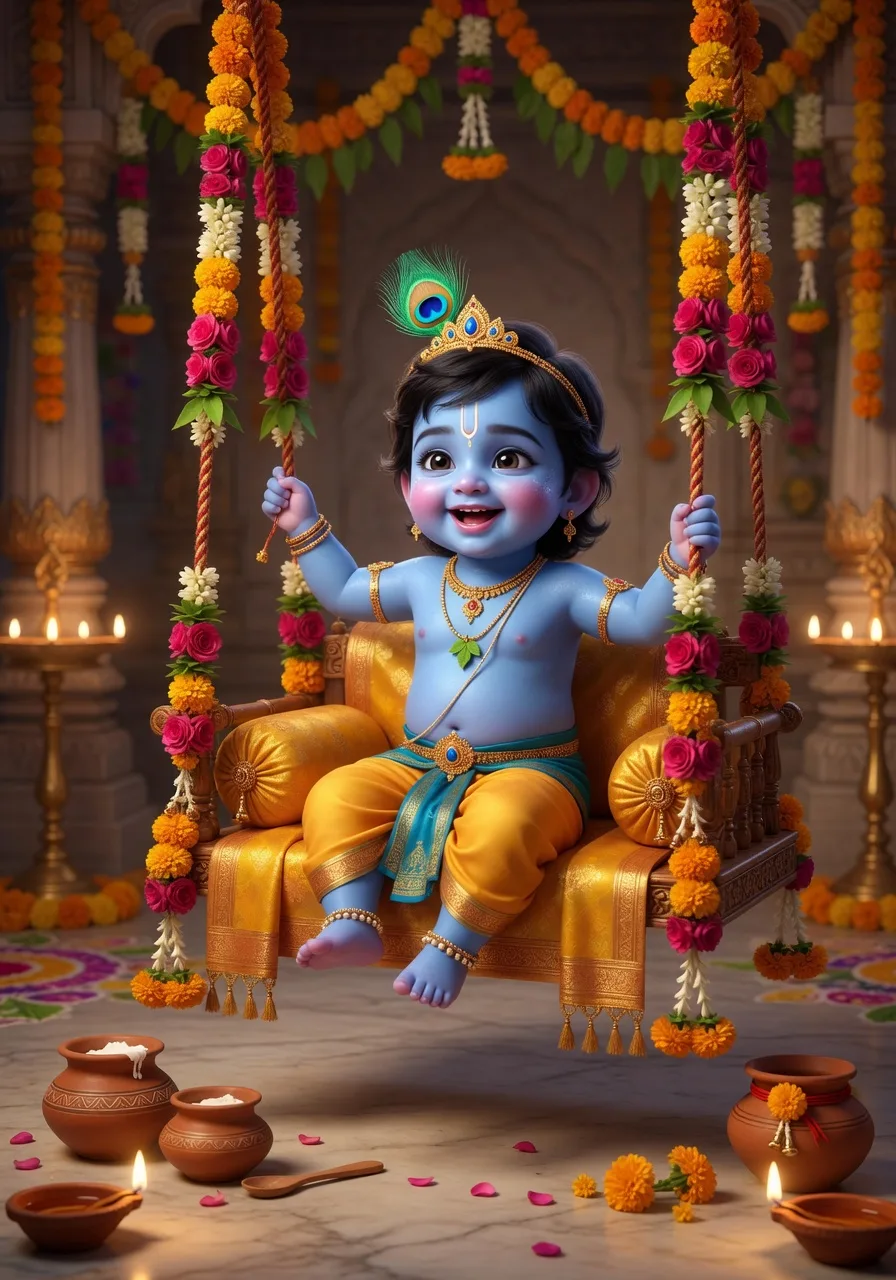
Janmashtami, around August, is perhaps the most celebrated festival in the whole calendar, the appearance of Lord Krishna. He came at the dead of night, inside a prison, and there is a message in that. We too live in a kind of prison, in darkness, and the Lord enters that very darkness to give us hope that he is with us, that he understands, and that he wants us free. We celebrate by swinging Bal Gopal, the child Krishna, on a beautifully decorated swing, by singing his glories and reading about him, and by bathing the Shaligram. Devotees generally fast until midnight, and those who cannot may take fasting food, the same grain-free food eaten on Ekadashi.
About two weeks later comes Radhastami, the appearance of Srimati Radharani, who is born at midday, so the fast is short. Radharani is the eternal consort of the Lord, the first expansion from him, and not different from him. Through her we learn that God is not only male. The female aspect of God is Radharani, and also Sita Devi and Lakshmi Devi, and her power is as great as the male aspect, if not greater, because she controls him through the sheer intensity of her love. We fast until midday and then feast. On this day, in the final arati, the lotus feet of Radharani are sometimes shown, a rare sight, since they are almost always kept covered. Her foot markings are not the same as Krishna's, for she does not bear his disk, though she carries signs of her own. We sing her bhajans and kirtans on this day, and the two differ: a kirtan repeats a single mantra over and over, while a bhajan is a devotional song that glorifies the Lord or his consort.
Ram Navami, Sita Navami, and Hanuman
Ram Navami is the appearance of Lord Ramachandra, a most powerful incarnation of the supreme Lord, who appears at noon. We fast until noon, keep to grain-free food, and glorify Rama and Sita, swinging their deities. About a month later falls Sita Navami, the appearance of Sita Devi, also born at midday, kept in the same way.
Soon after comes the appearance day of Hanuman, who bestows his mercy on all who remember Lord Ramachandra, because he himself remembers Rama so constantly. One small point of language: we do not call this a "Jayanti," because that word is used for those who have left this world, and Hanuman is still present. When Rama was departing he told Hanuman to remain, and though Hanuman was heartbroken, Rama assured him that as long as his name is chanted, Hanuman may stay in this world and bless those who chant it.
Maha Shivaratri
Around February comes Maha Shivaratri, the night of Lord Shiva. There is a Shivaratri every month, but this is the great one. It marks his appearance and his marriage to Parvati. The Shivling is bathed in abhishek, and Shiva is glorified through the night with bhajans. Who is Shiva? In the Vaishnava scriptures, the Brahma Samhita and the Srimad Bhagavatam, he is described as the greatest devotee of the Lord. When God wishes to touch this material world he takes the form of Shiva rather than touching it directly, so there is a deep bond between Shiva and Vishnu. Shiva is endlessly compassionate, giving shelter to anyone the whole world has rejected. There is no one he will not care for.
Holi and Gaura Purnima
Holi, the festival of colours and the start of spring, recalls Prahlada Maharaja. His aunt Holika, granted a boon of immunity from fire, sat in the flames holding the boy to kill him, but because she misused the boon against a pure devotee, it was she who burned while Prahlada sat unharmed. So we build a bonfire of old wood, offer coconuts, and throw our bad habits and our ego into the flames to be burned away, then play with colours. The play has roots in the pastimes of Krishna and the gopis, and in Barsana it runs a whole week, the gopis chasing the men with sticks.
The same day is Gaura Purnima, the appearance of Lord Chaitanya Mahaprabhu, the Yuga Avatar for this age. He came over five hundred years ago and gave the yuga-dharma, the practice for our time, the chanting of the holy names: Hare Krishna Hare Krishna, Krishna Krishna Hare Hare, Hare Rama Hare Rama, Rama Rama Hare Hare. In Kali Yuga this chanting is the one practical way back to the spiritual world. Gaudiya Vaishnavas, those in Chaitanya's line, fast until moonrise, then take fasting food and spend the day glorifying him.
The five days of Diwali
Diwali is not a single day but a sequence of five, each with its own meaning.
- Dhanteras, the thirteenth day, has two faces. It is the appearance of Dhanvantari, the Lord of medicine, who arose during the churning of the ocean together with Lakshmi Devi. And since dhan means wealth, people close their account books and offer them to the Lord, and buy utensils for good fortune. The deeper celebration is Dhanvantari, because our truest wealth is our health. Without it, no amount of money can be used in the Lord's service. As the saying goes, we lose our health to gain wealth, then spend our wealth to regain health.
- The fourteenth day is for worshipping Krishna, Yamaraj, and Hanuman to be cleansed of sin, since we cannot help committing some sin merely by living, by breathing in tiny creatures or treading on ants.
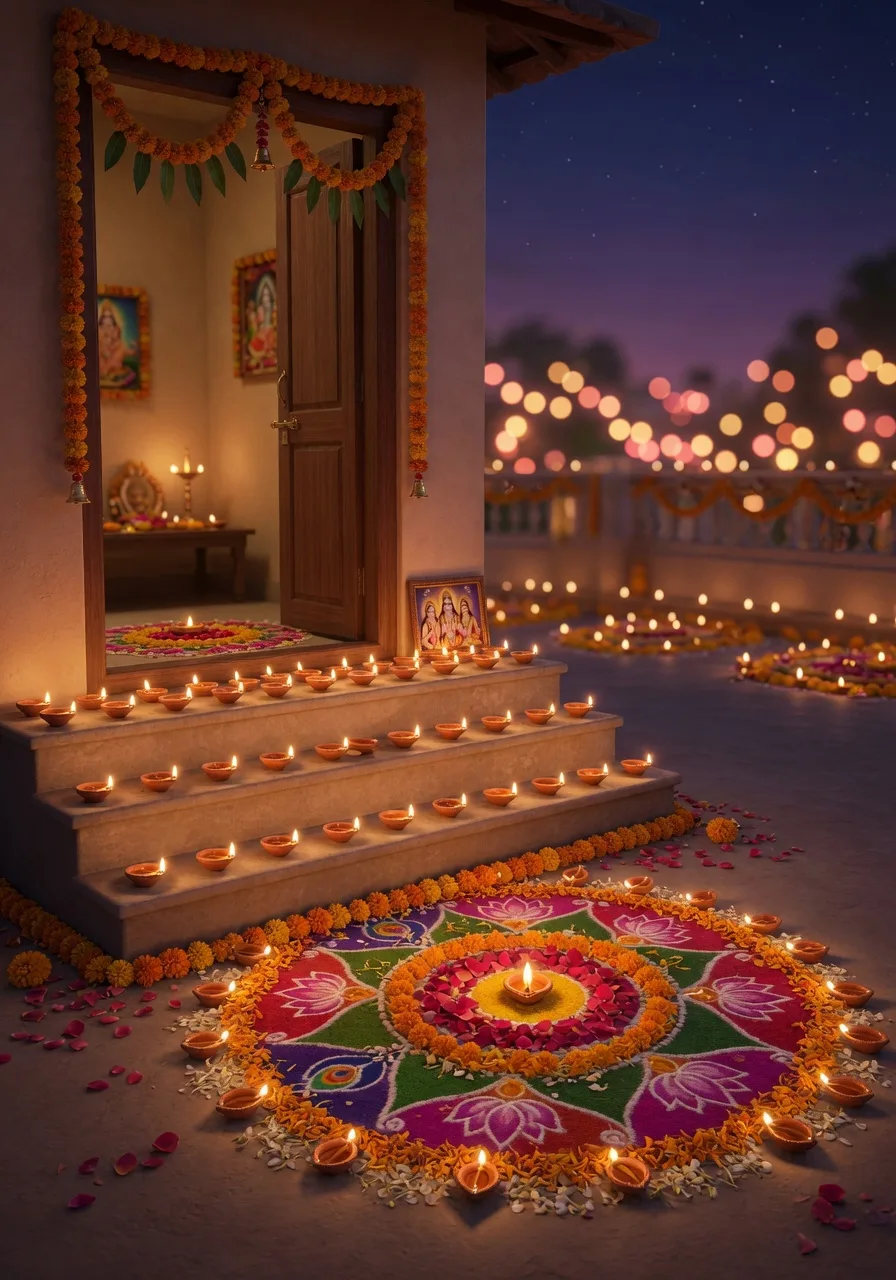
- Diwali itself falls on the new-moon night and celebrates the return of Rama, Sita, and Lakshmana to Ayodhya after fourteen years in the forest. The night had no moon, so the people of Ayodhya lit rows of lamps to light Rama's way home. That is why we light lamps, do Lakshmi puja, make rangoli, clean and even repaint our homes, and welcome the Lord with the mood, "my Lord is coming."
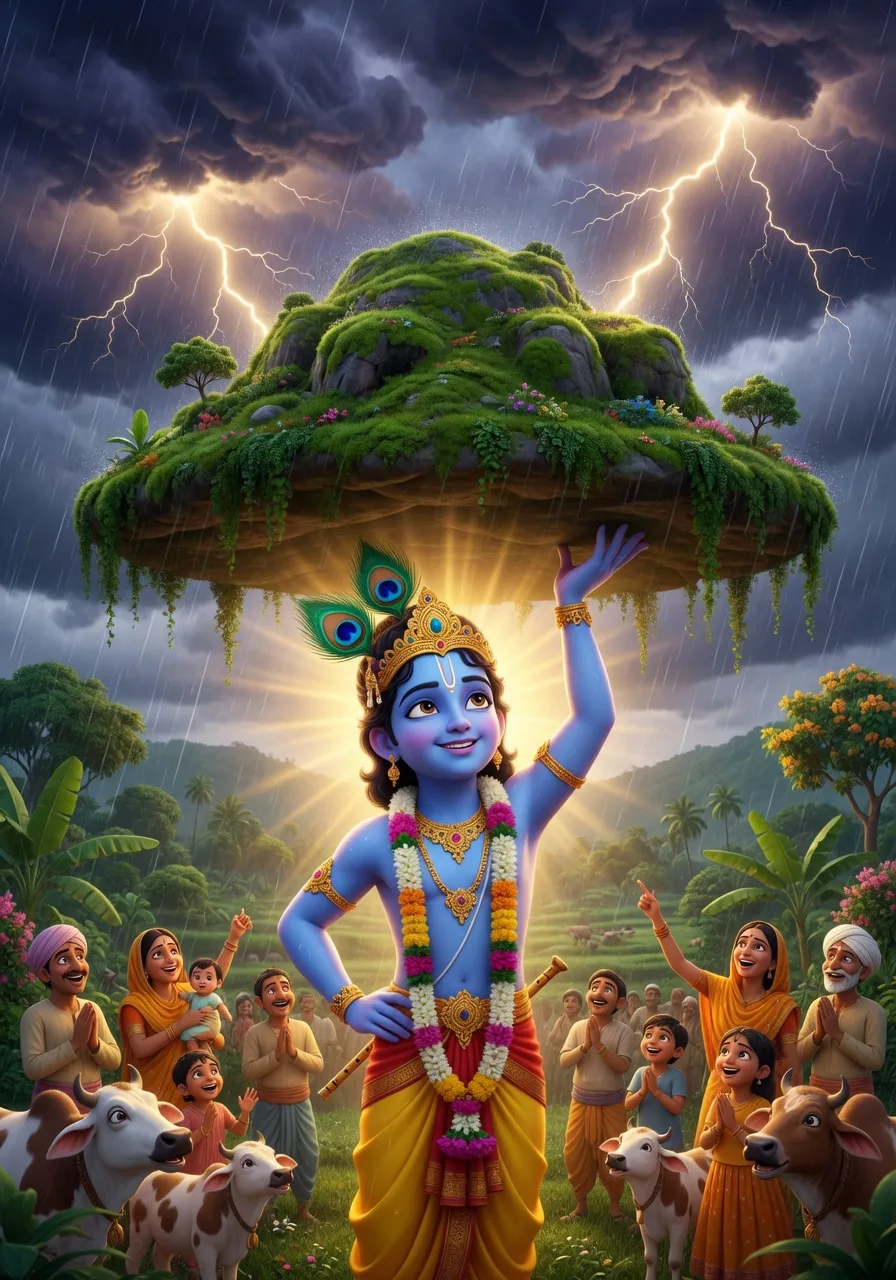
- Govardhana Puja, the fourth day, recalls how Krishna persuaded the people of Braj to stop worshipping Indra and worship Govardhana Hill and the cows instead. Why pray to Indra for rain, he asked, when rain comes anyway? When the offerings were made, Govardhana manifested as Krishna and ate them all. The slighted Indra sent his fiercest storm clouds to destroy the land, and Krishna lifted the whole hill on the little finger of his left hand for seven days and nights, sheltering every villager and cow beneath it. We celebrate by building a small hill of halwa or stones, walking around it as we would circumambulate the deity. The stones of Govardhana, called Giriraj, are worshipped on the altar as Krishna himself.
- The fifth day celebrates the bond of brother and sister, remembered through Yamuna and Yamaraj, much like Raksha Bandhan.
Tulsi Vivaha, Gita Jayanti, and more
Two weeks after Diwali, in the month of Kartik, comes Tulsi Vivaha, the wedding of Tulsi and Shaligram, with the full ceremony of a fire and the couple circling the mandap. Tulsi is so dear to Vishnu that an offering carrying a single Tulsi leaf is certain to be accepted, and where Tulsi is hard to grow, even sincerely calling her to the offering brings her presence.
Gita Jayanti, near the end of December, is the day Krishna spoke the Bhagavad Gita to Arjuna at Kurukshetra. It falls on an Ekadashi, so it is kept as a fast, and the whole Gita is recited.
Ganesh Chaturthi is the ten-day appearance festival of Lord Ganesh, a murti installed on the first day and immersed in water on the last. The immersion is debated. The usual explanation is that proper deity worship is so demanding, with strict rules, that the murti is worshipped for ten days and then given up to avoid committing offenses by neglect afterward. Some teachers gently disagree, holding that once a deity is established it should simply be worshipped and kept, not made and then immersed because the worship is hard to sustain. It is also said that as the murti enters the water, Ganesh carries away with him the obstacles of those who worshipped him. It remains a tradition that many follow.
Guru Purnima is the appearance of Vyasadeva and the day we honour the guru. It opens Chaturmas, the four months of the rainy season, when each month carries its own fast, the first being abstinence from certain greens, then from yoghurt, and so on. Balarama Purnima, in August, is the appearance of Lord Balarama, the first expansion of the Lord, again kept by fasting until noon. And there are more, the Navaratri seasons, the months of Purushottam and Dhanurmasa, so many that it is truly said every day is a festival.
What is Ekadashi, and where does it come from?
Ekadashi falls every two weeks, on the eleventh day of the waxing moon and the eleventh day of the waning moon. In this age we are asked for very little austerity, but this is the one austerity worth keeping. Scripture itself points to it: "One who hears this Bhagavatam on the Ekadashi or Dwadashi day is assured of long life, and one who recites it with careful attention while fasting is purified of all sinful reactions" (Srimad Bhagavatam 12.12.60).
The name comes from a pastime near the dawn of creation. A young girl manifested from the body of Lord Vishnu on the eleventh day of the moon, and in Satya Yuga she defeated a powerful demon named Mura. Pleased, Vishnu named her Ekadashi, "the eleventh," and granted her wish: that whoever observes the fast on Ekadashi, waxing or waning, will be freed from all sins and attain the transcendental abode.
There is a second pastime that explains the grains. Vishnu had created Papa Purusha, who punishes the sinful and is one with Yamaraja. Hearing the screams of the punished, Vishnu felt deep compassion, and that compassion took form again as Ekadashi, who declared that anyone serving Vishnu by chanting his name on her day should be saved. Vishnu granted it, and soon everyone was chanting and Papa Purusha had no one left to punish. When he complained, Vishnu told him that on the days of Ekadashi he may take shelter in grains. So sin hides in grains on Ekadashi, and to eat grains that day is to eat sin, even if the food has been offered to the Lord.
What is the inner meaning of Ekadashi?
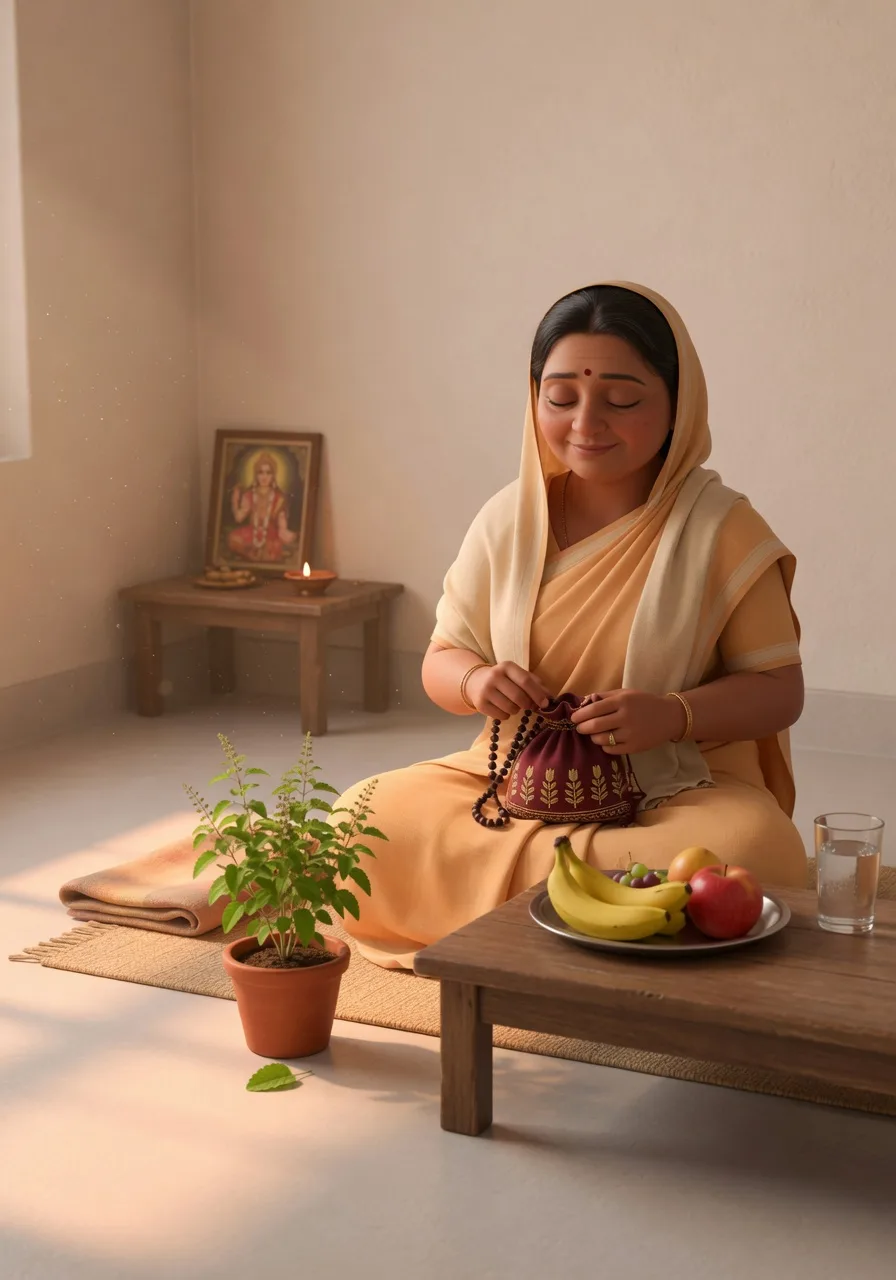
The fast has an outer face and an inner one. Outwardly, upavasa means abstaining from grains and beans on the eleventh day. Inwardly, upavasa means to come near, to draw close to God. The word Ekadashi itself points to our eleven senses, and the idea is to reduce the basic urges of eating and sleeping so that our absorption in Krishna through those eleven senses can grow. The Nectar of Devotion puts it plainly: Ekadashi means to absorb oneself completely in Krishna consciousness, and the basic principle is not merely to fast but to increase one's faith and love for Krishna, chanting more and reading more on that day. The fasting is the smaller part. Coming close to God is the point.
How do we keep Ekadashi?
There are degrees of fasting. The highest, giving the most spiritual reward, is nirjala, a complete fast without even water, kept every two weeks. But if abstaining makes us proud, "look how well I fasted, how pure I am," then the ego feasts and the purpose is lost. We fast and stay humble, so that the soul, not the ego, feasts on devotional service.
Going without water can build up acids that water would flush out, so taking regular sips of water through the day, while eating nothing, is another accepted way to fast. There is a well-known example here. Ambarisha Maharaja was completing a long fast within a fixed time when the sage Durvasa arrived as his guest and went off to bathe, taking his time at the river. Ambarisha could neither break his fast unfed of his guest, which would be an offense, nor let the time run out. The sages advised him to drink water, since water completes the fast without truly eating. Where water is not enough to keep one steady for spiritual practice, one may take fruits, vegetables, and nuts. Nuts are not counted as grains. Plain rice is avoided, but fasting grains like samak rice, along with sabudana and buckwheat, are allowed.
For anyone new to it, the way in is gradual. Begin by eating as often as you like on Ekadashi, only without grains, and then trim back a little each fortnight, until once in two weeks you can fast lightly or fully. Scripture recommends the fast from the age of five, and in practice from eight, up to eighty and beyond if health permits. Health is the limit, because a sick body cannot focus on the Lord, and we never sacrifice health for the show of an austerity.
A few timing points matter. The fast should be completed the morning after Ekadashi, on Dwadashi, within a short window after sunrise, with water if you are doing nirjala or with grains otherwise. Because we follow the lunar calendar, part of an Ekadashi day can still belong to the previous day, Dasami, and we do not fast on Dasami, so the safest practice is to fast as the Vaishnavas do, the later day, avoiding any mixing of Dasami and Ekadashi. Even the Lord himself, appearing as Chaitanya, asked his mother to keep the Ekadashi fast, which shows how much weight he gives it.
Why avoid grains? The body and the moon
Beyond the pastime of sin hiding in grains, there are reasons the body itself can feel.
Fasting is genuinely good for health. The Japanese cell biologist Yoshinori Ohsumi won the 2016 Nobel Prize in Physiology or Medicine for showing how cells recycle and renew their contents, a process called autophagy. Fasting switches autophagy on, which slows ageing and supports cell renewal and longevity. A fast of twelve to twenty-four hours begins to trigger it, and research links fasting to better blood sugar control, less inflammation, weight loss, and sharper brain function. One line of study found that cutting calories by about a quarter extends life, and that this can be reached by fasting once a fortnight for around thirty-six hours, which is almost exactly Ekadashi, from sunrise on the first day, through the night's sleep, to sunrise on the next.
There are subtler reasons too. We eat constantly and never rest the stomach, and grains are especially hard to digest, so a break every couple of weeks detoxifies the body and steadies the mind. The moon governs the mind, which is why people speak of the full moon and the "lunatic," and fasting when the moon is most active on the eleventh day helps us control the mind. The consciousness of the cook also passes into the food, as a study in American prisons suggested, where inmates fed food cooked with love and singing were noticeably more peaceful than those fed ordinary food. And the moon, which adds value to the taste of fruits and vegetables, as the Lord notes in the Gita (15.13), pulls hardest between Dasami and Dwadashi, causing the body to retain extra water through grains that it cannot easily flush, and the body is some three-quarters water. So the eleventh day is a wise day to leave grains aside.
The greatest Ekadashi: Pandava Nirjala
One Ekadashi stands above the rest, the Pandava Nirjala Ekadashi, also called Bhima Ekadashi, falling around June. If you manage no other Ekadashi in the year, keep this one. Even Bhima, who had a special fire in his stomach and could not live without eating, fasted on this day from all food and water, from sunrise on Ekadashi to sunrise on Dwadashi. Keeping it is said to count as if you had kept all the year's Ekadashis at once.
Key terms from this lesson
| Term | Meaning |
|---|---|
| Tapasya | austerity, such as fasting, undertaken to remember and please the Lord |
| Ekadashi | the eleventh lunar day, kept as a fast every fortnight |
| Upavasa | fasting, literally "drawing near" to God |
| Nirjala | a complete fast taken without water |
| Dwadashi | the twelfth lunar day, on which the Ekadashi fast is broken |
| Yuga-dharma | the recommended practice of an age; in Kali Yuga, chanting the holy names |
| Giriraj | the sacred stones of Govardhana, worshipped as Krishna himself |
| Shaligram | the sacred stone from the Gandaki, worshipped as Vishnu directly |
| Autophagy | the cellular renewal that fasting activates, linked to longevity |
What to carry forward
- Festivals mark the appearance of the Lord and his devotees, and their real purpose is to draw us close and win their blessing.
- Fasting on these days is a small austerity whose point is to remember the Lord more, not the hunger itself.
- Janmashtami, Radhastami, Ram Navami, Holi, Gaura Purnima, the five days of Diwali, and many more fill the year.
- Ekadashi, every eleventh lunar day, is the one austerity worth keeping in this age.
- Its outer form is abstaining from grains, and its inner form is drawing near to God through the eleven senses.
- Avoiding grains has subtle and bodily reasons, from sin sheltering in grains to autophagy and the pull of the moon.
- The Pandava Nirjala Ekadashi around June is the greatest of all, said to equal the whole year's fasts.
Previous lesson: ← Temple worship and the meaning of arati
Next lesson: Varnashrama: the four orders of society →
Back to the full course index.
Frequently Asked Questions
Independent writer, jaapak.com
I built the Jaapak app. I write in simple Hindi on the Bhagavad Gita and the satsang tradition — so seekers don't struggle with the scripture.
Read all articlesAbout this article
The commentary is based on the general understanding of the Sanatan tradition and written in accessible language. No verbatim quotation of any modern commentator is used.