The Devatas: Who They Are and How They Relate to God
Understanding the devatas in Sanatana Dharma: one God and many devatas, the king-and-ministers model, the 50 to 64 qualities, why a devotee worships the
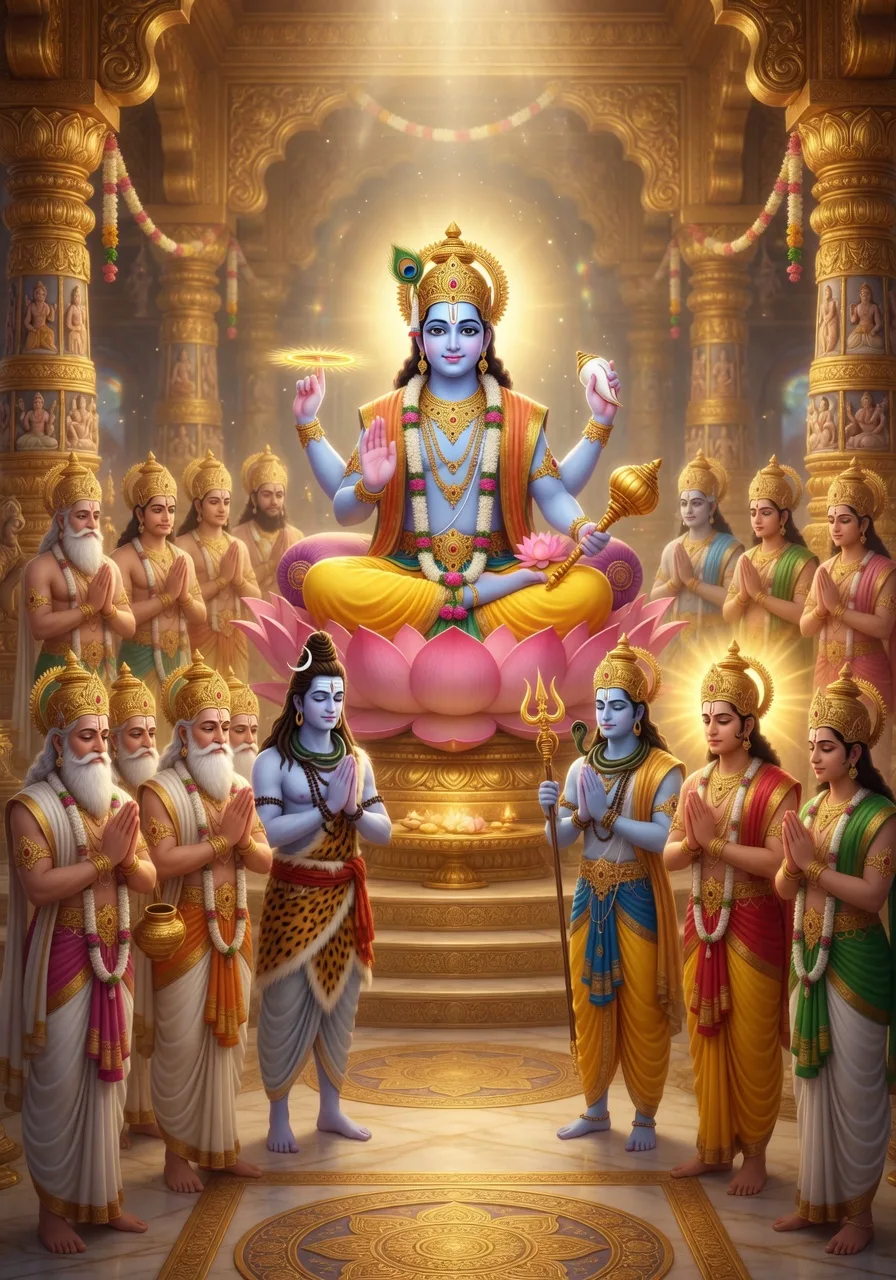
This is a sensitive subject, and it is the last lesson of the course. Many of us grew up worshipping the devatas, the way it has always been done at home, so some of what follows may sit uneasily at first. None of it is said against any personality, for we should never be against any of them. The point is only that there are different levels of worship, and they give different results. Our human life is short, and if we put our devotion on the wrong path we lose a great deal in that short time, while if we get it right we make great progress quickly. So the aim is simply to get it right.
One God, and many devatas
First, who is God? The scriptures define him as the source of everything, complete and perfect. In Sanatana Dharma God is not only male, for God is female as well, and the counterpart, whether we call her Radha, Sita, or Lakshmi, is equally powerful. God is the supreme controller, the owner and enjoyer of all, all-knowing, and full of six opulences in their entirety, wealth, strength, fame, beauty, knowledge, and renunciation. Many claim to be God, almost one on every street corner, but the test is whether they meet that description. Krishna declares himself to be God, the source of all (Bhagavad Gita 10.8), and backs it with reference after reference, noting that the sages too accept it, and Brahma himself, the secondary creator of this world, praises Govinda as the origin of all who has no other origin, the cause of all causes. A genuine incarnation is foretold in scripture in advance, performs deeds that draw everyone, gives divine knowledge, can show the universal form, comes with a particular mission, and bears certain marks on his palms and soles.
So is there one God or many? There is one God with a capital G and many small gods, because the word god really means controller, and there are smaller levels of control. The Supreme alone has full control over everything. The relationship is best seen as a government. A queen appoints a prime minister, who appoints a cabinet to run the country, and in the same way the Lord appoints his first minister, Brahma, who carries the creation forward with the help of an immense staff of ministers who govern the universe. There are thirty-three crore devatas, three hundred and thirty million of them, because it takes a great many to run even our smallest of universes, and every one of them receives his power from Krishna.
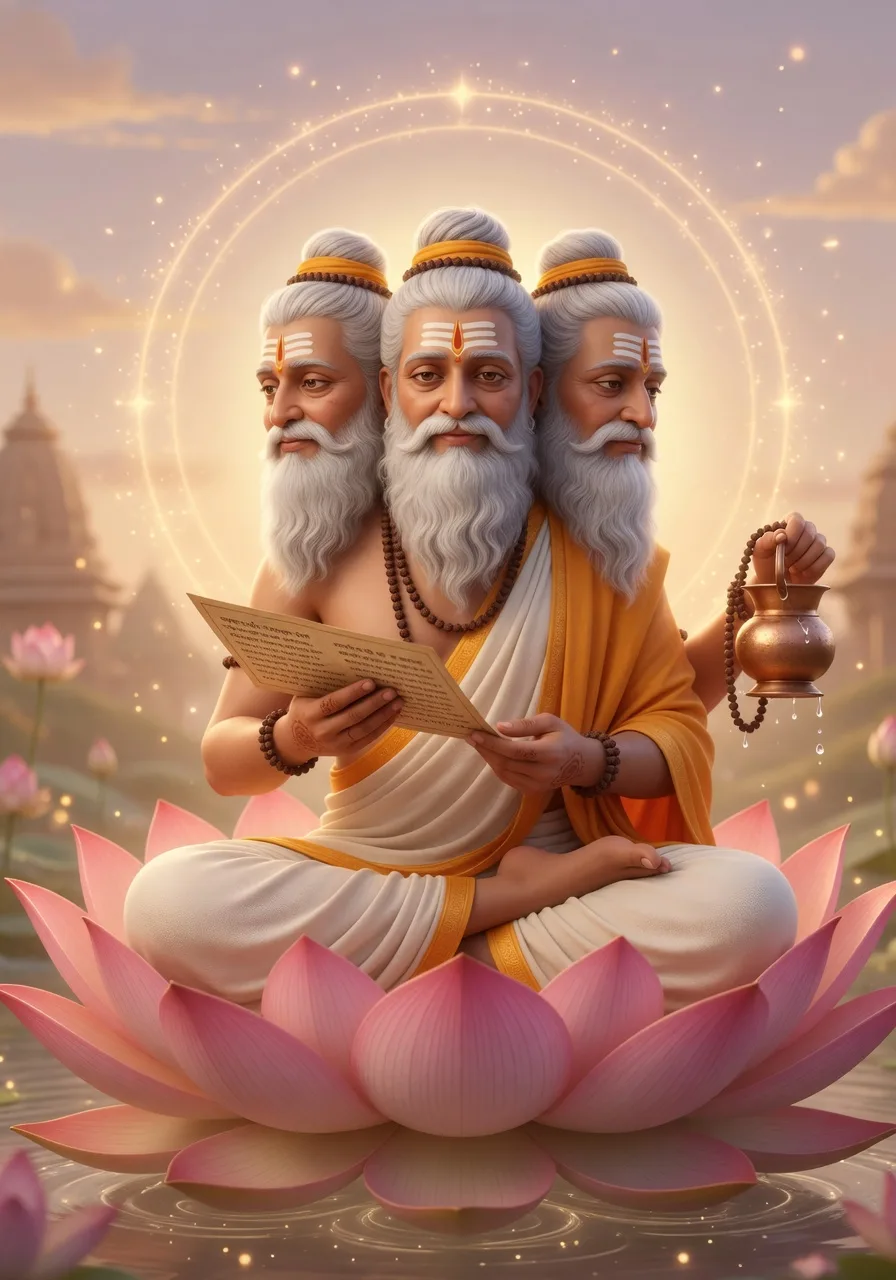
The key to all of it is this: a devata is a post, not a fixed person. Brahma is a position, like the office of prime minister, and a sufficiently qualified soul can come to occupy it. Brahma is a soul like you and me, only one made extraordinarily powerful by his austerities and prayers, to whom the Lord has given the power to create. The four-headed Brahma we know belongs to this universe, the smallest of all, while in the vaster universes the Brahmas wear many more heads, for there is far more in them to create. We too could in principle rise to the post of any devata, though it is not a thing worth wanting. The one exception is Shiva, whom no soul can become, because Shiva is what Krishna becomes when, through his expansion as Vishnu, he comes into contact with this material world. And even Brahma, for all his power, dies when his enormous life of some three hundred and eleven trillion years runs out, which is nothing against eternity. Our real aspiration is not to climb to some high post in this world but to return to the spiritual world and the direct company of Krishna, which is our eternal position.
What makes Krishna different from the devatas
When Arjuna asked to see the universal form, Krishna showed it at once, and within that form all the devatas were seen emanating from him, even great ones like Shiva and Brahma. No other devata ever revealed such a form or claimed to be the source of all beings. Krishna does, and means it.
The clearest way to see the gradation is through an analysis the acharya Rupa Goswami drew from the scriptures, counting the qualities a being can possess.
| Being | Qualities | Share of the divine attributes |
|---|---|---|
| Jiva (an ordinary soul, including Brahma) | 50 in full | 78% |
| Shiva | 55 (five the jiva can never have) | 84% |
| Vishnu | 60 (five more than Shiva) | 93% |
| Krishna | 64 (four more than Vishnu) | 100% |
This is why a jiva can never become Shiva, who holds five qualities beyond our reach, and why even Shiva is not Vishnu, and why Vishnu, full as he is, is still distinguished from Krishna by four qualities all his own: Krishna has the most exalted devotees, performs the most wonderful pastimes, plays the flute better than anyone, and dances better than anyone. These sixty-four are only his principal qualities, for his qualities are in truth unlimited and forever increasing, so much so that once, catching his own reflection in Dwaraka, he did not recognise the astonishingly beautiful person looking back.
Why a devotee worships the Supreme
Worship of the devatas is generally done for material gain, and the scriptures call it a kind of business, the mood of karma kanda, "I worship you, you give me something in return." Bhakti is the opposite, the wish to serve the Lord wanting nothing back. The Gita says plainly that those who worship the devatas for material ends have small intelligence, since the fruits they win are temporary and limited (Bhagavad Gita 7.23). No devata can liberate anyone. Their worshippers reach the planets of the devatas, which lie within this material world and are themselves destroyed in time, and not the spiritual world at all.
There is a kinder way to honour the devatas, which is to worship Krishna. Just as pleasing the grandparents makes the parents happy, worshipping the Lord satisfies all the devatas at once. Lord Shiva himself tells Parvati that of all forms of worship, the worship of Vishnu is the highest, and Shiva is forever chanting the holy name, which is why he is honoured as the greatest of Vaishnavas. When you see him seated in meditation with his beads, he is meditating on a form of Vishnu called Sankarshana. The devatas draw their power from the Lord, Durga as his external potency, Ganesha from the touch of his lotus feet.
And the Lord is generous beyond the devatas. Worship a devata with a selfish desire and the desire may be filled, but you are left no purer, only a little more entangled. Worship Krishna even with a motive, and he is so kind that he turns the selfish wish into selfless love. The young boy Dhruva went to the Lord wanting a kingdom greater than his forefathers', performed austerity for six months, and won the Lord's darshan, and the moment he saw him the desire fell away. "I was searching for broken pieces of glass," he said, "and I have found a diamond." The contrast is Vrikasura, who worshipped Shiva, whose nature is to grant whatever is asked, and the moment he got his boon he tried to use it on Shiva himself. Krishna never deals out a desire so blindly. This is one of the differences between them, and yet Shiva remains the kindest of all and a most wonderful devotee.
To think God and the devatas stand on the same level is, the scriptures say, a form of atheism, because the one who thinks so forfeits the chance to love the Supreme. The teacher who gathered the impersonal view, Shankaracharya, is a case worth knowing. He came to repair the damage done when the Vedas were being misused, and on the Lord's own instruction he taught that God has no form, a teaching he did not himself prefer but accepted as the Lord's servant. Yet his closing instruction broke from it, the famous bhaja govindam, "worship Govinda," and he left behind hymns glorifying Krishna.
The constitutional position of the devatas
The devatas have bodies, but not bodies like ours. Where ours are made of earth, water, and fire, theirs are subtle, made chiefly of mind, intelligence, and ego, which is why they are so powerful and so capable of enjoyment, yet still material and still temporary. By their past good deeds they are placed in the mode of goodness, with refined enjoyment, but even goodness can hold a soul back from the final step, and no being here or in the higher worlds is free of the three modes (Bhagavad Gita 18.40). They differ from the great sages in this, that the devatas are administrators running the universe for the Lord, while the sages are bhaktas drawing nearer to him. Their station is a master-servant relationship, generous and flexible, in which they look like masters and are in truth servants. The scriptures even trace their origins to the Lord's own person, Indra from his prowess, the devatas as a body from his mercy, Shiva from his anger, Brahma from his sober intelligence, the sacred hymns from his bodily hairs, and the great sages from his loins.
The acharya Madhva, quoting the Garuda Purana, set out a ladder of saintly beings, all of them counted as shanta, the peaceful and pious, within the three modes, and on it the devatas stand high, above even the great mystic sages who can travel at will between planets, with the humans who perfectly perform Vedic rites lower still. This is exactly why the devatas deserve our deep respect, even more than those mystics. They are wonderful servants of the Lord, and to offend them is to harm our own spiritual life. The pure devotee, by contrast, stands beyond all three modes, for one in full devotion at once transcends them (Bhagavad Gita 14.26), and so the surest course is to seek the company of such a devotee.
One more thing guards us against pride here. The devatas do not always recognise Krishna as God. Brahma once doubted him and tested him by stealing his cowherd boys and calves, and Indra, not knowing him, sent torrents of rain that Krishna answered by lifting Govardhan Hill. Sometimes the Lord arranges this forgetfulness himself, for the sake of his pastimes, and everything that passes between him and the devatas is finally for the good of all. So it is best never to judge them, Brahma and Indra above all, on a small human scale.
The familiar devatas, in brief
Before turning to the three most worshipped, it helps to meet the wider cast, each a great servant of the Lord in his own department. Brahma we have met, the secondary creator; the first creation, the sarga, is the Lord's own as he breathes out the universe, and the secondary creation is carried forward by Brahma once the Lord has equipped him for it. His consort is Saraswati, the goddess of learning. Surya, the sun-god, is a representative of Surya-Narayana, and without his sunshine there would be almost no life at all; he is generally a powerful empowered soul, and at times the Lord himself. Kartikeya, son of Shiva and Parvati and brother of Ganesha, is the commander of the armies of the devatas, and across the south of Bharat many worship him as supreme. Hanuman is the greatest of servants, specially empowered, not God himself but a most powerful devotee of God. And there are many more, each with a charge of his own: Vayu the wind, Agni the fire, Varuna the waters, Kubera the treasurer of the devatas, and Yamaraja, also called Dharmaraja, who deals out the punishment for wrongdoing and the reward for good.
Lord Shiva
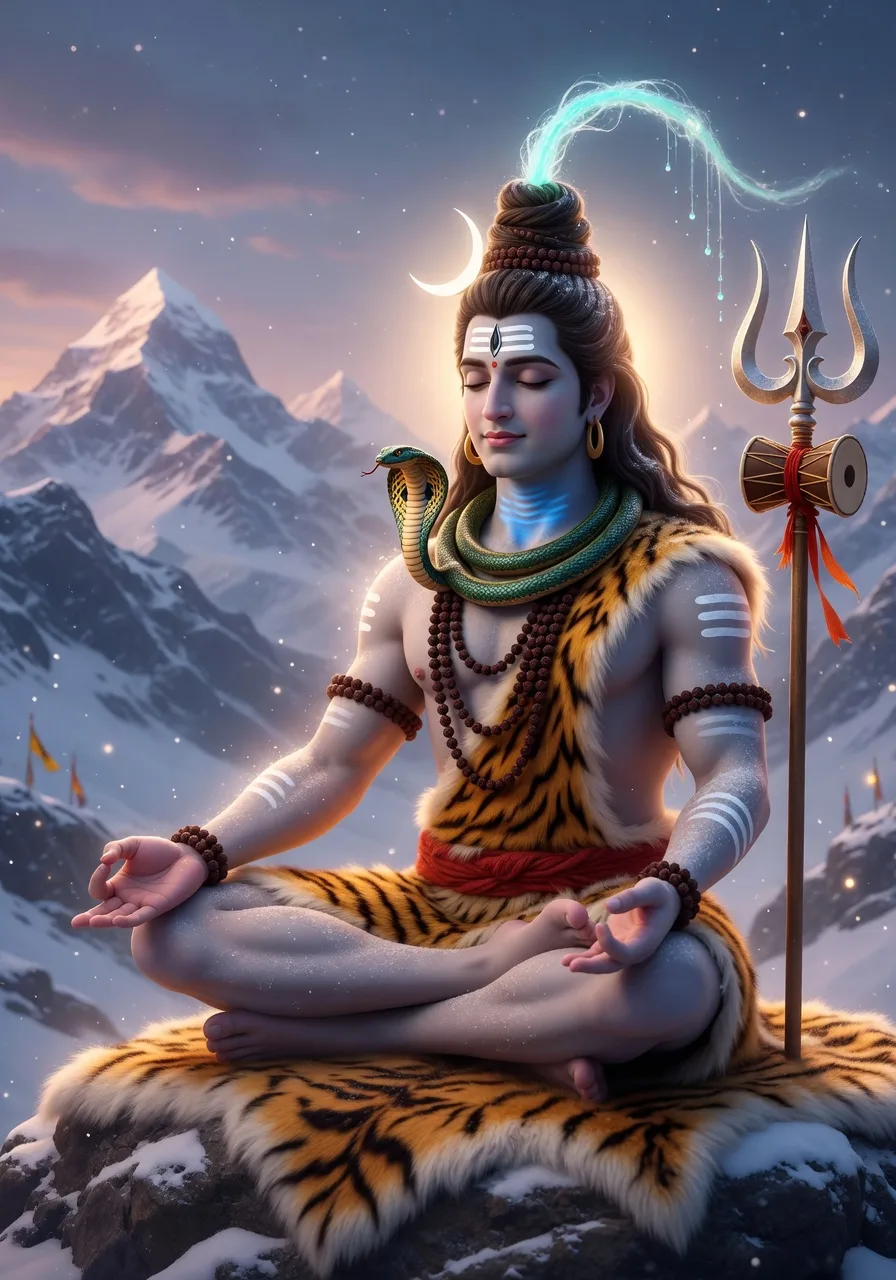
Of all the devatas, Lord Shiva is the closest to the Supreme, and the most worshipped, so he deserves a careful look. When Krishna, through Vishnu, wishes to touch the material world, he becomes Shiva, and Shiva's glance wakes up material nature. So Shiva is at once the same as Krishna and different from him, a paradox the scriptures explain with milk. Milk turns into yogurt by the touch of an acid, and the yogurt is neither quite the same as the milk nor quite different, and once turned it cannot turn back. In just this way the Lord, in contact with matter, becomes Shambhu, Shiva, for the work of destruction (Brahma Samhita 5.45). There is no difference, as milk and yogurt are one substance, and yet a difference, because Krishna and Vishnu never touch this world directly and do so only through Shiva.
So Shiva is not the Supreme Personality of Godhead, though he is intimately close to him, both divine and yet set apart by his nearness to matter and his charge over the mode of ignorance. He is not himself in ignorance, but in charge of it, and worship of him does not carry a soul to the same spiritual heights as worship of Vishnu. And yet Shiva is the kindest of all. Whoever has been cast out by society, by community, by family, by every well-wisher, Shiva takes in. He holds the key that lets a soul leave this material world, while Krishna holds the key that lets it enter the spiritual one. At Kashi it is said that when a person dies, Shiva himself comes and speaks the name of Rama into their ear, for it is Rama who carries the soul home.
His devotees come in three kinds. There are the ghosts, goblins, and strange outcast beings whom he shelters out of pure kindness. There are the yogis and ascetics who worship him in renunciation. And there are the many who simply want something, to whom this most generous of givers grants it. He stands above Brahma yet below Vishnu, a unique living being in a category all his own called Shiva-tattva, with his fifty-five qualities. His abode is Mount Kailash, also called Shivaloka, which sits beyond this world at the very corner where the material meets the spiritual, half within the spiritual realm and half outside it. He is one of the guna-avataras, in charge of ignorance, and at the end of the universe it is his work to destroy it, and through it all he remains the greatest of Vishnu's devotees. He is worshipped in the form of the linga, at the twelve great Jyotirlingas and countless smaller ones, with Kashi the dearest of his cities, and he heads one of the four authorized Vaishnava lineages, the Rudra Sampradaya. Bathed with bel leaves and milk, easily pleased, so easily that he will grant even what is bad for the asker, he is rightly called Ashutosh.
One detail puzzles many. Even Lord Rama worshipped Shiva, and people ask how the Supreme could worship anyone. The answer lies in the Lord's own humility. Great souls do not advertise themselves, and Krishna asserts his supremacy only in the Gita, caring far more to deal with his devotees as a friend than to be acknowledged as God. So the Lord both lets Shiva worship him and worships Shiva in return, for he loves his devotees that dearly, and Shiva is the greatest of them. It is no stranger than a kind employer who fetches a cup of tea for his own staff. The same Lord welcomed the poor brahmana Sudama, who came with nothing, thin and in dirty clothes, and seated him on his own bed, washed his feet, fed him, and clothed him.
Durga, the keeper of the prison
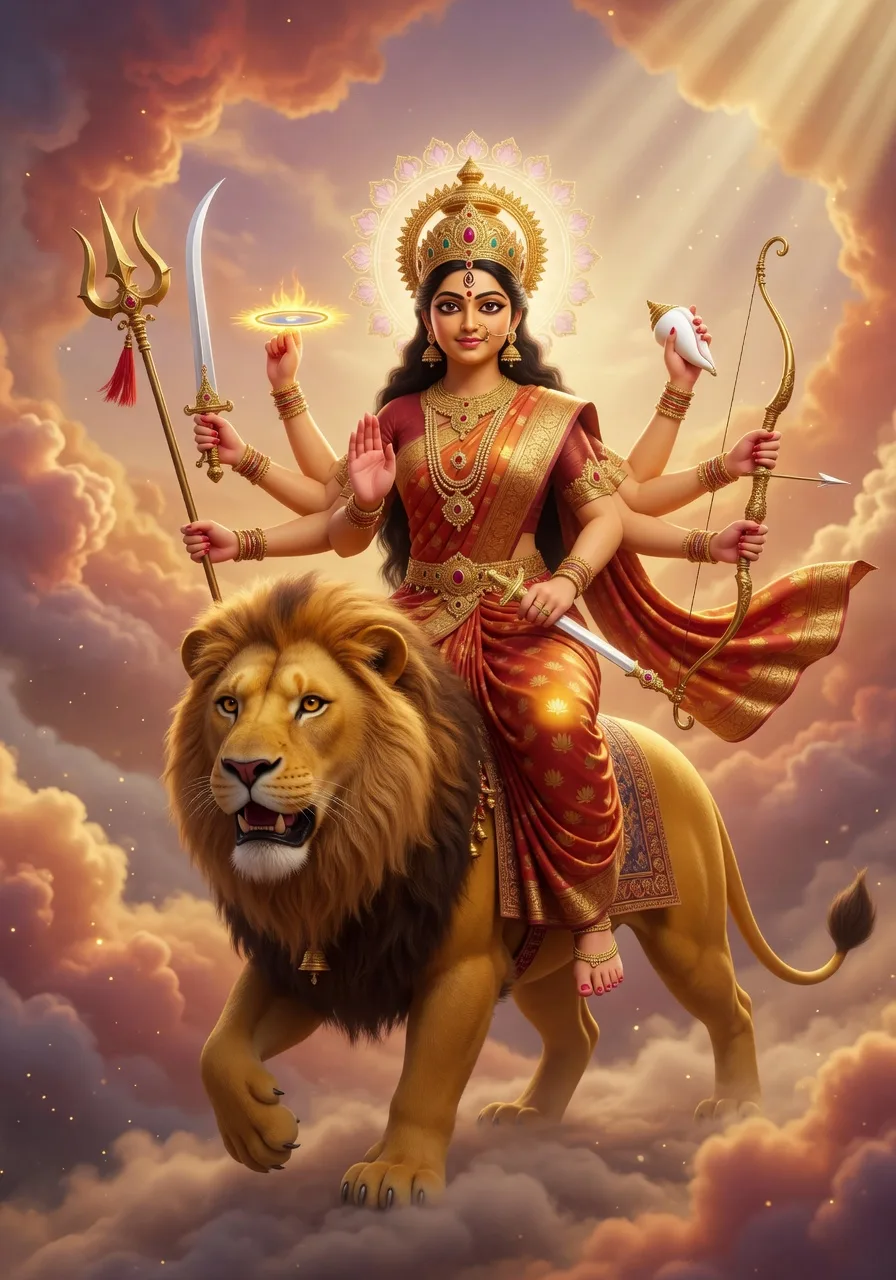
To understand Durga we begin in the spiritual world, where the Lord has three potencies, sandhini which holds existence together, samvit which is knowledge, and hladini which gives pleasure, and the pleasure-giving hladini is headed by Srimati Radharani herself. From this flow two forms often both called Durga. The first is Yogamaya, the Lord's internal potency, an expansion of Radharani. She is the one who makes even the Lord forget that he is the Lord, for if he always remembered, no one could play with him, and there would be none of the sweet exchanges of his pastimes. It is she who lets his pure devotees love him as a father, a mother, a friend, a beloved, and who arranges every pastime he performs. The second is Mahamaya, into whom Yogamaya transforms in this world, and she is the Durga we know. Her task is to reform the souls who rebelled against the spiritual realm and fell here, and to keep here those who will not be reformed. She is the one who casts the spell by which a conditioned soul believes himself happy in a world where no one can truly be happy, though she has no power at all over the liberated souls who are already with the Lord.
The image the scriptures give is a prison. This world is the prison house, and Durga is its superintendent, its gatekeeper. Life here is uncertain, misery is sure, every bond is temporary, and death is certain, and as prisoners are issued a uniform, we are issued these bodies of flesh and bone. As long as we wear one we are under her jurisdiction. But she is a pure devotee of the Lord, and her keeping of us is not cruelty. She holds us only until we are ready to reform, and the moment we turn toward the Supreme she turns from jailer to helper. The Brahma Samhita states it exactly, that the external potency Maya, the shadow of the spiritual energy, is worshipped by all as Durga, the agency of creation, preservation, and destruction in this world, and that she acts entirely according to the will of Govinda (Brahma Samhita 5.44). When a soul, through the company of the self-realised, begins to remember Govinda, Durga herself becomes the means of its deliverance.
So the whole question is what we ask of her. People worship her for wealth, health, a spouse, children, a car, and she gives these things and keeps them here, and the chance is lost. Ask instead to come closer to the Supreme, and she will carry you there. She is Shiva's consort under her many names, the original material female as he is the original material male, and their two sons are Kartikeya and the elephant-headed Ganesha. She has a hundred and eight names and a great festival, especially in Bengal, where Durga Puja runs for days, and she is shown beautiful and fierce at once, many-armed, weapon-bearing, riding her lion, famed for slaying the demon. Her sway reaches well beyond religion, and the song Vande Mataram is in essence addressed to her. The worship is vast, and the misunderstanding of it is the danger.
One story holds the lesson. Chandidas worshipped Durga and was wealthy, while his brother, a poor Vaishnava, worshipped the Shaligram. The brother once longed to offer a lovely garden flower to the Lord and, since the flower was not his to pick, offered it only in his mind. That same day Chandidas offered the very same flower to Durga, and the instant he did, the goddess appeared before him, full of pleasure, offering him a benediction. Astonished, he asked why, when he worshipped her every day, she was so pleased on this one. Because, she said, the flower you have offered me was first offered to the Lord, and seeing that sanctified flower I was delighted. He asked whether, then, she was pleased when one worships the Supreme Lord Krishna, and she answered that yes, the Supreme is the cause of all causes, and she is most pleased of all when anyone worships him, so if he wished to please her, he should worship the Supreme. Chandidas understood, became a great devotee of Krishna, and in time composed many songs on the love of Radha and Krishna in separation.
Ganesha, who clears the path
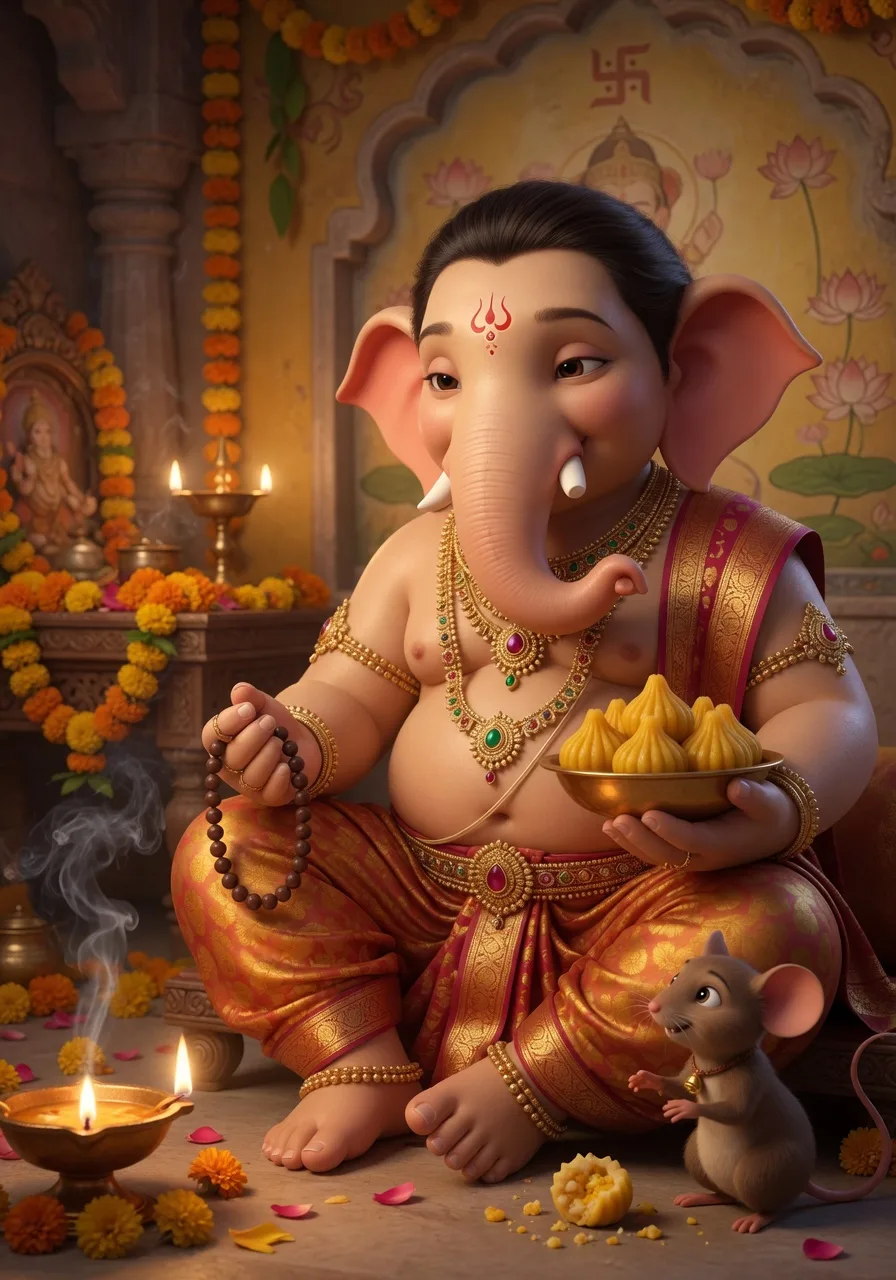
Ganesha's place is set by a single verse, which describes him forever holding the lotus feet of the Lord against the bumps of his elephant head, drawing from them the power to clear every obstacle from the path of the three worlds (Brahma Samhita 5.50). That is the heart of him. He removes the obstacles on the road toward the spiritual world, and the power to do it comes from the lotus feet of Govinda. This is why he is worshipped at the start of any undertaking, the first to be honoured before a ritual or even the buying of a car, the eldest of Shiva's sons, a chubby, lovable, fun-loving figure with his elephant head, his fondness for sweets, his tendency to overeat, and his little mouse for a carrier.
His relation to the Supreme is gentle and clear. He can help us remove the obstacles on our path to the Lord. But one who is already a devotee of Krishna need not separately worship him, nor Shiva, nor any devata, because these personalities exist eternally in the spiritual world as expansions of Vishnu, and a soul who has taken shelter of Krishna is already within their shelter. This is no disrespect. We remember these great personalities with affection precisely because they are themselves great devotees of the Lord who help others become devotees. And we owe Ganesha a particular debt, for it was he who wrote down the scriptures as they were dictated, so that when we open the Bhagavad Gita or the Bhagavatam, it is by his mercy that we can read them at all.
A note on respect
Nothing here is meant to lower the devatas. They are powerful, beautiful, and good, the trusted servants of the Lord and themselves his great devotees, and the tradition holds them in the highest respect. We may even ask their help on the path, asking Shiva to bring us closer to Radha and Krishna, honouring a devata on their day with that same prayer in our hearts. The single point of the lesson is that for liberation, for the journey out of this world and home, we worship the Supreme, and in doing so we honour every devata at once.
Key terms from this lesson
| Term | Meaning |
|---|---|
| Devata | a powerful empowered servant of the Lord who administers the universe; a post, not a fixed person |
| Shiva-tattva | Shiva's own unique category, neither ordinary soul nor Vishnu, with 55 qualities |
| Yogamaya | the Lord's internal potency, who arranges his spiritual pastimes |
| Mahamaya | the external potency, the Durga of this world, keeper of the material prison |
| Karma kanda | ritual worship for material reward, a "business" with the devatas |
| Sankarshana | the form of Vishnu on whom Lord Shiva meditates |
| Ashutosh | "easily pleased," a name of Shiva who grants even what is unwise |
What to carry forward
- There is one Supreme God and many devatas, who are his empowered servants running the universe, as ministers serve under a sovereign.
- A devata is a post that a qualified soul can hold, and even Brahma is a powerful jiva who must die; only Shiva stands in his own category, what the Lord becomes in contact with matter.
- Rupa Goswami's count, fifty qualities for the soul, fifty-five for Shiva, sixty for Vishnu, sixty-four for Krishna, maps the whole gradation.
- Devata worship brings temporary material fruits and cannot liberate, so a devotee worships the Supreme, which satisfies every devata at once.
- Shiva is the most compassionate, the greatest Vaishnava, and holds the key to leaving this world, while Krishna holds the key to entering the spiritual one.
- Durga is the keeper of the prison of this world, acting by Govinda's will, who turns from jailer to helper the moment a soul turns home.
- We respect every devata as a great devotee of the Lord, and Ganesha clears our path by Govinda's power, but for liberation we take shelter of the Supreme alone.
Previous lesson: ← The Bhagavad Gita in summary
You have reached the end of the course. Return to the full course index to revisit any lesson.
Frequently Asked Questions
Independent writer, jaapak.com
I built the Jaapak app. I write in simple Hindi on the Bhagavad Gita and the satsang tradition — so seekers don't struggle with the scripture.
Read all articlesAbout this article
The commentary is based on the general understanding of the Sanatan tradition and written in accessible language. No verbatim quotation of any modern commentator is used.