Dashavatara: The 10 Avatars of Vishnu and the Story of Evolution
The ten avatars of Vishnu — Matsya, Kurma, Varaha, Narasimha, Vamana, Parashurama, Rama, Krishna, Buddha and Kalki — their stories, their meaning, and the
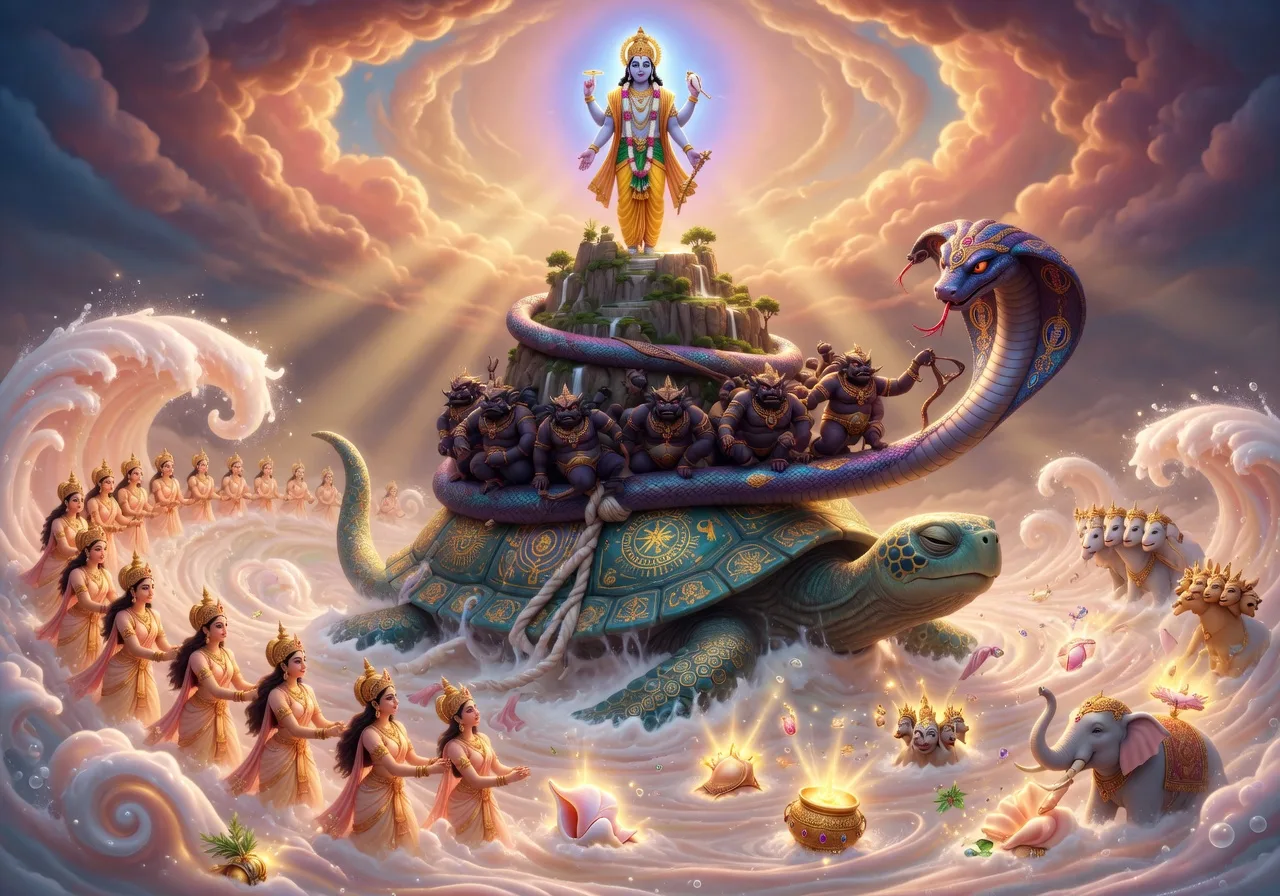
The Lord descends into this world again and again, form after form, and the ten best known of those descents are the Dashavatara, the ten avatars. There are not really only ten. There are hundreds, thousands, countless avatars without limit, but these ten are the ones everyone remembers. And remembered in order, they hold a surprise. The sequence in which they appear, fish first and a man on a horse last, traces the very ascent of life on earth, the same climb from water to land to humanity that science would map out only in the last two centuries. This lesson tells all ten stories and follows that hidden pattern through them.
Is Sanatana Dharma one God or many?
People often say, "you have so many gods." The Bhagavad Gita is clear that there is only one God, yet the truth is richer than a flat "one God." There is one supreme Lord, and he expands himself endlessly into avatars and forms, so the Vedic idea is best called polymorphic monotheism, many forms of the one God. There are also the devatas, the demigods, who serve as intermediaries on different levels, which makes it multi-layered. And the one supreme form appears as a divine couple, Radha and Krishna, Sita and Rama, Lakshmi and Narayana, two who are one. Put together, the Vedic conception of God is a multi-layered, polymorphic, two-in-one monotheism. Complex, but it holds together: one God, with countless aspects.
Who is that one source? The Brahma Samhita, the Vishnu Purana, and the Srimad Bhagavatam all point to Krishna as svayam Bhagavan, the original Supreme Personality of Godhead from whom all the other forms come. The simplest answer is that the one God is Krishna. He takes so many forms because he wishes to attract everyone and will not confine devotion to a single shape. Each soul longs to love him in its own way, and he meets every one of them.
Parikshit Maharaja once asked why the Lord takes forms we would not call beautiful, like Varaha the boar. The answer is that the Lord is always transcendental, never touched by material conditions, in any form he takes. He comes as a fish, a tortoise, a boar, a lion-man, because every kind of life belongs to him, and by entering each kind he draws all living beings toward himself.
The Dashavatara as a map of evolution
Long before anyone drew a tree of life, the order of these ten descents had already traced one. Read them in sequence and a striking pattern appears, the same rising staircase of life that modern biology would describe many centuries later.
Matsya is a fish, and life on earth began in the water. Kurma is a tortoise, an amphibian at home in the sea and on the shore, life's first step onto land. Varaha is a boar, a full land mammal. Narasimha is half lion and half man, the strange threshold where the animal becomes human. Vamana is a dwarf, the first complete human form but small and unfinished, like the short early people. Parashurama is a man with an axe, human now but wild, forest-dwelling, his single tool a weapon. Rama is the civilised man, the king who brings law, society, and settled order. Krishna is the complete human being, cowherd, statesman, philosopher and lover at once, the full flower of human capacity, who speaks the Bhagavad Gita. Buddha is the inward turn, the human mind reaching past the body toward enlightenment and non-violence. And Kalki is what is still to come.
Water, then amphibian, then mammal, then the man-beast, then the dwarf-man, then the rough man, then the lawful man, then the complete man, then the awakened man. The geneticist J. B. S. Haldane, no devotee of any temple, once remarked that the Dashavatara gives "a rough idea of vertebrate evolution." He was right that the pattern is there. But it would be a mistake to read these as merely an ancient guess at biology. Each avatar descends for a reason of its own, to rescue the Earth, to shelter a devotee, to restore dharma, and the order in which they come happens to climb the same ladder that life itself climbs.
Sanatana Dharma had already taught that ladder from the other side. The soul rises through some 8.4 million species, life after life, until it reaches the human form where it can at last ask who God is. The avatars come down the same staircase the soul is walking up, and they meet in the middle, at the human form. Seen this way, evolution is not a blind accident of chemistry but the soul's long journey home, and the Lord steps onto every rung of it.
The ten avatars at a glance
| # | Avatar | Form | Age | Evolutionary rung |
|---|---|---|---|---|
| 1 | Matsya | the fish | Satya Yuga | life in the water |
| 2 | Kurma | the tortoise | Satya Yuga | amphibian, sea and land |
| 3 | Varaha | the boar | Satya Yuga | the land mammal |
| 4 | Narasimha | the lion-man | Satya Yuga | animal becoming human |
| 5 | Vamana | the dwarf brahmin | Treta Yuga | the first, small human |
| 6 | Parashurama | the axe-bearing sage | Treta Yuga | early man, wild, armed |
| 7 | Rama | the ideal king | Treta Yuga | the civilised, lawful man |
| 8 | Krishna (with Balarama) | the cowherd-statesman | Dvapara Yuga | the complete human being |
| 9 | Buddha | the awakened teacher | Kali Yuga | the inward, enlightened mind |
| 10 | Kalki | the rider, yet to come | end of Kali Yuga | the future |
1. Matsya, the fish who saved the seeds of life
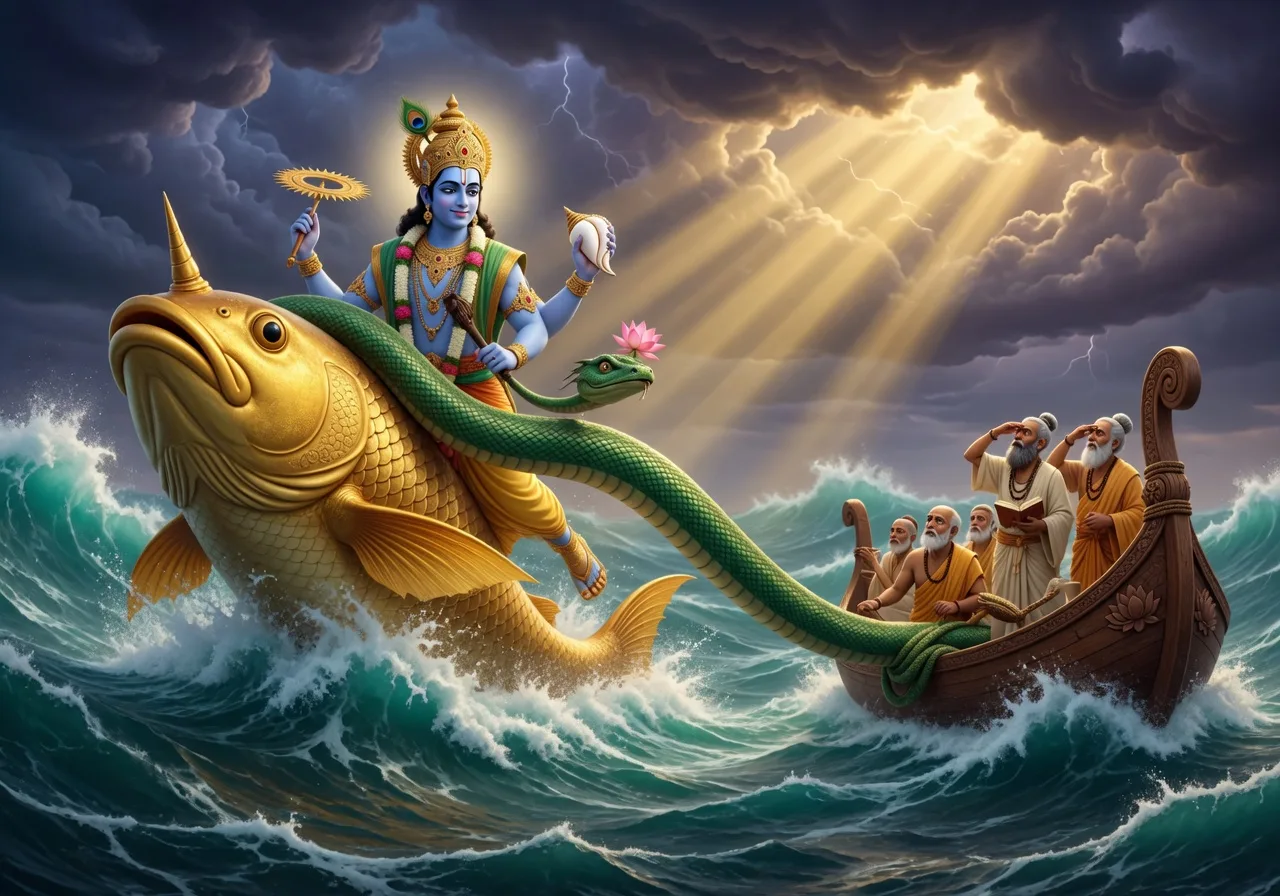
A righteous king named Satyavrata was offering water from the Kritamala River when a tiny fish appeared in his cupped palms and spoke: "Why throw me back, where bigger fish will eat me? I am afraid. Please protect me." Astonished, and being the protector of every creature in his realm, the king kept the fish in a jug. By the next day it had outgrown the jug, so he moved it to a well, then a pond, then a lake, and each it outgrew within a day, until he set it in the ocean and understood that this was no ordinary fish.
The fish revealed himself: "I am the Supreme Personality of Godhead. In seven days this whole universe will be flooded. A great boat will come. Gather every kind of herb and seed, load them aboard with the seven sages, the Saptarishis, and the creatures of the world, and do not lose heart. When the storm tosses the boat, tie it to my horn with the great serpent Vasuki as a rope, and I will guide you to safety and speak to you the knowledge of the Vedas." A week later the rains came, the boat came, they tied it to Matsya's horn, and he carried them through the deluge, instructing them all the while. It is the same story the world knows as Noah's ark.
The first descent is a fish because the first life was a fish, and the flood from which Matsya saves the seeds of every species is, fittingly, the water out of which life itself first came.
2. Kurma, the tortoise at the churning of the ocean
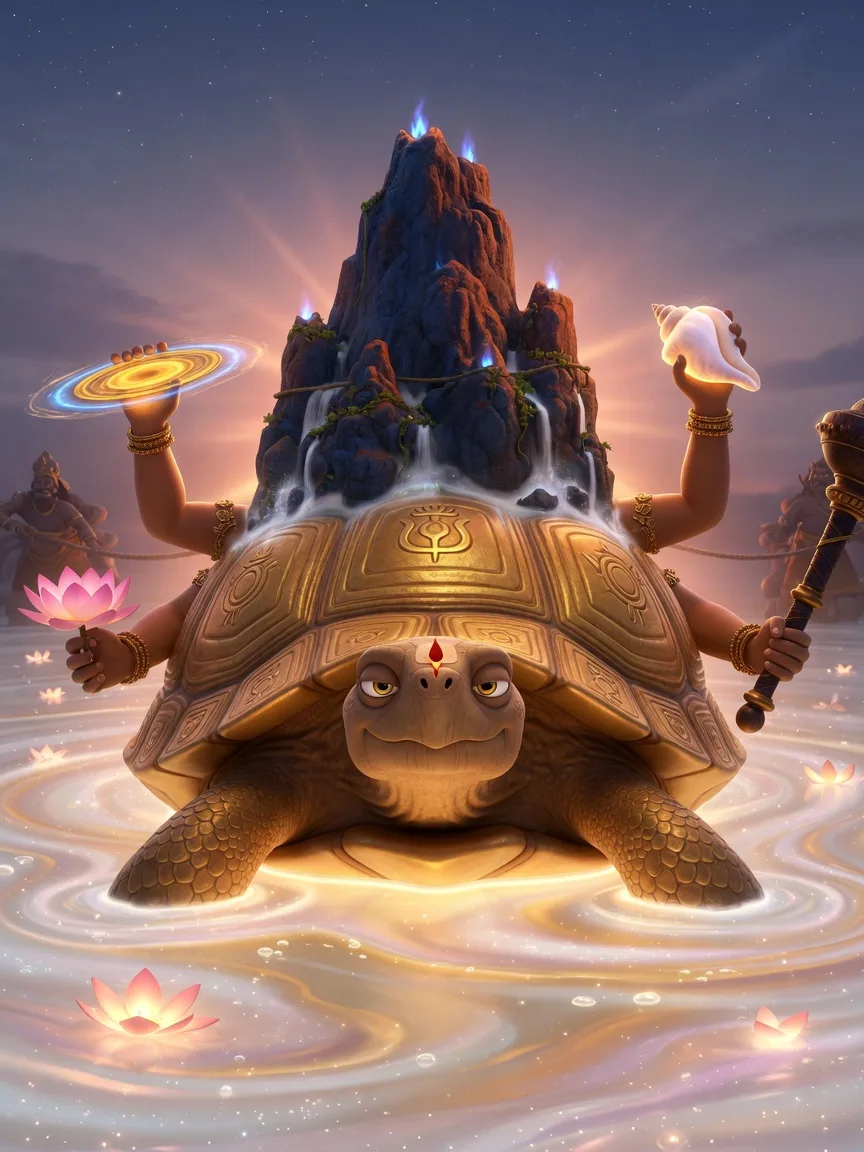
The demigods, weakened by a curse from the sage Durvasa whom Indra had offended, were losing to the demons. They went up to the planet where the Lord resides, an embassy of the spiritual world that the demigods may enter to petition him, and asked for help. He gave them strange advice: make peace with the demons, and together churn the ocean of milk for its hidden nectar. "I will become Kurma, the tortoise, and hold up the mountain on my back, and you will use the serpent Vasuki as your churning rope." So Mount Mandara was set on the tortoise's back, the demons gripped the serpent's head and the demigods its tail, and the churning began.
The first thing to rise was not nectar but a deadly poison, and in their terror they ran to Lord Shiva, who swallowed it and held it in his throat, which turned blue, earning him the name Nilakantha. Then came the treasures, one after another, Dhanvantari the physician of the gods, Lakshmi Devi, the cow Gau Mata, the healing herbs, and at last the pot of amrita, the nectar of eternal life. The demons snatched it and fled, so the Lord appeared again, this time as Mohini, a woman of bewitching beauty, and won the nectar back for the demigods. Because drops of that nectar fell to earth at four places, the Kumbh Mela is held to this day at Haridwar, Prayag, Ujjain, and Nasik.
The tortoise lives in two worlds, water and land. The second descent is the amphibian, life taking its first step out of the sea onto the shore.
3. Varaha, the boar who lifted the Earth
The four Kumaras, the eternal child-sages who are Brahma's first sons, were once turned away at the gate of Vaikuntha by the doormen Jaya and Vijaya, who mistook them for children. The offended sages cursed the two to be born on earth, and the Lord, apologising, offered them a choice: to return to him after seven lives as his devotees, or after only three as his enemies. They chose the shorter road of three demon lives, to be parted from him for less time.
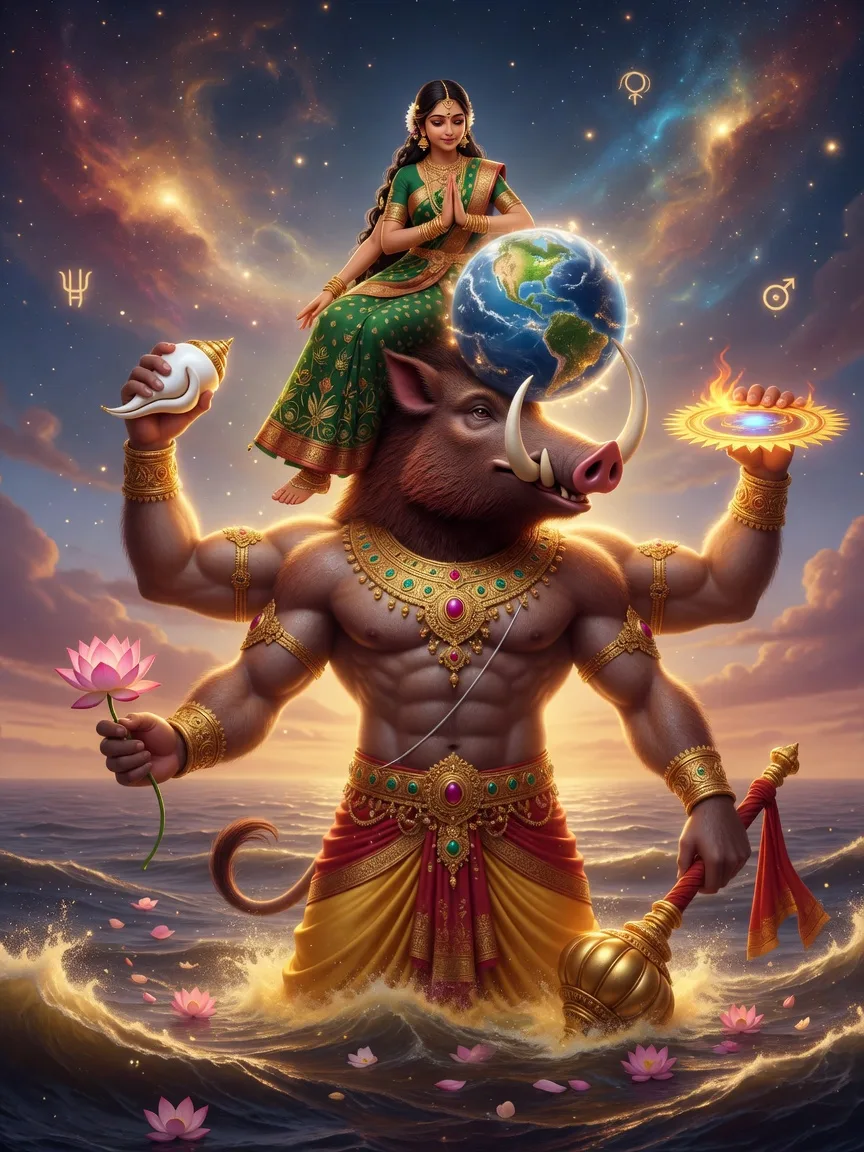
In their first life they were born as the brothers Hiranyaksha and Hiranyakashipu. Hiranyaksha, fresh from the spiritual world and immensely strong, dragged the Earth from her place and sank her into the cosmic Garbhodaka ocean. To rescue her the Lord appeared as Varaha, the boar, dived into the depths, lifted the Earth on his tusks, and set her back in her orbit, then fought and defeated Hiranyaksha in a battle he thoroughly enjoyed, for the Lord cannot fight among the devotees of the spiritual world and so comes here for a worthy opponent.
The boar is a full creature of the land, rooting in the soil with its tusks. The third descent has left the water behind entirely: this is the land mammal, life established on solid ground.
4. Narasimha, the form between animal and man
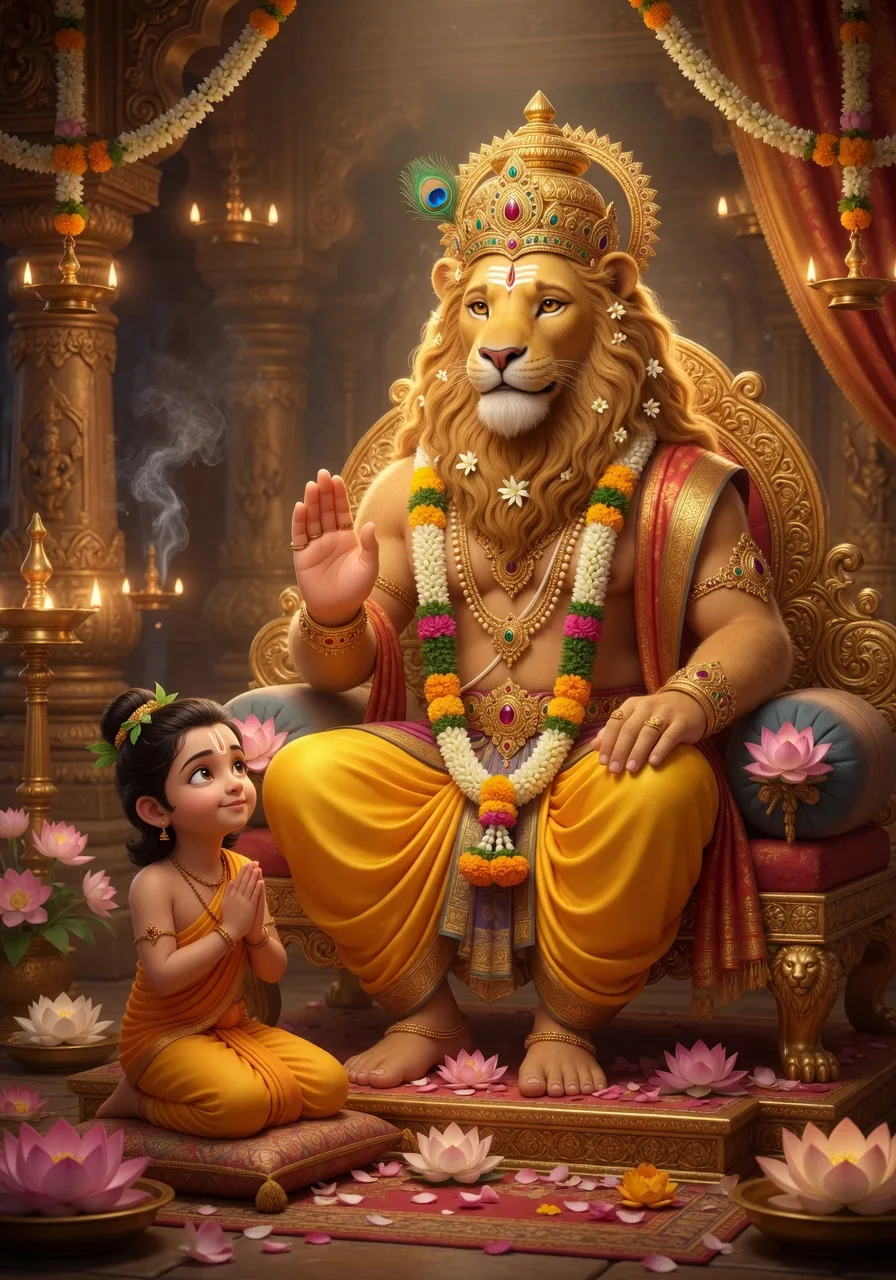
Hiranyaksha's brother Hiranyakashipu set out to conquer death itself. Through ages of fierce austerity, standing on his toes with arms raised until ants ate away his body, he drew Brahma to him. He asked first for immortality, but Brahma answered that he too, though he lives more than three hundred trillion years, must one day die, and cannot give what he does not himself have. So the demon asked instead for a web of boons: that he could be killed by no man and no animal, by no weapon, neither by day nor by night, neither inside nor outside, neither on the ground nor in the air. He believed himself immortal, and forced the whole world to worship him as God.
His own five-year-old son refused. While the demon was away at his austerity, the demigods had seized his pregnant wife, meaning to kill the child, until Narada Muni stopped them, promising the boy would be a great devotee, and took her to his ashram. There she sometimes dozed as the sage taught, but the child in her womb drank in every word, and so Prahlada was born loving only Vishnu. Enraged, Hiranyakashipu tried to kill the boy in every way, by sword, by elephant, by a pit of snakes that turned to ropes, by poison that turned to nectar, by the fire of his aunt Holika, and by a fall from a cliff, and each time Prahlada, undisturbed and chanting Om Namo Bhagavate Vasudevaya, came to no harm. At last the father demanded, "Where is this Vishnu of yours? Is he in this pillar?" and struck it with his sword.
With a roar that shook the earth, the Lord came out of the pillar as Narasimha, walking upright but with the head of a lion, his eyes like fire and his mane like a thousand serpents. Honouring every one of Brahma's boons, he laid the demon across his lap, neither on the ground nor in the air, on the threshold of the doorway, neither inside nor outside, at the hour of dusk, neither day nor night, and ended him with his nails, no weapon at all, being himself neither man nor beast. The Lord cannot be outwitted. Yet to his small devotee Prahlada he was gentleness itself, and when the boy asked nothing for himself but only that his cruel father be forgiven, the Lord told him that through his devotion twenty-one generations were already freed. We pray to Narasimha for protection to this day.
Half lion, half man, walking upright on the threshold of a door: there is no clearer image of the fourth rung, the exact moment in the ascent of life where the animal stands up and becomes human.
5. Vamana, the dwarf who measured the universe
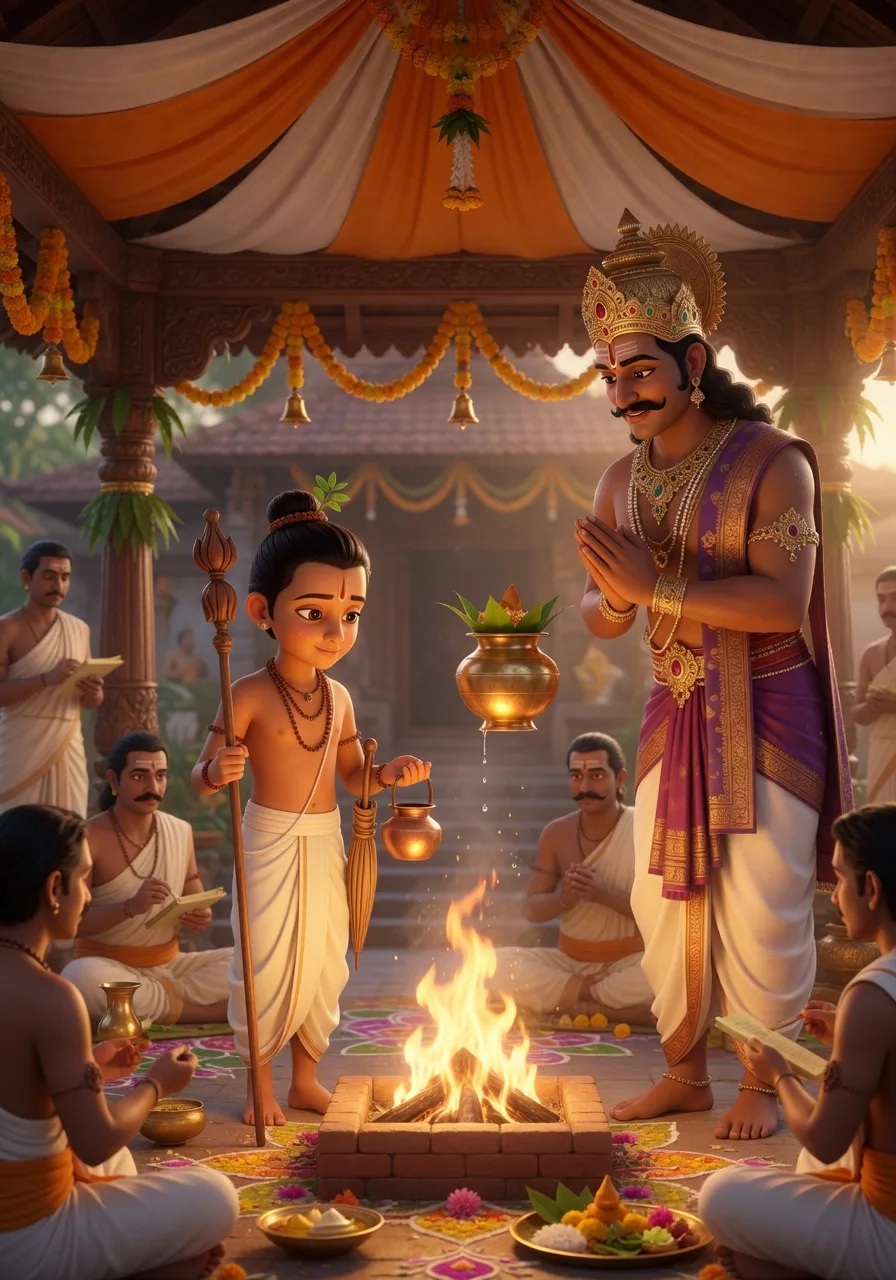
When the demon king Bali Maharaja, guided by his guru Sukracharya, had conquered the heavens and driven out Indra, Indra's mother Aditi prayed to the Lord, who took birth from her and appeared as Vamana, a small brahmin boy. Bali was performing a great sacrifice when the radiant boy arrived, and the generous king rose to honour him and offered him anything at all, land, gold, villages, cattle. Vamana asked only for three paces of land. Bali laughed that he could give a whole planet, but the boy said one should not be greedy, three steps would do.
Sukracharya saw at once that this was the supreme Lord come to take everything, and told Bali to withdraw his promise, but Bali refused to break his word even to Vishnu himself, and accepted his guru's curse rather than go back on it, for though a demon he was in truth a great devotee. Then Vamana grew. With the first step he covered the Earth, with the second the whole of the universe, and he became Trivikrama, the Lord of three strides. Asked where the third step should fall, Bali bowed his head and offered it: "Place your foot here, my Lord, I surrender." So pleased was the Lord that he gave Bali the realm of Patala and became his gatekeeper for all time.
Vamana is a dwarf, a complete human being and yet small and unfinished. The fifth rung is the first true human, but a short and early one, before the body had grown into its full stature.
6. Parashurama, the axe-bearer who humbled the warriors
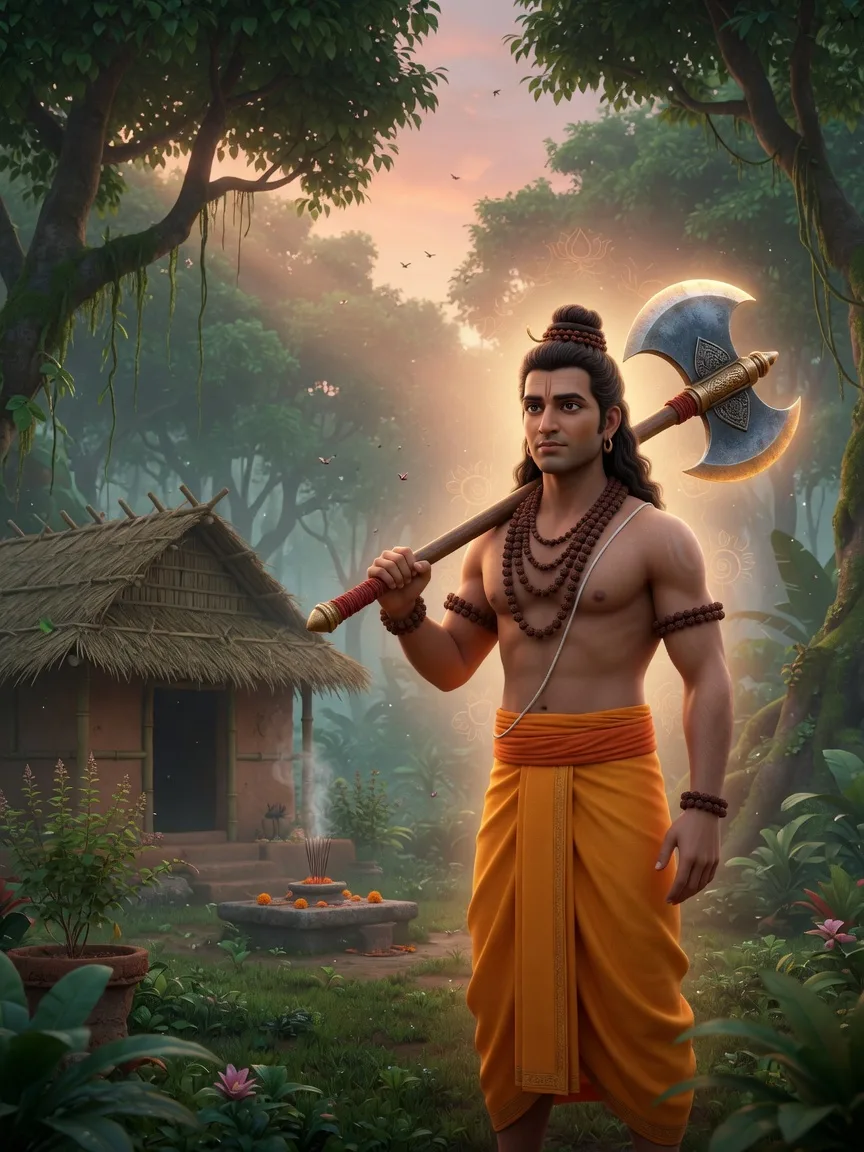
Parashurama was born to the sage Jamadagni and his wife Renuka, a brahmin by birth who took up a warrior's weapon. His name means "Rama with the axe," for the axe was a gift from Lord Shiva, whom he had pleased with long penance. In his age the kshatriyas, the warrior kings whose whole duty was to protect the people, had turned into tyrants and predators, and the worst of them, the thousand-armed king Kartavirya Arjuna, came to the hermitage, stole the family's wish-fulfilling cow by force, and later had the gentle Jamadagni killed.
Grief and fury rose in Parashurama, and he took up the axe. Twenty-one times over he cleared the earth of that corrupt and cruel warrior class, until the balance was restored and the meek could live unafraid. He is one of the deathless sages, said to be in deep meditation still. His descent carries two lessons at once. When those appointed to protect become the ones who prey, the Lord himself will take up the axe against them. And yet his story is also a long meditation on the danger of anger, even righteous anger, which is why the later avatars move away from the axe and toward the law.
On the ladder of life he is the early human, fully human now but still half-wild, a forest-dweller whose single great tool is a weapon. Man has arrived, but civilisation has not.
7. Rama, the perfect man and the rule of law
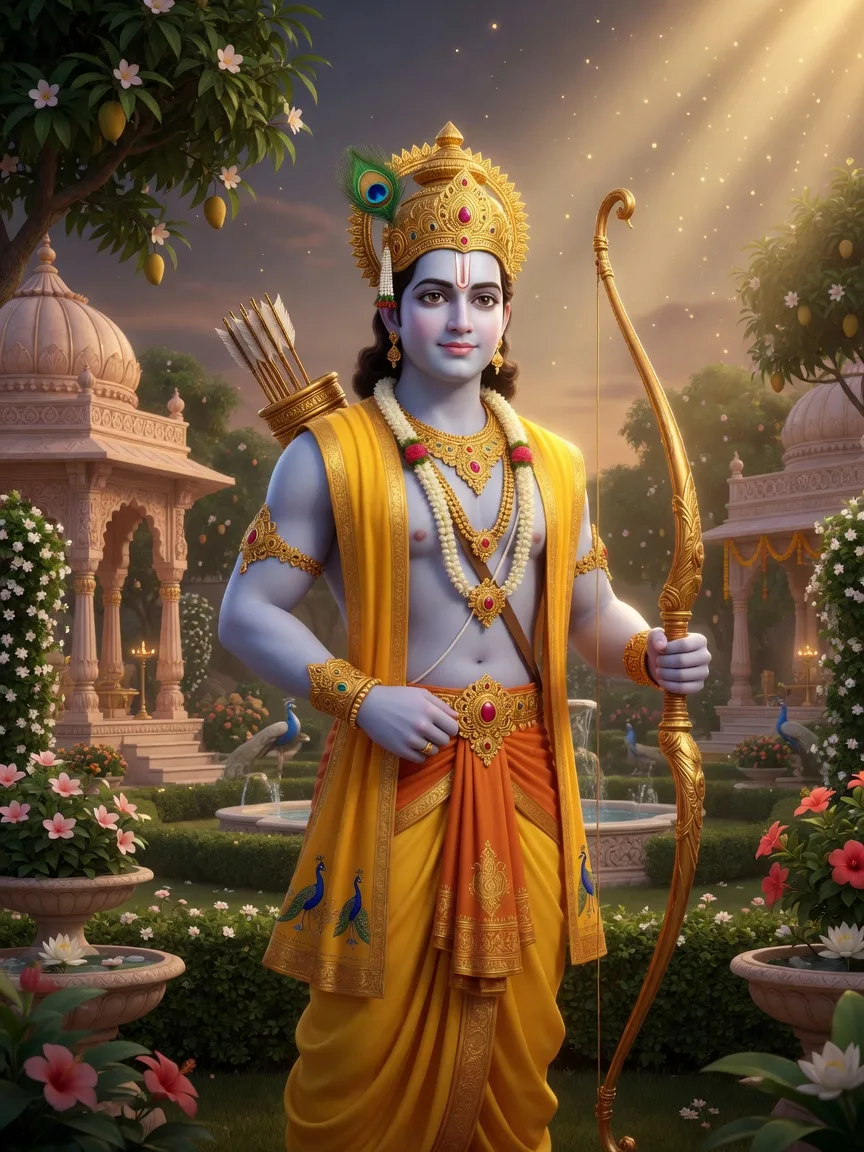
Rama, prince of Ayodhya and son of King Dasharatha, is the hero of the Ramayana and the very model of dharma. He came, as the tradition puts it, to behave as the ideal human being, and almost never displayed his divinity, teaching instead by the flawless example of his life. On the eve of his coronation he was exiled to the forest for fourteen years to honour a promise his father had been bound to keep, and he went without a moment's complaint, the ideal son. His wife Sita followed him, the ideal wife; his brother Lakshmana followed too, the ideal brother, while another brother, Bharata, ruled in his place but set Rama's sandals on the throne and governed only as his servant.
In the forest the demon king Ravana abducted Sita and carried her to Lanka. Rama formed an alliance with the vanaras, and his greatest devotee Hanuman leapt the ocean to find her, a bridge was built, Ravana was defeated, and Rama returned to rule. His reign, Rama-rajya, became the byword for a kingdom of perfect justice, where none went hungry or afraid. Because his story is so vast and so dear, it has a lesson of its own later in this course.
Here is the seventh rung: the civilised man. The wild forest-warrior has given way to the lawful king, to society, duty, marriage, and settled moral order. Humanity has grown up.
8. Krishna, the complete human being
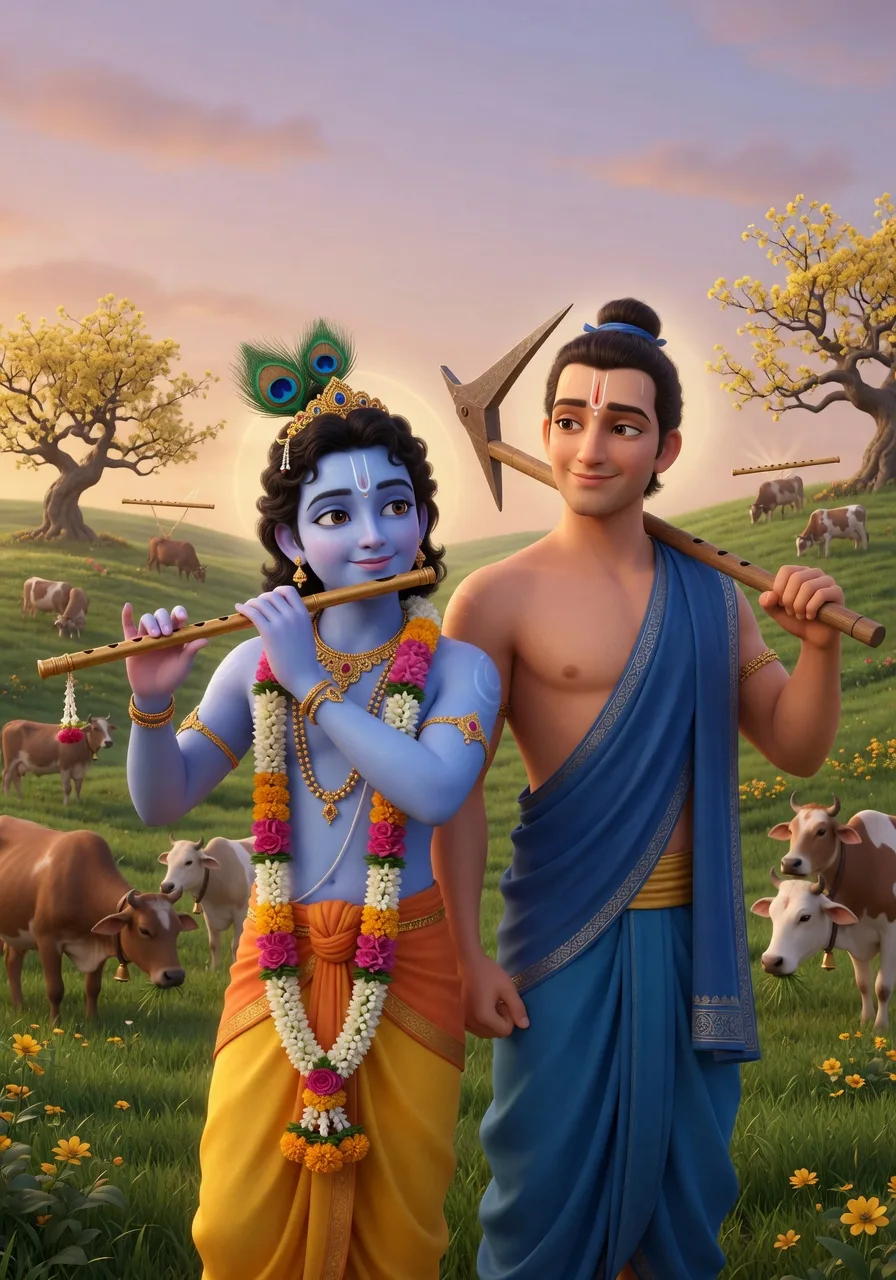
Krishna appeared in Dvapara Yuga with his elder brother Balarama, and he is not a partial descent like the others but svayam Bhagavan, the original Lord himself, the source from whom all the avatars come. He lived the fullest life imaginable. He was the butter-stealing child of Vrindavan and the flute-player who enchanted the cowherd girls; he lifted Govardhan Hill on one finger to shelter his village from Indra's storm; he was a prince, a warrior, a statesman who steered the politics of an age, and finally the charioteer who, on the battlefield of Kurukshetra, spoke the Bhagavad Gita to Arjuna. Balarama, his brother, is his first expansion, the bearer of the plough, embodying strength and the dignity of the land.
If Rama is the ideal man, Krishna is the complete one: tenderness and statecraft, philosophy and play, the deepest love and the highest wisdom held in a single life. Every one of the divine qualities shows in him in full. Because his life and teaching are so large, they too unfold in their own lessons further on.
On the ladder he is the full flower of the human being, the height of what a human life can hold, intellect and art and love and government all at once.
9. Buddha, the awakening of the mind
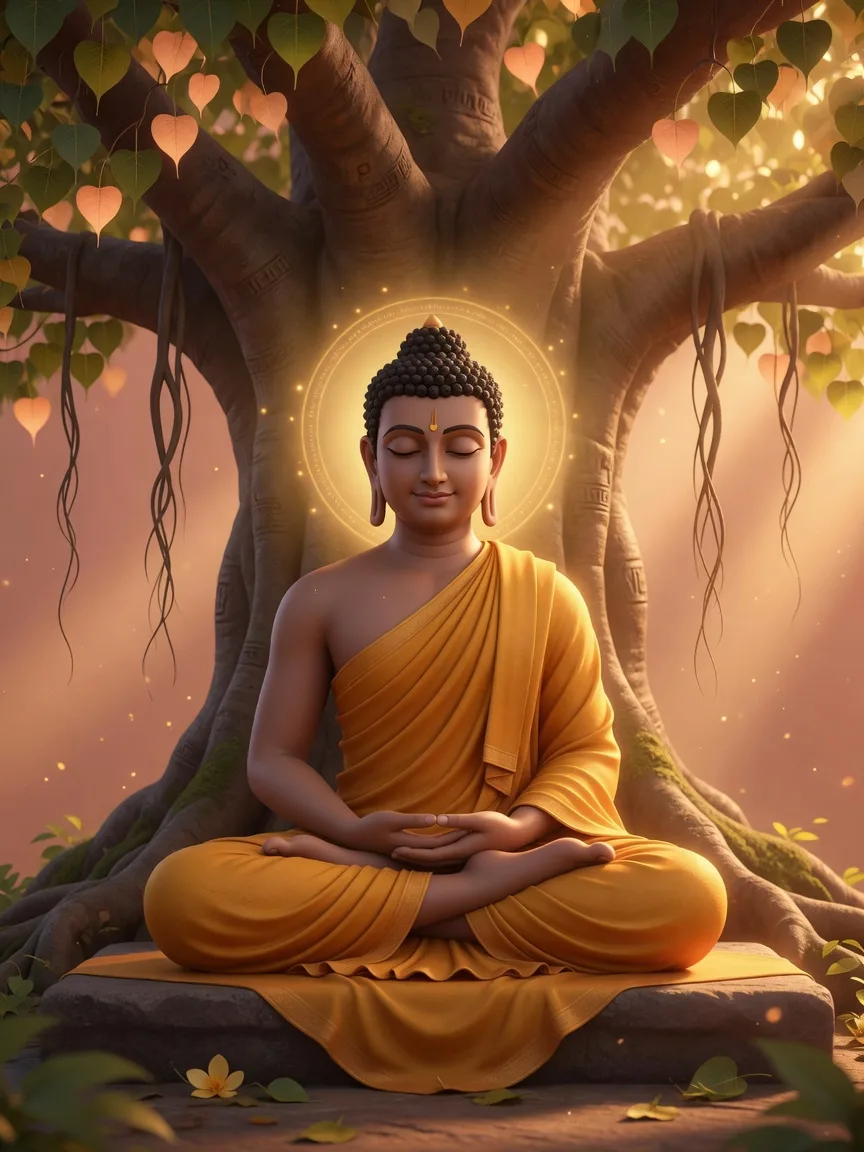
The Srimad Bhagavatam names Buddha among the avatars, foretelling that the Lord would appear in the age of Kali as the son of Anjana to bewilder the enemies of the gods. Born a prince, Siddhartha Gautama left his palace when he saw old age, sickness, and death for the first time, sat in meditation until he awoke beneath the Bodhi tree, and taught a path of compassion and non-violence.
The Vaishnava understanding of his descent is tender and particular. By the close of the earlier ages the Vedic rites of animal sacrifice had rotted into a mere licence for killing, men slaughtering creatures in the name of religion. So the Lord came as Buddha and, out of compassion, drew people away from the scriptures they were abusing, teaching them not to kill, not to harm, to turn the mind inward. He set the outward letter of the Vedas aside precisely in order to rescue their inner heart, which is non-violence and self-knowledge. It was a kindness wearing the mask of a refusal.
His is the ninth rung, and it is no longer about the body at all. Man has stood up from the water, grown civilised, and now turns inward; this is the awakening of the mind, the human being reaching past the flesh toward enlightenment.
10. Kalki, the avatar yet to come
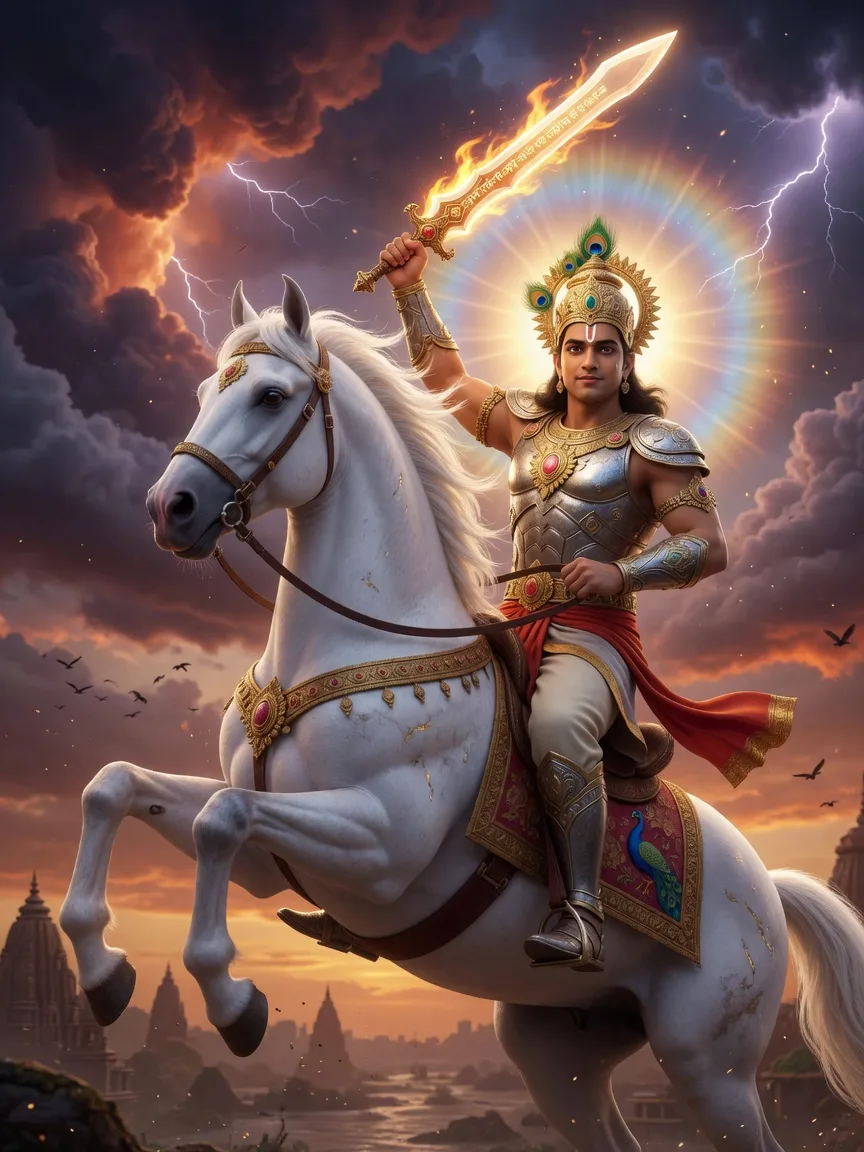
The tenth avatar has not yet appeared. We stand near the beginning of Kali Yuga, the age of quarrel and darkness, which runs for 432,000 years and of which only about five thousand have passed. As it draws toward its end, when dharma has all but vanished from the earth and cruelty rules unchecked, the Lord will come as Kalki, born in the village of Shambhala to a brahmin named Vishnuyasha. He will ride a swift white horse, raise a blazing sword, and sweep the wicked from the world, bringing the long night of Kali to a close and opening a fresh Satya Yuga, a new golden age. Then the great wheel of the four ages turns once more, and the whole cycle begins again.
Kalki is the rung that has not been climbed. He is the future, the promise that however dark the age becomes, the Lord will descend one final time to set it right.
Key terms from this lesson
| Term | Meaning |
|---|---|
| Avatar | a descent of the Lord into this world; literally "one who comes down" |
| Dashavatara | the ten most celebrated avatars of Vishnu |
| Svayam Bhagavan | the original Supreme Lord, Krishna, source of all other forms |
| Matsya | the fish avatar who saved the seeds of life from the flood |
| Kurma | the tortoise who upheld Mount Mandara at the churning of the ocean |
| Varaha | the boar who lifted the Earth from the cosmic ocean |
| Narasimha | the lion-man who appeared to protect Prahlada |
| Trivikrama | Vamana grown vast, who crossed the universe in three steps |
| Kalki | the future avatar who will end Kali Yuga |
What to carry forward
- There is one God, who expands into unlimited forms, so Sanatana Dharma is best called a layered, many-formed, two-in-one monotheism, and the one source is Krishna, svayam Bhagavan.
- The Lord is fully transcendental in any form, even a fish or a boar, and descends to attract every kind of soul.
- Read in order, the ten avatars trace the ascent of life: fish, amphibian, mammal, man-beast, dwarf-man, wild man, civilised man, complete man, awakened man, and the future.
- Matsya saved the seeds of life, Kurma upheld the churning that gave the nectar, and Varaha lifted the Earth.
- Narasimha came from a pillar to protect a five-year-old devotee, and Vamana measured the universe in three steps and was conquered by Bali's surrender.
- Parashurama humbled a corrupt warrior class, Rama brought the rule of law, Krishna was the complete human being, and Buddha turned the mind inward toward compassion.
- Kalki is still to come, to end the age of darkness and begin a new golden age, and the soul, rising through 8.4 million species, climbs the very staircase the avatars descend.
Previous lesson: ← Samskara: the sacraments of a lifetime
Next lesson: Brahma Samhita and the abode of the Lord →
Back to the full course index.
Frequently Asked Questions
Independent writer, jaapak.com
I built the Jaapak app. I write in simple Hindi on the Bhagavad Gita and the satsang tradition — so seekers don't struggle with the scripture.
Read all articlesAbout this article
The commentary is based on the general understanding of the Sanatan tradition and written in accessible language. No verbatim quotation of any modern commentator is used.