Brahma Samhita 5.23: How Creation Begins in Darkness
A study of Brahma Samhita verse 5.23: the cosmology of Maha Vishnu and the Causal Ocean, Brahma born on the lotus into darkness, and how creation, like every
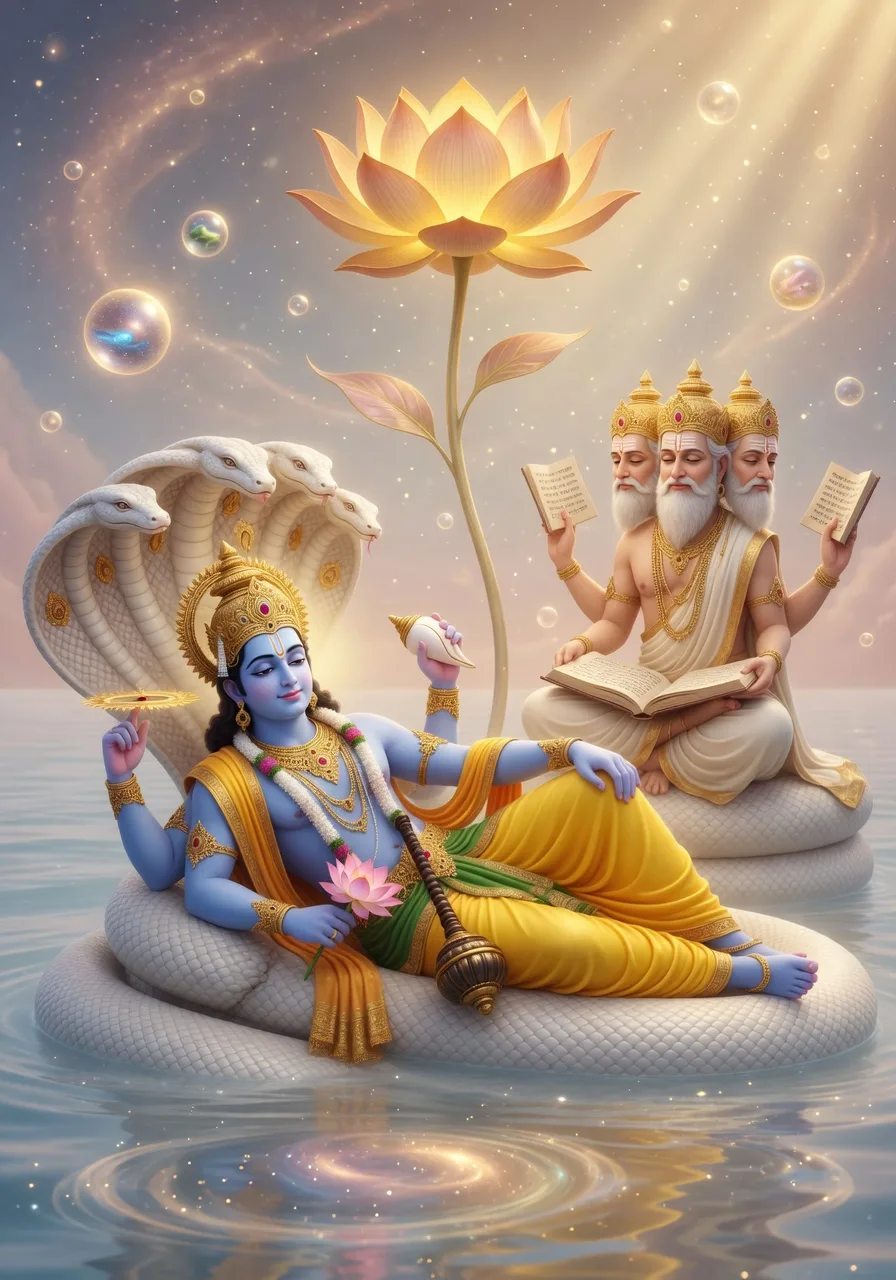
The Brahma Samhita is a set of prayers that Brahma himself offered to Govinda at the dawn of creation, and its fifth chapter holds some of the most precious verses in all of Sanatana Dharma. This lesson follows that chapter to its twenty-third verse, where the creator of our universe is born onto a lotus, looks around, and finds only darkness. What he does next, and why, opens up the whole meaning of samskara, the impressions we carry from life to life.
What is the Brahma Samhita?
The Brahma Samhita is an ancient scripture of Brahma's own realisation, and its fifth chapter was treasured and carried back from a temple in South India by Chaitanya Mahaprabhu, who recognised it at once as a jewel. Its very first verse is the anchor we have already met: "Krishna, who is known as Govinda, is the supreme Godhead. He has an eternal, blissful, spiritual body. He is the origin of all, himself without origin, and the prime cause of all causes" (Brahma Samhita 5.1).
From that origin the chapter unfolds the whole architecture of creation, verse by verse, down to the moment Brahma awakens. Verse 5.23 sits at the end of that descent, so to understand it we first follow the path that leads there.
The cosmology that leads to verse 23
The verses before 5.23 describe, step by step, how the one Lord becomes the many worlds.
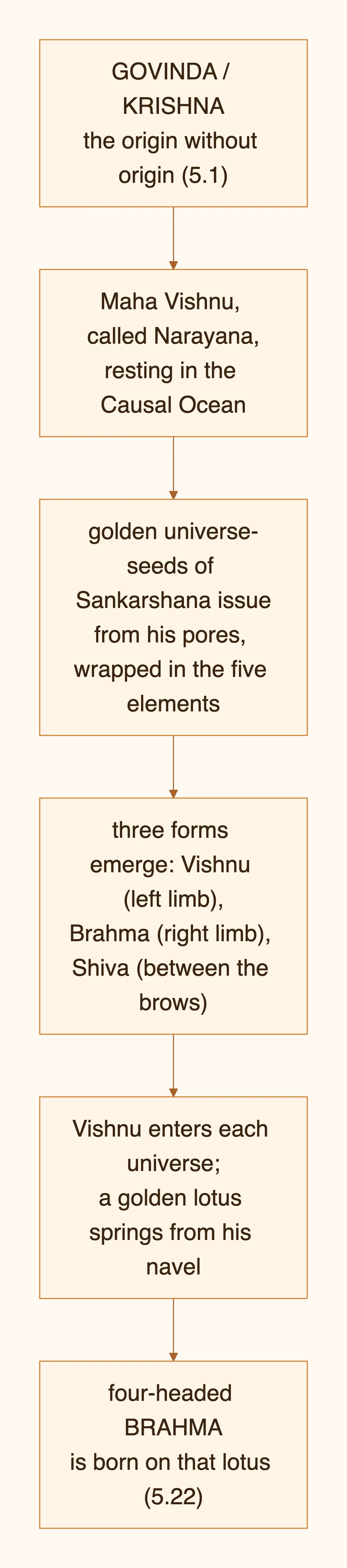
The same supreme person, resting as Maha Vishnu on the spiritual Causal Ocean in a state of divine sleep, yoga-nidra, sends out countless universes, which appear as golden seeds from the pores of his skin, each one a seed of his portion Sankarshana and wrapped in the five great elements. Those elements first lie separate and unmixed, and it is the Lord, stirring Maya by his spiritual potency, who joins them together so that worlds can take shape. He then expands into three forms for the work of the world, Vishnu for its preservation, Brahma for its creation, and Shiva for its destruction, the three drawn respectively from his left side, his right side, and the space between his brows, and from Shambhu, the form of Shiva, in relation to the soul, the mundane ego, the ahankara, arises. Entering each universe with his own form, Vishnu lies upon the inner ocean of milk, and from his navel a single golden lotus rises on a long stem. On that lotus, at the very top, four-headed Brahma, knower of the four Vedas, takes his birth. Through all of this the individual soul, the jiva, is never created and never destroyed. The jiva is eternal, beginningless, and joined to the supreme Lord by an everlasting kinship, lying dormant through the cosmic dissolution and waking once more, with its old desires, when the Lord re-enters the universe to begin it anew.
Verse 5.23: Brahma alone in the dark
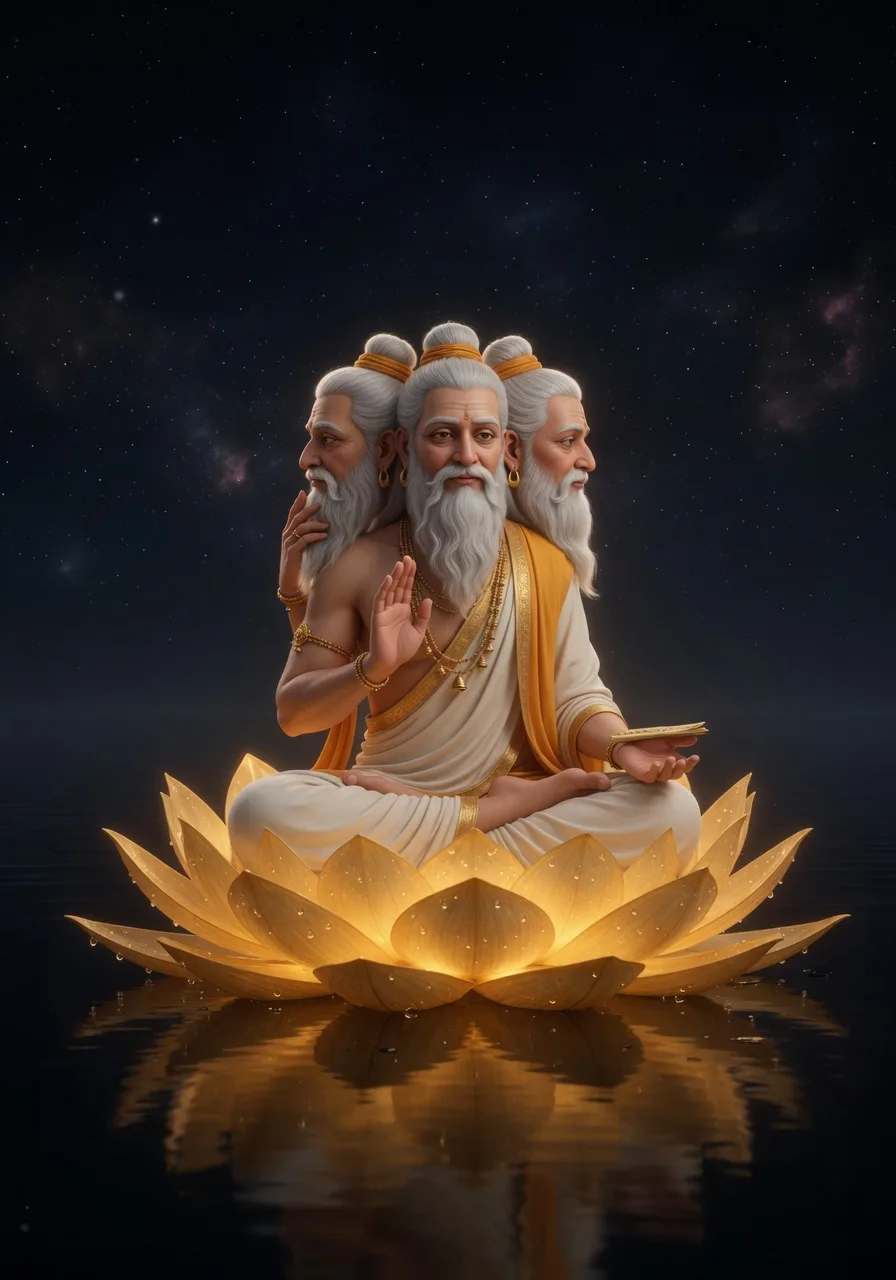
So Brahma is born, alone, on a lotus floating in the waters, with the task of building an entire universe ahead of him.
Here is the verse:
"Coming out of the lotus, Brahma, guided by the divine potency, tuned his mind to the act of creation under the impulse of previous impressions. But he could see nothing but darkness in every direction." (Brahma Samhita 5.23)
Read that carefully, because two things are happening at once. Brahma is guided by the divine potency, the Lord's own energy moving him, and yet he acts under the impulse of previous impressions, the samskaras carried over from his past. And for all that, he sees only darkness. He does not yet know how to begin.
The lesson hidden in the darkness
This is one of the clearest teachings on samskara in all of scripture. The verse says plainly that creation itself arises from previous impressions. Every jiva takes up its new life shaped by the marks left on it by former births, and so its activity can begin at all. This carried-over residue is called adrishta, "the unseen," the silent result of deeds done before.
We see the same thing in small, ordinary ways. One person sits at a piano and the music flows, while another labours at it for years, and the difference is not luck. The first has practised in another life, and the impression has come with them, so the skill is ready to act. What looks like a natural gift is an old samskara waking up. Brahma's situation is the same on a cosmic scale, his impulse to create formed by the deeds of a previous kalpa, a previous day of creation.
Yet notice what the verse does not say. It does not say Brahma simply got on with the work. He could see nothing but darkness, because the task of creating a universe is too vast for impressions alone. Brahma had to meditate for a very long time, and only then did the Lord pour out his mercy and reveal how to proceed. The samskara gives the impulse, but the power to build a world comes as grace. Even the creator depends on it.
Brahma is an office, not a single person
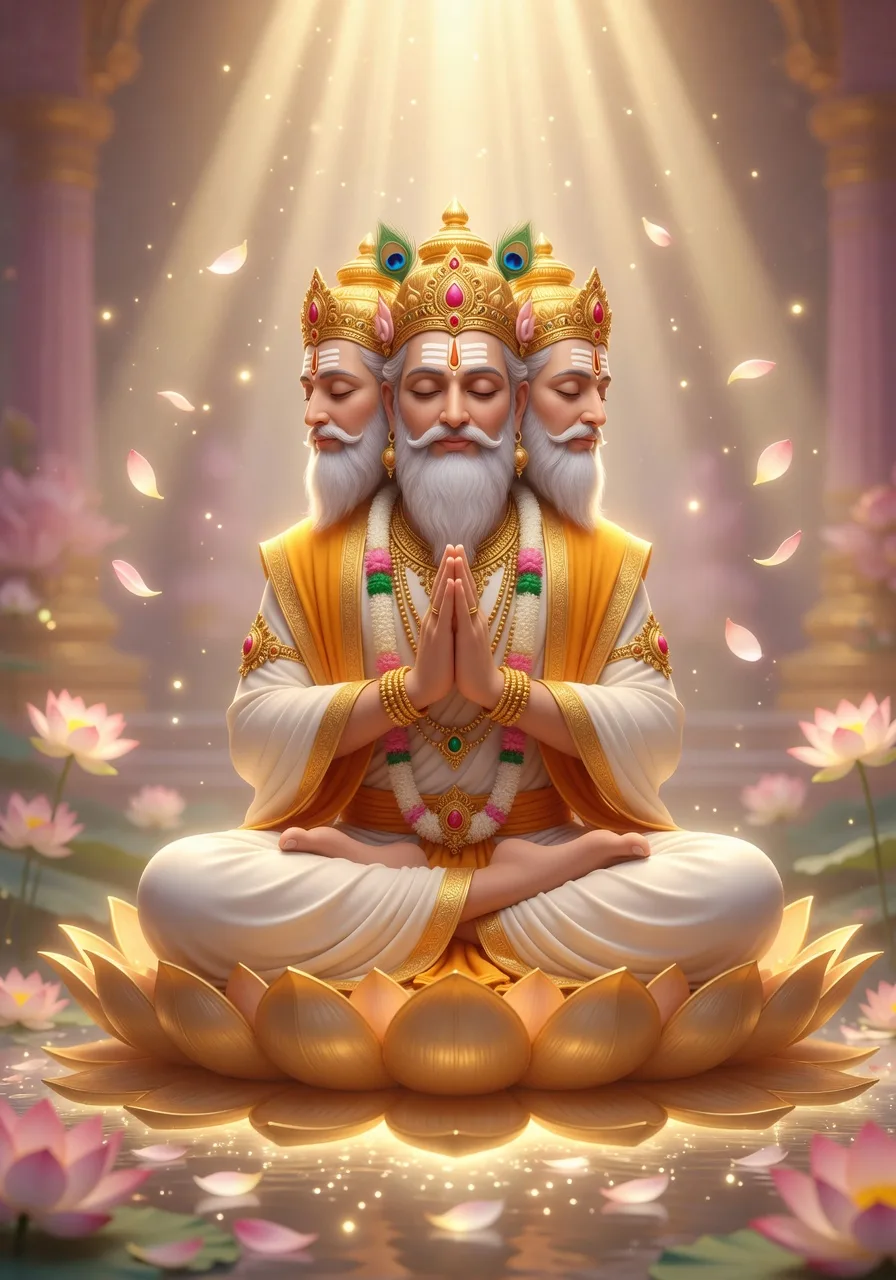
The verse closes with a startling line: some eligible jivas also attain to the office of Brahma in this way. Brahma is a post, not one fixed and unique being. It is a position of immense responsibility that a sufficiently qualified soul can rise to, the hardest of jobs, and when one Brahma's term ends another eligible jiva may take the seat. This fits everything the verse has taught. A soul reaches even that height by the impressions it has built and the mercy it has earned.
And the Lord is generous with that mercy. The rewards he holds out are real and they are the highest, the eternal abode of Vaikuntha and, beyond it, Goloka, his own sweet realm. The same divine kinship that binds every jiva to the Lord is also the door home.
Key terms from this lesson
| Term | Meaning |
|---|---|
| Brahma Samhita | Brahma's prayers to Govinda; its fifth chapter holds the famous verses |
| Maha Vishnu | the form of the Lord who rests in the Causal Ocean and emanates the universes |
| Yoga-nidra | the Lord's divine sleep in the Causal Ocean |
| Causal Ocean | the spiritual water from which the universes arise |
| Samskara | a subtle impression from past action, carried across lives |
| Adrishta | "the unseen," the result of one's previous deeds |
| Kalpa | a day of Brahma, one full cycle of creation |
| Jiva | the individual soul, eternal and beginningless, never created |
What to carry forward
- The Brahma Samhita's fifth chapter, recovered by Chaitanya Mahaprabhu, opens with Krishna as Govinda, the origin of all (5.1).
- The one Lord becomes the many worlds through Maha Vishnu, the Causal Ocean, the universes from his pores, and the three forms Vishnu, Brahma, and Shiva.
- Brahma is born on the lotus from Vishnu's navel and, in verse 5.23, finds only darkness.
- Creation begins under the impulse of previous impressions, samskaras, the same force that makes one person's skill flow where another's struggles.
- Impressions give the impulse, but the power to create a universe comes only as the Lord's mercy, earned through long meditation.
- Brahma is an office, and an eligible jiva can attain it through samskara and grace.
- Every jiva is eternally kin to the Lord, and that kinship is the path home to Vaikuntha and Goloka.
Previous lesson: ← The ten avatars of Vishnu
Next lesson: The abodes of the Lord →
Back to the full course index.
Frequently Asked Questions
Independent writer, jaapak.com
I built the Jaapak app. I write in simple Hindi on the Bhagavad Gita and the satsang tradition — so seekers don't struggle with the scripture.
Read all articlesAbout this article
The commentary is based on the general understanding of the Sanatan tradition and written in accessible language. No verbatim quotation of any modern commentator is used.