The Bhagavad Gita in Summary: All Eighteen Chapters
A chapter-by-chapter summary of the Bhagavad Gita: its three-part structure of karma, bhakti, and gyana yoga, the soul and the body, devotional service, the
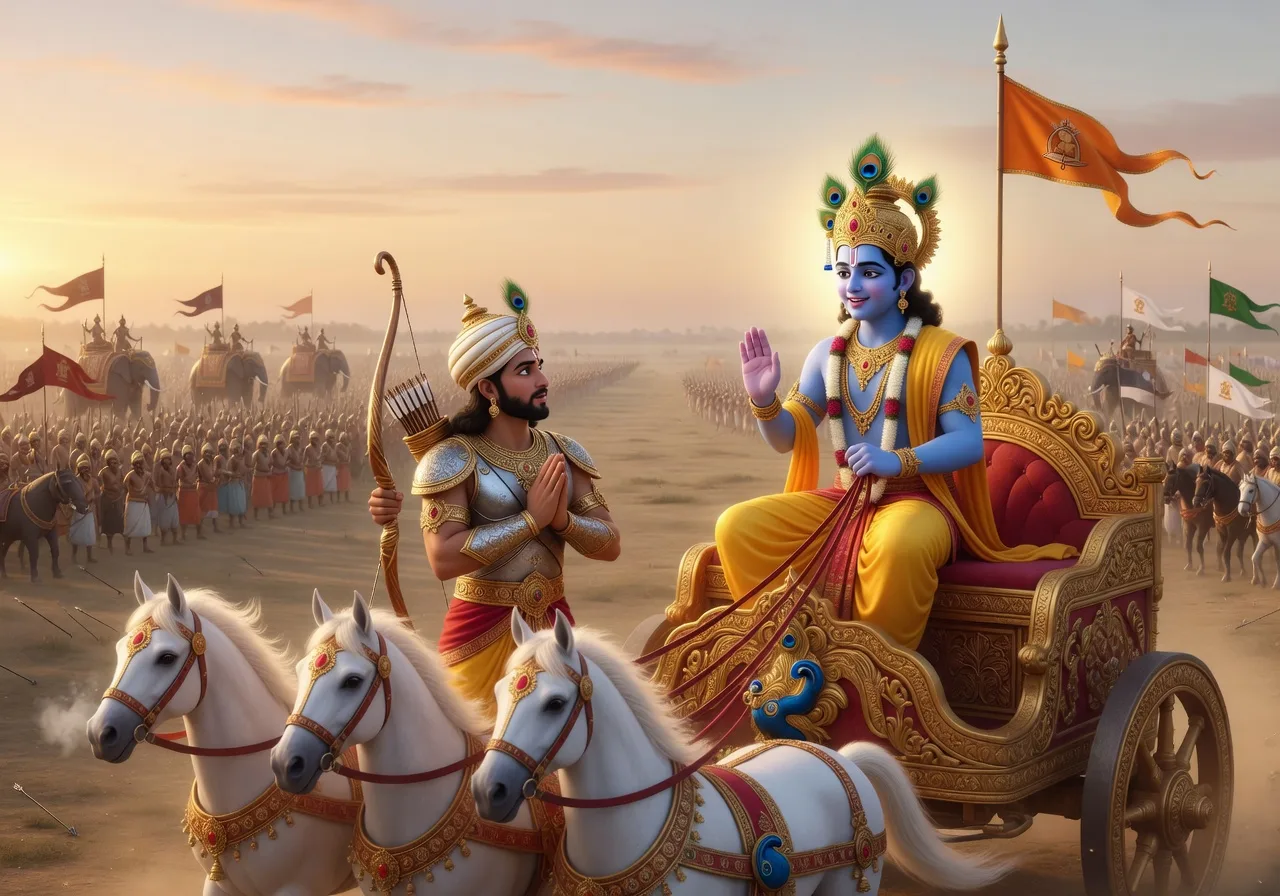
The Bhagavad Gita is, more than anything, a guide for how to live in this world. It is meant to be studied and not merely read, because a person who truly understands it can meet anything life brings and still keep the connection with the Supreme. This lesson walks through all eighteen chapters, one by one, gathering the whole of the Gita into a single map. It is long because the Gita is large, but each chapter has a clear theme, and once you see how they fit, the book opens up.
The shape of the Gita
Before the chapters, see the design. The eighteen chapters fall into three groups of six, and the order is deliberate.
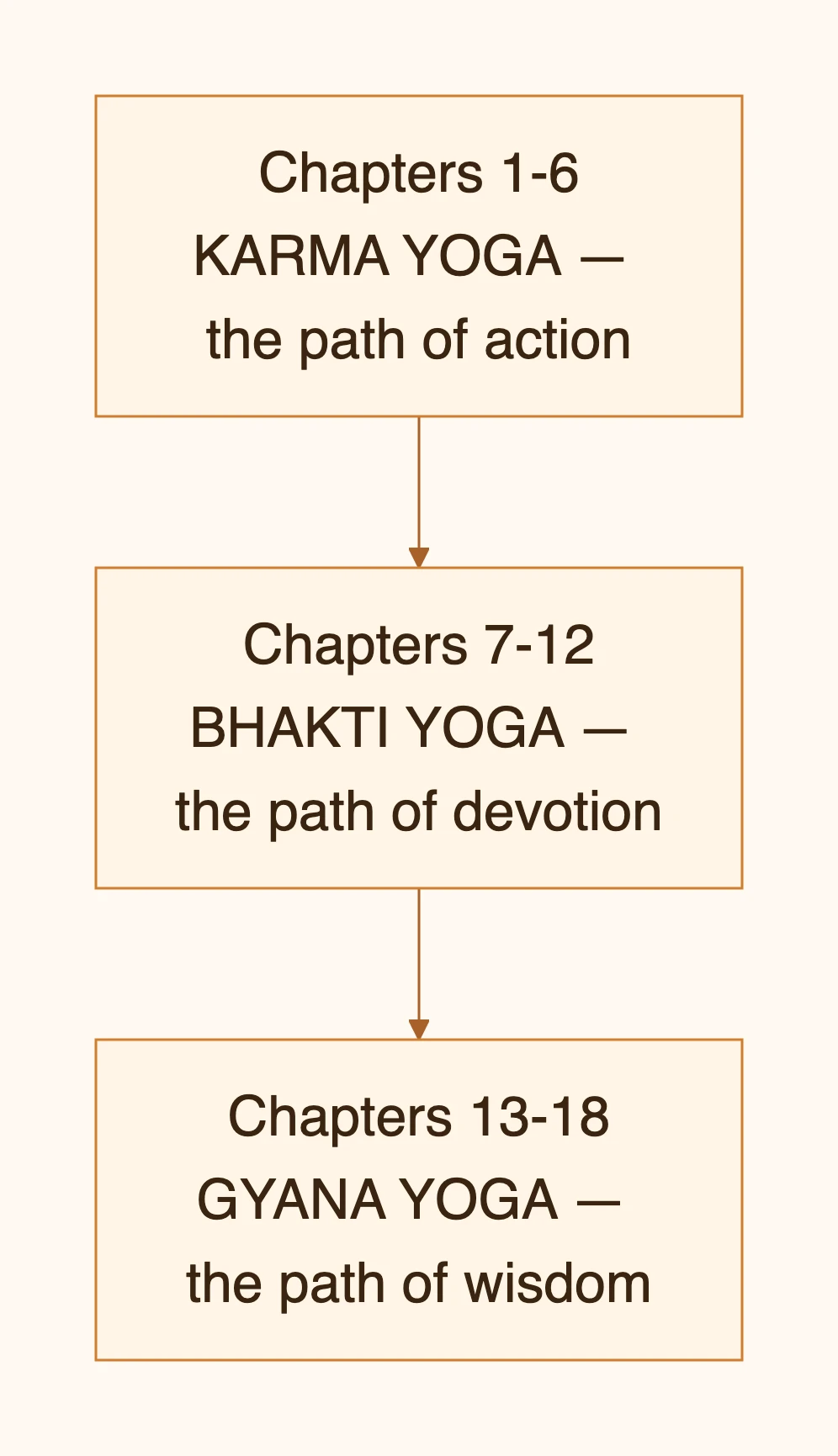
Devotion sits in the middle, sheltered on one side by action and on the other by knowledge, because bhakti is the heart that the other two protect. The whole book also turns on five subjects: Ishvara, God; jiva, the soul; prakriti, material nature; kala, time; and karma, action. Of these five, only one is ours to change, and that is karma. Change your actions and you change your destiny.
Chapters 1 to 6: the path of action
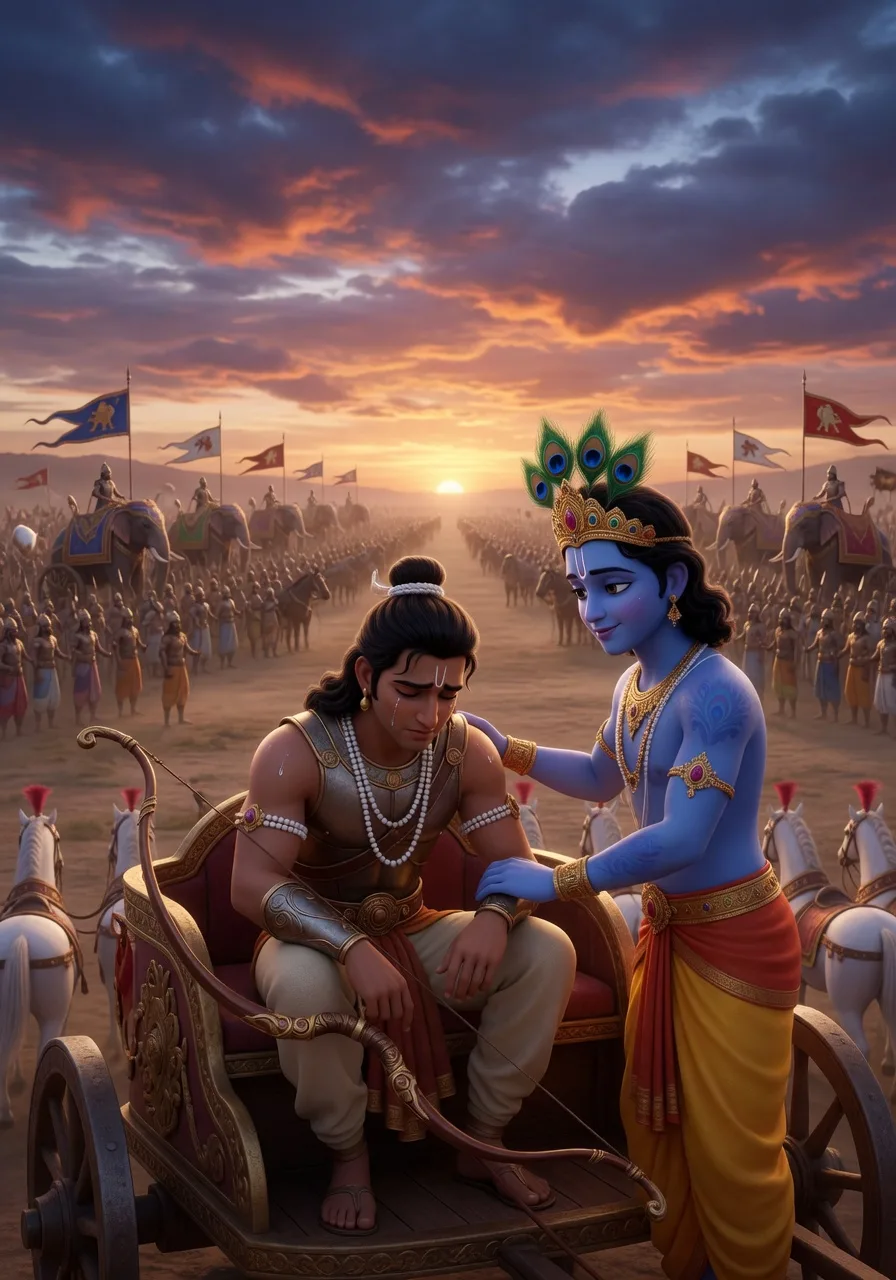
Chapter 1, Arjuna's crisis. The battle is about to begin, and Arjuna asks Krishna to drive the chariot into the middle of the field so he can see who has come to fight. Something staggering has already happened, for the Supreme Lord has agreed to be his devotee's charioteer, made subservient by the power of bhakti, which controls even God. Krishna drives the chariot straight in front of Bhishma, the mightiest warrior there and Arjuna's own beloved grandfather, and Arjuna breaks. The Lord has brought him face to face with exactly what he is least able to face, and he will do the same to us, but he also gives the strength to bear it. Arjuna pours out his reasons not to fight, compassion, the emptiness of victory, the sin of it, the ruin of family and tradition, and Krishna says almost nothing. We do this too. We tell the Lord what we need and how he should fix our lives, and we never pause to let him answer.
Chapter 2, the Gita in miniature. Now Arjuna sees the problem is bigger than he can handle, and he surrenders. Only now does the Lord begin to speak, because the student is ready to listen. Krishna goes straight to the spiritual platform and gives the first instruction of the whole Gita: we are not this body, we are the spirit soul. He tells Arjuna that all these kings existed before, exist now, and will go on existing, and so will Arjuna and he himself, for the soul is eternal. This chapter, the longest at seventy-two verses, is a summary of the entire book. It establishes the eternity of the soul against the body, it establishes duty seen from two sides, the duty of the body one has been given and the duty of the soul in Sanatana Dharma, and it paints the portrait of the sthita-prajna, the steady person who performs that duty perfectly, how he sits, how he speaks, how he holds his senses, how he meets a provocation. If a person read only this chapter, they would have the Gita.
Chapter 3, karma yoga. This is the technique of connecting with God through our own duties. Act for the pleasure of the Supreme, without selfish motive, and the same work that once bound you sets you free. Set against it is karma kanda, ritual done for a reward, a business deal with the demigods, "I worship you, you give me," which is neither devotion nor yoga. Every act either binds or liberates, and eating is the plainest example. Meat, fish, and eggs bind a person hard, and even vegetarian food binds if it is eaten without being offered, but food offered to the Lord becomes prasad, non-different from him, and eating it liberates. Even the already-liberated, like King Janaka, keep doing their duty to set an example. When Arjuna asks what drives a person to sin, Krishna names it without hesitation: lust, and it must be dealt with quickly.
Chapter 4, transcendental knowledge. Spiritual knowledge is shruti, "that which is heard," carried down in older ages by hearing, remembering, and passing it on unchanged. The Vedic image is that we can see God through the ears, for our eyes may be weak but the ear can receive him. This knowledge descends through parampara, from guru to disciple, and that disciple becomes a guru in turn, which is exactly how the Gita itself has come to us. The chapter sorts action into three kinds: karma, prescribed action, vikarma, forbidden action, and akarma, action that leaves no reaction because it is spiritual, the prasad again. And it insists that we each need a guru to guide our progress, whether a formal initiating guru or a teacher we simply learn from.
Chapter 5, work as worship. Arjuna is confused by all this talk of renouncing, so Krishna shows him how to turn work into worship, performing every action outwardly while inwardly letting go of its fruits. This is nishkama karma yoga, where the results are surrendered to the Lord, and its fruit is a hard and beautiful realization: we are not the doers. We are the desirers. We want, and the body's machinery, run by material nature and the demigods, carries the want into action. When I lift my hand there was a desire to lift it, but the lifting is done by forces beyond me, and the soul is only one of several factors. To the soul sheltered in the Lord, all beings look equal, and here Krishna gives the first hint of the meditational path and the formula for peace.
Chapter 6, the path of meditation. Now the strict regimen of the ascetic yogi, the postures, the breath control, the long meditation. Millions today practise pieces of it as exercise, and there is real benefit in that for the body, but yoga means to connect with God, and yoga without God in the picture is only exercise. The mind, Krishna says, is our best friend or our worst enemy depending on whether it is controlled, and Arjuna answers honestly that it would be easier to hold the wind than to hold the mind. Anyone who has sat to meditate knows it, the mind is gone within a minute, off to dinner or the television. Krishna teaches how to rein it in, and when Arjuna asks what becomes of the seeker who starts this path and fails, neither of this world nor the next, Krishna reassures him that such a soul is never a loser, and adds that of all yogis the one who practises bhakti is the highest.
Chapters 7 to 12: the path of devotion
Chapter 7, knowing the Absolute. Here the middle section opens, and the simplest definition of bhakti arrives: bhakti is when God is the centre of our existence. Krishna is the supreme truth and the force that sustains everything, material and spiritual, and the advanced surrender to him while others turn their minds to lesser objects of worship. Of all the limbs of devotion, hearing is the most important, attentive hearing about God. Krishna shows where he is present in the world, holding everything together as the thread holds the pearls of a necklace, and he describes the kinds of people who come to him and those who do not, and the worship of the demigods, a subject the Gita will reopen.
Chapter 8, reaching him at the end. Arjuna asks his hardest question, how to know and remember Krishna at the moment of death. Many find it morbid to dwell on death, yet it is one of the four predicaments none of us escapes, birth, death, old age, and disease, and we forget how certain it is. Krishna gives the key: whatever state of consciousness one holds at death, that is what one attains next, carried by one's consciousness and one's karma together. He describes where different practitioners go, and the bright and dark paths of those who pass at different times. The practical lesson is to treat death like the most important examination of all, which cannot be crammed for the night before. Begin bhakti now, while there is time to prepare, so that the Lord is in the mind when it matters most.
Chapter 9, the king of secrets. As a pearl hides in its shell, the essence of the Gita is set in its middle, and the ninth chapter is that essence, the king of all knowledge and the most secret of secrets. Krishna reveals the most confidential truth about himself to his faithful friend. He is inconceivable, impossible to fully understand, and the point is not to understand him but to love him, for through bhakti he reveals himself within the heart. He clears away the common misconceptions about God and establishes worship of himself alone. And he gives a promise that touches all of us, since none of us is spotless: even one who has done wrong, if he turns and takes up devotion with a sincere heart, is to be counted among the saintly.
Chapter 10, the opulence of God. People say they cannot see God, and so will not believe. But we cannot see the air either, and we do not doubt it while we breathe. We know God by the order of things, for such a vast and exact order must have a hand behind it, and no accident could produce it. Because Arjuna is his friend, Krishna opens his nature further, and to one who is hostile he reveals nothing. The essence verses of the whole Gita sit here, where he tells how he is the source of all, how his devotees live in him, and how he reveals himself and burns away their ignorance. Then he names the places he can be recognized, the sun among lights, the moon among stars, the Himalayas among mountains, the Ganga among rivers, the banyan among trees, Om among sounds, the Gayatri among verses, the letter A among letters, silence among secrets, and on and on, ending that by a single fragment of himself he holds up the entire universe. When he says "among the Pandavas I am Arjuna," he means that the bhakti and strength in Arjuna are his, not that Arjuna is God.
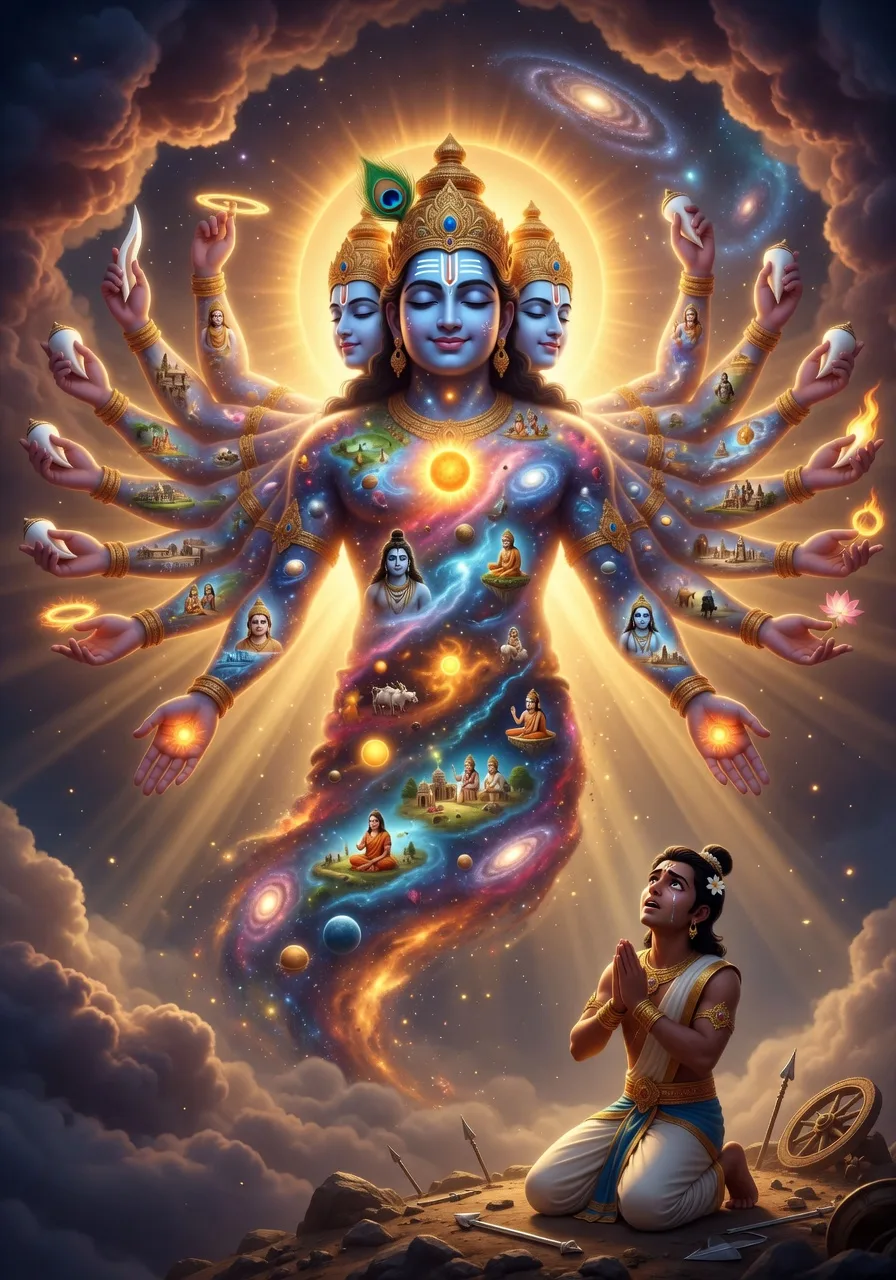
Chapter 11, the universal form. The oldest debate is whether God is personal or impersonal, mere light or a person with a nature of his own. Krishna settles it. He appears both ways, but he states plainly that his two-handed form, holding the flute, is the original, and the formless light rests on that person. At Arjuna's request he shows the Vishwarupa, the universal form, so that future generations could test anyone who falsely claims to be God. Arjuna is terrified, seeing all the armies crushed within that form, and he begs forgiveness for having treated Krishna as an ordinary friend, sharing a bed and a plate, joking with him. Then he asks for the gentle form back, and Krishna returns, first to four-armed Vishnu and then to the original two hands, saying this form is seen only through pure devotion.
Chapter 12, devotional service. For many this short chapter of only twenty verses is the dearest, holding the very wisdom that carries a soul home. Arjuna asks at last whether it is better to worship the personal or the impersonal, and Krishna answers without hedging: the personal is better, for the impersonal path is too hard for an embodied being. Then comes his tenderness. Fix your mind on me, he says, and you will reach me. Cannot? Then follow the practices of bhakti. Cannot? Then work for me. Cannot? Then at least give me the fruits of your work. Not even that? Then meditate, chant a little. Still too hard? Then simply gather some knowledge of me. He lowers the bar again and again, our well-wisher and father, flexible because he knows we are a little wayward. And he names the qualities that make a devotee dear to him, returning four times to one above all, to be steady, unmoved in joy and in sorrow, neither crushed by hard times nor carried away by good, knowing this world is brief.
Chapters 13 to 18: the path of wisdom
Chapter 13, the field and its knower. The final six chapters turn to wisdom, the knowledge that loosens us from the world and binds us to Krishna. Arjuna asks Krishna to define a set of terms, prakriti and purusha, nature and the enjoyer, the kshetra, the body as a field of activity, and the kshetrajna, the knower of that field, along with knowledge itself and its goal. Krishna lays out the nature of the Lord, the nature of the soul, and how the soul moves within material nature. It is the most philosophical chapter, and it rewards a careful reader who wants to see deeper into what we are.
Chapter 14, the three modes. A classic chapter on the three gunas, goodness, passion, and ignorance, which colour everything we see, hear, taste, touch, and smell, and shape every attitude and habit. We imagine we act by free will, but in truth we act according to the mode that grips us, and until a person rises above all three they stay trapped in the world, for even goodness, the highest of the three, is still a binding. The chapter explains what the modes are, how they work, how a person under each one behaves, and how to climb past them. Understand this chapter well, it is said, and you hold the key out of birth and death.
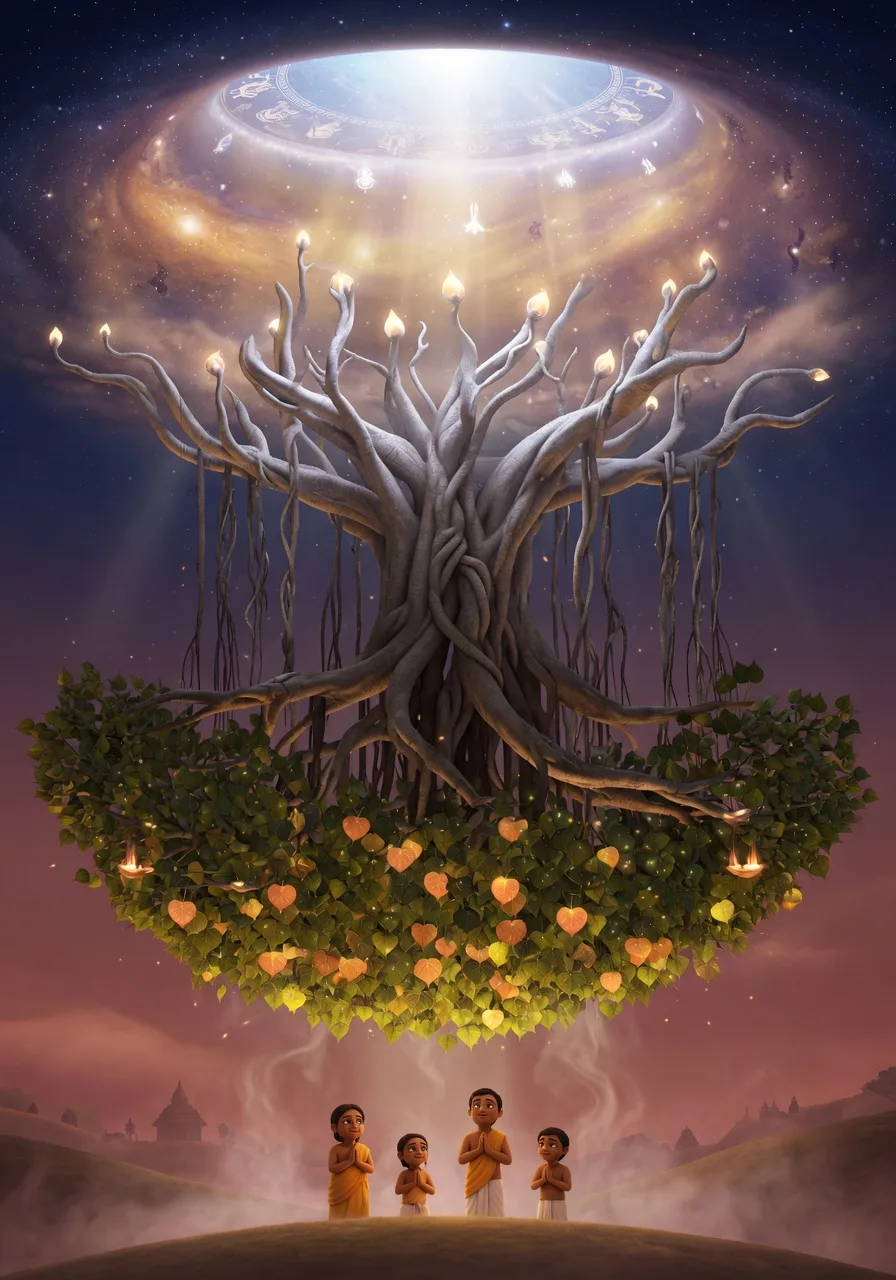
Chapter 15, the Supreme Person. Recited daily by many, this chapter names the real purpose of all Vedic knowledge: to detach from the entanglement of the material world. That is our great problem, that we are attached to everything, to our food and our phones, our families, our cars, our houses. Krishna gives an image to break the spell. Picture a traveller who checks into a hotel room for a short stay and begins painting the walls, buying furniture, refitting the bathroom, hanging family photographs. It is absurd to build for the long term in a temporary room, and yet that is exactly what we do here. The world, he says, is a perverted reflection of the spiritual world, like a banyan tree with its roots growing upward and its branches hanging down, an upside-down image of the real. He gives a glimpse of his own realm, and he reminds us that he maintains us at every level, even the air we breathe and the quiet power that digests our food while we sleep.
Chapter 16, the divine and the demoniac. Those who live whimsically, ignoring scripture, take on demoniac qualities and sink to lower births, while those who live by divine qualities and scriptural rule rise toward perfection. In older ages the two kinds were clearly apart, in different planets, lands, even bodies, but in this age of Kali the line has so blurred that the divine and the demoniac now live inside the same person. The chapter sets out the saintly qualities and dissects the demoniac ones, exposing the attitudes that quietly destroy a person's spiritual life, and it shows the way out. If ever pride in your achievements swells up, this is the chapter to read, for it returns you to reality.
Chapter 17, the divisions of faith. Most of us are not purely divine or purely demoniac but shades of grey, wearing many faces, and the faces we wear reveal our faith, what we truly trust and value. Our faith follows the mode we are attached to, and the chapter traces this through the things of daily life. Food divides by the modes, the decayed, the flesh foods, and mushrooms in ignorance, the fiercely hot and pungent, with onion and garlic, in passion, the wholesome and nourishing in goodness. So does austerity, harmful self-torture in ignorance, display for reward in passion, and discipline done as duty in goodness. So does charity, given to the wrong cause in ignorance, given for recognition in passion, and given to the right person at the right place and time in goodness.
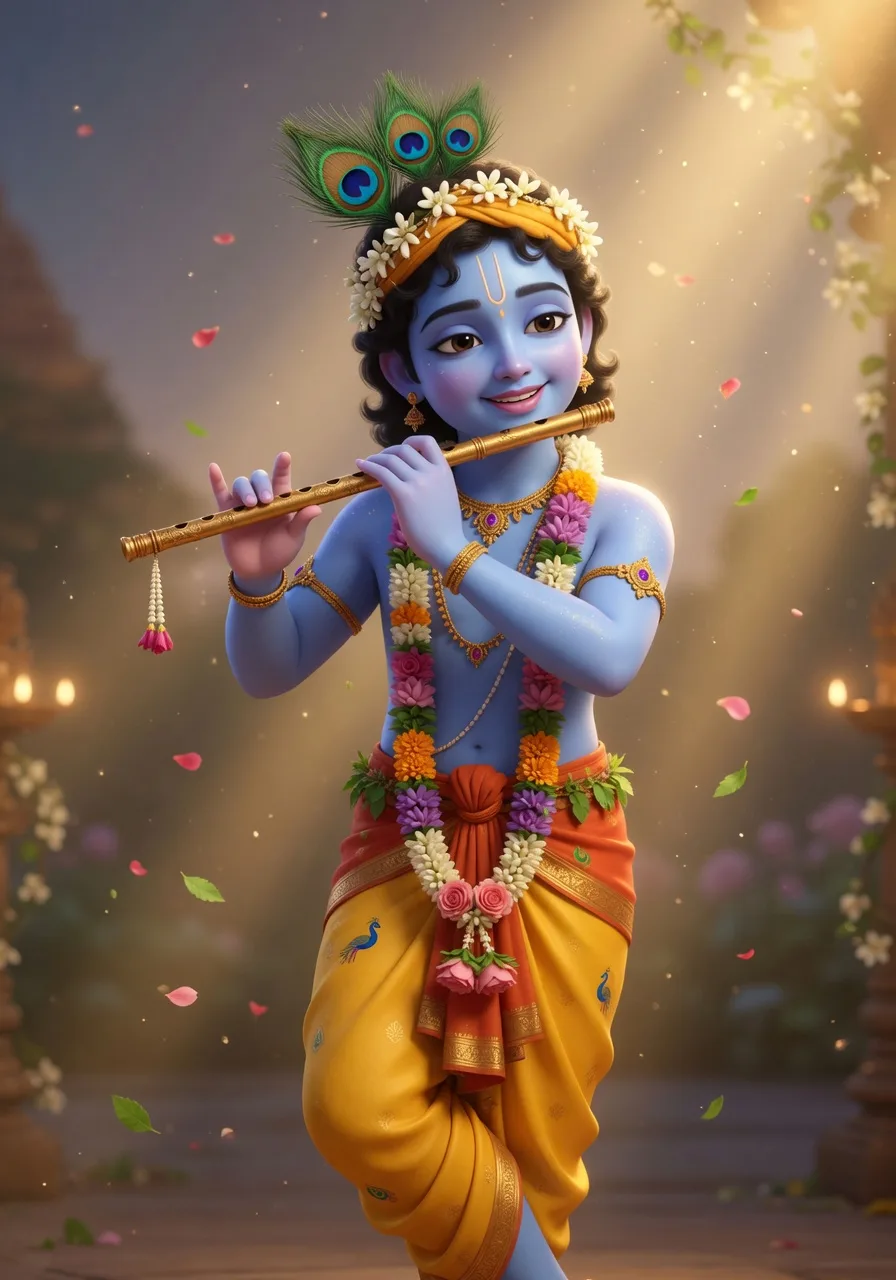
Chapter 18, the perfection of renunciation. The longest chapter and the conclusion gathers everything and presses it to a point. After laying out truth upon truth, Krishna gives his supreme instruction, to take up bhakti yoga, the one practice woven through every chapter but the first. In that consciousness a person is offered lasting happiness, and can smile through any circumstance whatever, sure that the smiling Krishna is his constant companion and eternal friend. This is the real secret of the Gita, that even a painful or unwanted turn of life is the mercy of the Lord, and the one who sees this does not sink into despair, because he knows the Lord is his only well-wisher and will never act against him. The chapter covers the five causes of action and the three kinds of knowledge, action, and happiness, and touches the varnashrama order, and then comes the final word: abandon all varieties of religion and simply surrender unto me, and I will protect you, do not fear (Bhagavad Gita 18.66). Krishna adds that whoever explains this secret to his devotees is most dear to him, that no servant is dearer. To carry the Gita to others is a high service, and a person should at least once buy a Gita and give it as a gift, and if they do it often, the Lord is very pleased.
Key terms from this lesson
| Term | Meaning |
|---|---|
| Karma yoga | connecting with God through one's duties, offered without attachment |
| Bhakti yoga | loving devotional service, with God at the centre of life |
| Gyana yoga | the path of transcendental knowledge that detaches one from matter |
| Sthita-prajna | the steady soul of chapter two who performs duty perfectly |
| Prasad | food offered to the Lord, which liberates rather than binds |
| Vishwarupa | the universal form Krishna shows in chapter eleven |
| Three modes | goodness, passion, ignorance, which colour all we do |
| Sarva-dharman parityajya | "abandon all religions and surrender to me" (18.66) |
What to carry forward
- The Gita is a guide to living in this world, built in three sixes, karma yoga, bhakti yoga, and gyana yoga, with devotion sheltered in the middle.
- Its first lesson is that we are not the body but the eternal soul, and chapter two alone is a summary of the whole.
- Work offered to the Lord liberates, food offered becomes prasad, and the deepest realization is that we are the desirers, not the doers.
- Bhakti is the heart of the Gita, hearing is its first limb, and what we hold in mind at death decides where we go next.
- Krishna's original form is the two-handed flute-player, the universal form proves his supremacy, and he lowers every bar so that anyone can approach him.
- The three modes drive what we mistake for free will, the world is an upside-down banyan we must detach from, and in Kali Yuga the divine and demoniac share one heart.
- The Gita ends in surrender, abandon all and take shelter in him (18.66), smile through every circumstance as his mercy, and share the Gita with others.
Previous lesson: ← The glories of Srimad Bhagavatam
Next lesson: The devatas, the Lord's administrators →
Back to the full course index.
Frequently Asked Questions
Independent writer, jaapak.com
I built the Jaapak app. I write in simple Hindi on the Bhagavad Gita and the satsang tradition — so seekers don't struggle with the scripture.
Read all articlesAbout this article
The commentary is based on the general understanding of the Sanatan tradition and written in accessible language. No verbatim quotation of any modern commentator is used.