The Abodes of the Lord: A Map of the Spiritual World
The graded realms of Sanatana Dharma from Brahma Samhita 5.43: Goloka, Vaikuntha, Maheshadhama, and Devi-dhama, the lotus of Goloka and its rasas, the seven
There is a whole geography to reality, far larger than the universe we can see, and the scriptures map it out in detail. The Brahma Samhita, the Padma Purana, and the writings of the great Goswamis, who are residents of the spiritual world, among them the Brihad-Bhagavatamrita with its detailed map of that world, lay out the abodes of the Lord one above another. This lesson is a tour of that map, from the material corner where we live up to Goloka, the sweetest realm of all. It is a vast subject, taught elsewhere over many weeks, so here we take the essence.
What are the four graded realms?
The Brahma Samhita sets out the whole structure in a single verse, four realms stacked one above the next:
"Lowest of all is Devi-dhama, the material world. Above it is Maheshadhama, the abode of Lord Shiva. Above that is Hari-dhama, the abode of Hari, Lord Vishnu. And above them all is Goloka, Krishna's own realm. I worship the primeval Lord Govinda, who has allotted their authorities to the rulers of these graded realms." (Brahma Samhita 5.43)
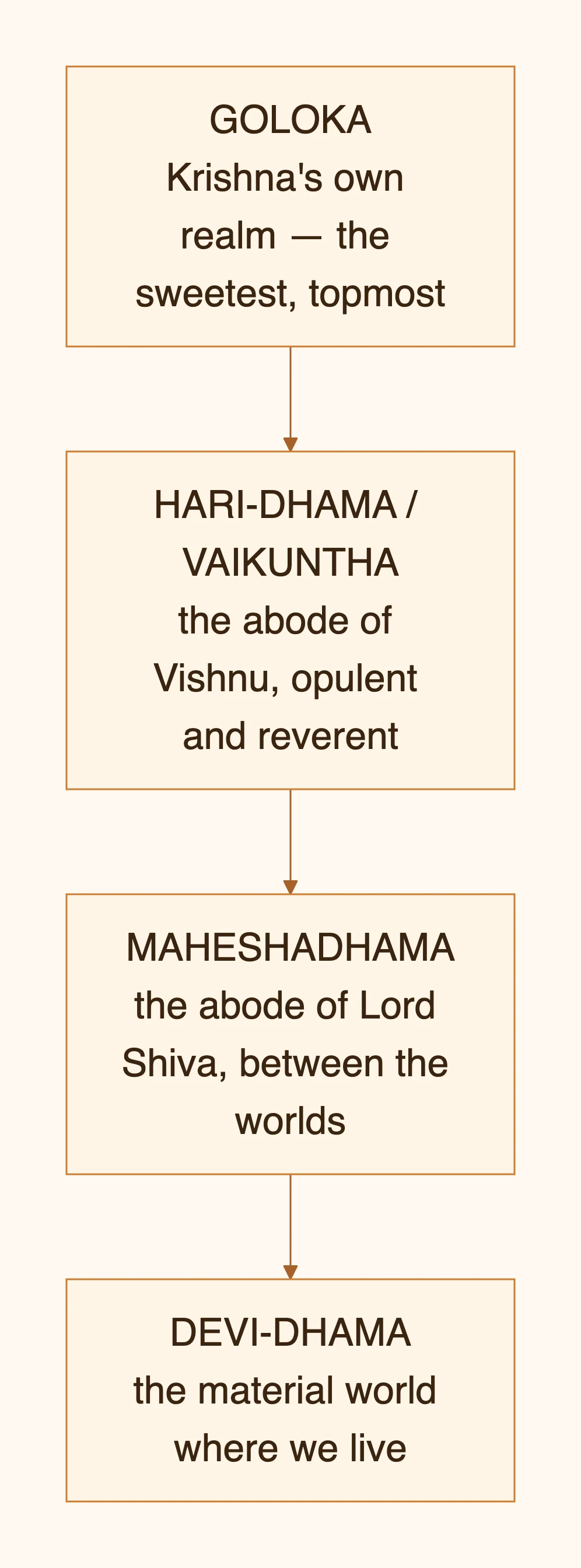
So Goloka is at the top, then Vaikuntha, then the abode of Shiva, then the material world at the bottom, with the formless Brahman effulgence, the brahma-jyoti, shining around it all. Govinda himself appoints the ruler of each.
How small is the material world?
Very small. The whole material creation sits in one corner, the northeastern corner, of the spiritual world, and it is less than a quarter of the total reality. The spiritual world is the overwhelming majority, and the material world is the tiny minority where, unfortunately, we have ended up.
Even so, the material side is staggering in its own scale. When Maha Vishnu exhales, millions of universes stream out from the pores of his skin. Picture a room packed to the ceiling with mustard seeds, and that is roughly how many universes there are. The one we live in is among the smallest. Others are a hundred or a million times larger, and in those greater universes Brahma has many more than four heads, because there is so much more for him to create.
Goloka: the topmost realm
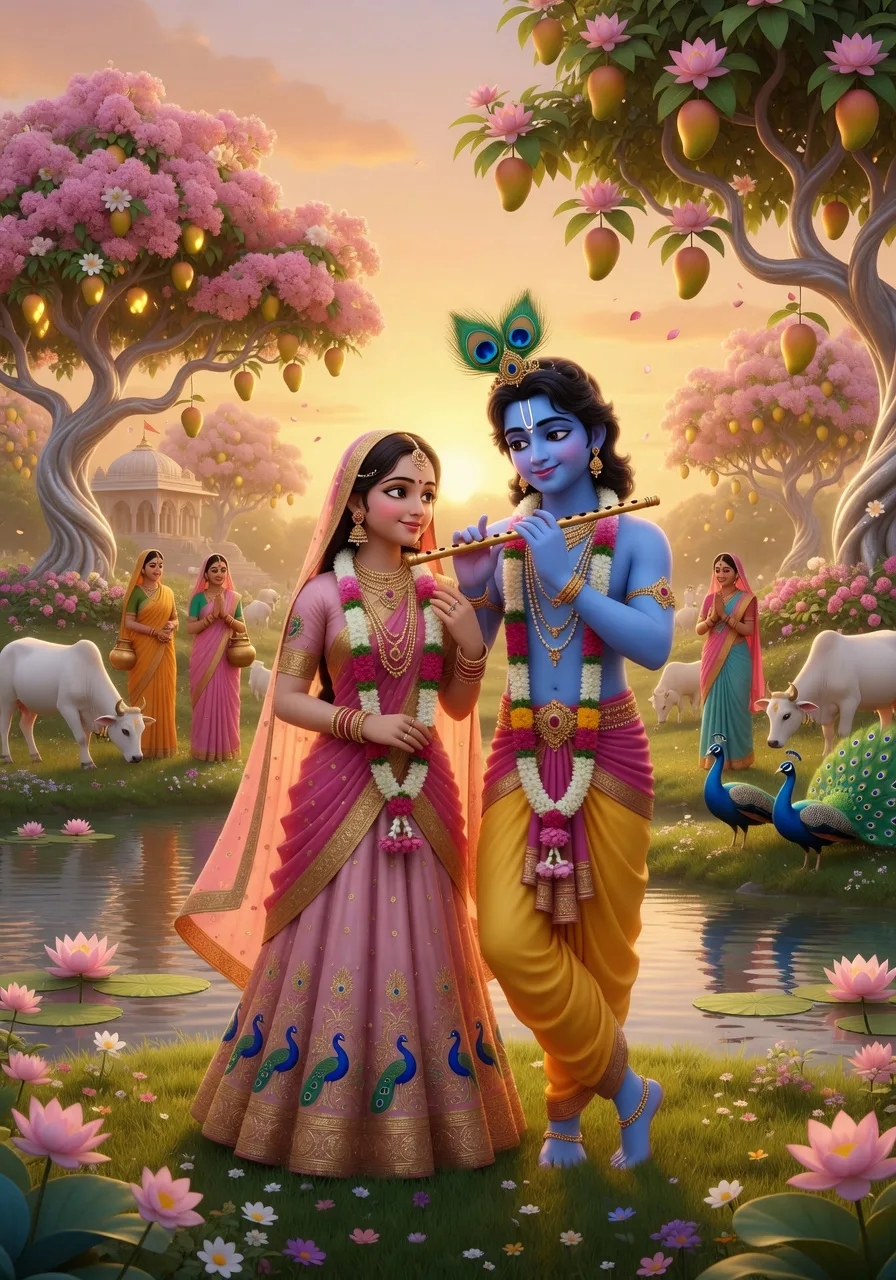
Goloka is the highest planet, and it is shaped like a great lotus. In the whorl at its centre stand Radha and Krishna, and the whole design rests on a sacred geometric figure, a yantra of interlocking hexagons, the kind sometimes kept on a home altar. Around the centre, the petals hold the Lord's dearest devotees in rings of closeness.
The innermost petals belong to the gopis, and above all the eight chief gopis, the ashta-sakhis, who are so dear to the Lord as to be practically non-different from him. The next petals belong to the manjaris, the younger maidservants who assist the gopis. The manjaris are admitted to the most intimate pastimes of all, ones the gopis themselves may not see, because Radha and Krishna are not shy before them. The great Goswamis who recovered and wrote down this knowledge, Rupa, Sanatana, Raghunatha, and the others, are these very manjaris in the spiritual world, which is why their books carry such authority.
Goloka itself has three regions, and the Bhagavatam's tenth canto shows their weight, for of its ninety chapters nearly half are given to Krishna in one of them.
| Region of Goloka | Krishna's life there | Mood |
|---|---|---|
| Vrindavan (Gokula) | his childhood, at the very centre | the sweetest, most intimate |
| Mathura | about eleven or twelve years | between sweetness and grandeur |
| Dvaraka | a large part of his life, on the outskirts | royal and opulent |
Alongside these three stand Jagannath Puri and one further holy dham, all parts of the same supreme realm. The whole realm is organised by rasa, the kind of loving relationship a soul has with the Lord, and the different rasas occupy different petals. At the centre is the sweet love of the gopis and manjaris, then the parental love of Yashoda, Nanda, and Rohini, then the friendship of the cowherd boys, then the mood of servants, and at the outer edge the neutral love of those who simply witness. The closer the petal, the sweeter and less formal the love.
Ayodhya and the moods of love
Ayodhya, the abode of Lord Ramachandra, sits just below Goloka, and the reason is instructive. The mood in Ayodhya is one of aishwarya, awe and reverence, where the Lord is approached as a majestic king. Dvaraka is more opulent still, and Vrindavan is sweeter than either, with the least formality and the most intimacy. So the realms rank not by the Lord's greatness, which is the same everywhere, but by the closeness of the love. Devotees with a special attachment to Rama, like Hanuman, reach Ayodhya, where they enjoy a wonderful relationship with the Lord in that reverent mood.
Vaikuntha: the realm of Vishnu
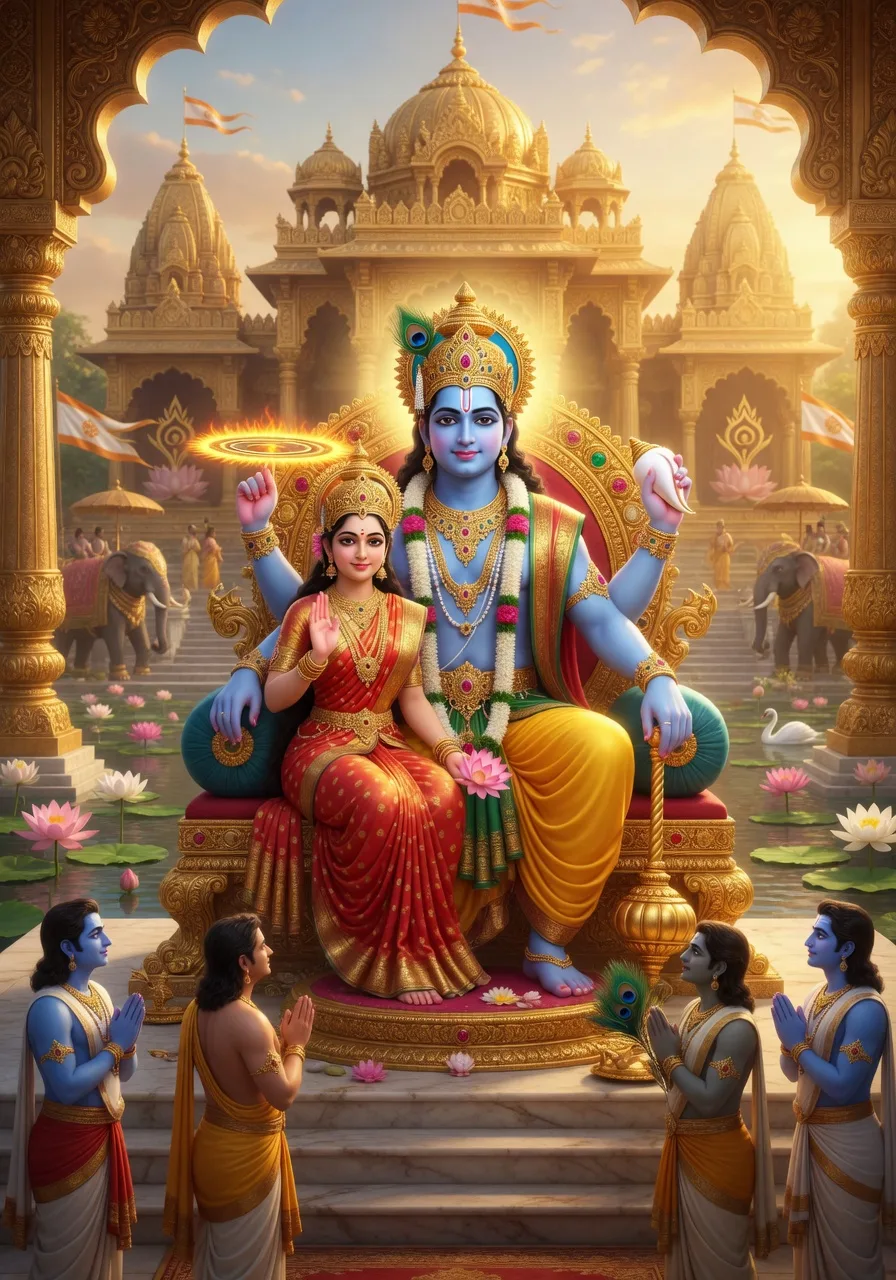
Goloka alone is said to be half of the entire spiritual world, and below it lies Vaikuntha, Hari-dhama, itself unlimited. Here Lord Narayana is worshipped with the goddess Lakshmi at his side, in a realm of countless planets, and it too is built as a lotus with Lakshmi-Narayana at the centre and seven surrounding layers.
| Layer of Vaikuntha | Who resides there |
|---|---|
| 1 | the four primary expansions, the chatur-vyuha, with their consorts; from this group the first unfolds into Ayodhya, and from Sankarshana, who appears as Lakshmana, comes Narayana, the source of all the Vaikuntha planets |
| 2 | the twenty-four forms of Vishnu, so many because the Lord loves to exchange love with his devotees |
| 3 | the three purusha-avataras, the Maha Vishnu forms |
| 4 | the eight eternal associates, including the original Ganesha and the original Durga |
| 5 | the four Vedas in person |
| 6 | the Lord's personal weapons, which are living persons |
| 7 | the eternal protectors, including an eternal Indra and Lord Shiva in his Vishnu form |
A few of these deserve a note. The original Ganesha and Durga in Vaikuntha are Vishnu-tattva, part of the Lord himself, and from them the demigods of the material world expand, not as the same persons but as their inspiration. The Lord's weapons there are not mere objects but personalities. And in the seventh layer Shiva stands in his Vishnu form at the northeastern corner, the very corner where the material world is anchored. Worship in Vaikuntha is grand and governed by the rules of the palace. One could never simply leap onto the Lord's back there, as one can in the freedom and sweetness of Goloka, because the relationship is one of reverence.
The Brahman effulgence, and why merging fails
Surrounding all the abodes is the brahma-jyoti, the impersonal effulgence of the Lord, his brightness, as sunshine streams from the sun. The yogis who long to merge with the Lord arrive here. It sounds like a high destination and it is not, because we are eternally individual souls, active by nature, and in that effulgence the soul can do nothing at all. For an ever-active soul that emptiness is worse than hell, and in time such a soul usually falls back into the material world, unless the mercy of a great devotee lifts it higher. We were always individuals, originally in the spiritual world, and we are here only because we once chose to part from the Lord. This world he built for us is perfectly imperfect, where birth, death, age, and disease keep the soul forever unsatisfied, and where death is a hard stop that takes everything away. The simplest way back to our true home is to chant the holy names.
The dividing line: the Viraja and the two halves of Shiva
Between the spiritual and the material lies a great divide. When the Lord wishes to create, Sankarshana expands as Karanodakshayi Vishnu, Maha Vishnu, and as he exhales the universes from his pores, the ocean that forms from his perspiration, the Causal Ocean, also called the Viraja, separates the two worlds. Right at the northeastern corner the abode of Shiva is cut in half, one half in the spiritual world and one in the material.
Maha Vishnu's glance is what begins it all. Looking toward Rama-devi, his spiritual potency, he gives life to the universe, and the millions of jivas resting within him, full of old material desires, are sent out to pursue them again. Rama-devi's shadow becomes Maya, or Durga, and the Lord's glance becomes Shambhu, so the Lord sets the material world in motion while remaining entirely apart from it. Shambhu then carries the souls into matter and brings the inert material energy, the pradhana, to life.
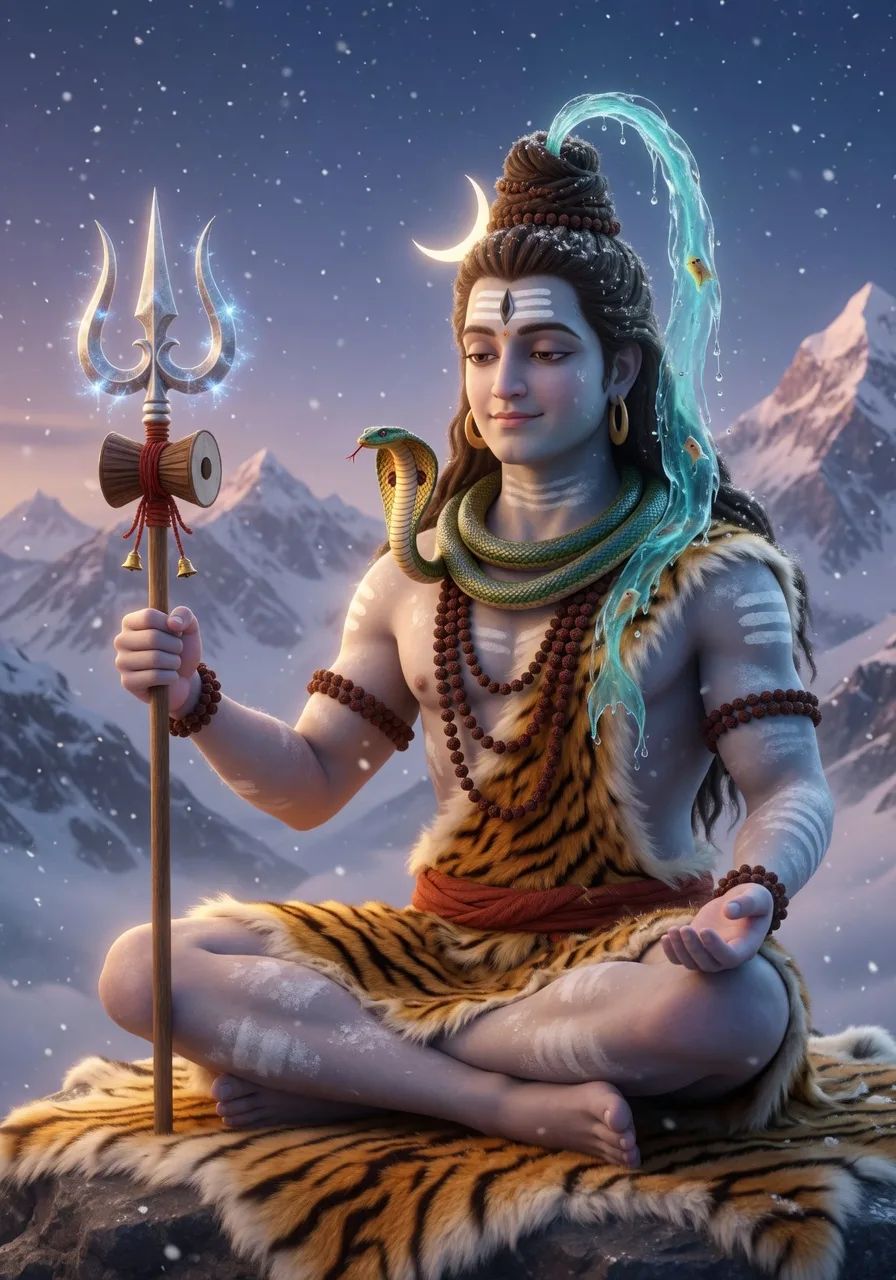
This is where Shiva becomes Shiva. The Shiva of the spiritual world is non-different from Vishnu and is called Shambhu, but the moment he touches the material world he becomes Shiva-tattva, no longer quite Vishnu. The old image makes it clear: add a curdling agent like lemon to milk and it becomes yoghurt, the same milk and yet different. Vishnu in contact with matter becomes Shiva in the same way, the same source and yet not identical, for Shiva is not equal to Vishnu. His half in the spiritual world remains forever pure, and his half in the material world becomes the compassionate Shiva who shelters everyone the world has cast out.
Inside our universe: seven coverings and fourteen worlds
From Maha Vishnu, the Lord expands again as Garbhodakshayi Vishnu, the second Vishnu, who enters each universe. From his navel sprouts the lotus on which Brahma is seated. Every universe is sealed in seven coverings, of earth, water, fire, air, ether, total energy, and false ego, each one ten times thicker than the last, so vast that the layer of earth alone is larger than the universe within it. Each covering is itself a world full of life, and a self-realised soul passing outward must keep its vision fixed on Goloka and refuse the luxuries along the way, or it will be trapped in them.
Within the universe Brahma fashions the fourteen planetary systems, seven higher worlds rising to his own Satyaloka and seven lower ones, where, contrary to expectation, the demons live in great luxury. Above us rise the realms of the sages, the Prajapatis, the fathers of mankind, and the great devotees such as Bhrigu Muni, then Svargaloka, the heaven of the administering demigods, Indra, Vayu, Surya, Chandra, Ganesha, and Yamaraja the lord of justice, who help Brahma run the world, and just above the earth lie planets of bodiless but elevated souls who serve the demigods. The seven lower worlds receive no sunlight at all, yet shine by a remarkable light of their own. Below the fourteen systems lie the twenty-eight hellish worlds, where a soul suffers briefly for its worst deeds before returning to earth.
And the Lord comes closer still. From Garbhodakshayi Vishnu expands the third Vishnu, Ksirodakashayi Vishnu, who enters every single living being as the Paramatma, the Supersoul. This is why the Lord has billions upon billions of expansions, for one of them sits beside each of us through this whole life.
Key terms from this lesson
| Term | Meaning |
|---|---|
| Goloka | Krishna's own topmost realm, the sweetest abode |
| Vaikuntha / Hari-dhama | the opulent realm of Lord Vishnu and Lakshmi |
| Maheshadhama | the abode of Lord Shiva, between the spiritual and material |
| Devi-dhama | the material world, ruled under Durga |
| Brahma-jyoti | the impersonal effulgence surrounding the abodes |
| Ashta-sakhi | the eight chief gopis closest to Radha and Krishna |
| Manjari | the younger maidservants admitted to the most intimate pastimes |
| Rasa | the kind of loving relationship a soul has with the Lord |
| Viraja / Causal Ocean | the water that divides the spiritual and material worlds |
| Seven coverings | the layers of earth, water, fire, air, ether, total energy, and ego around each universe |
What to carry forward
- The realms are graded, Goloka above Vaikuntha, above Shiva's abode, above the material world, with the brahma-jyoti shining around all (Brahma Samhita 5.43).
- The material world is a tiny corner, less than a quarter of reality, and our universe is one of millions from Maha Vishnu's pores.
- Goloka is a lotus with Radha-Krishna at its heart, ringed by gopis, manjaris, and all the rasas of love.
- The realms differ not by the Lord's greatness but by the closeness of the love, sweetest in Vrindavan, reverent in Ayodhya and Vaikuntha.
- The brahma-jyoti is no true goal, for the active soul finds only emptiness there and tends to fall back.
- The Viraja divides the worlds, and Vishnu in touch with matter becomes the compassionate Shiva, as milk becomes yoghurt.
- Each universe holds seven coverings and fourteen worlds, and in every soul sits the Paramatma, the Lord's nearest expansion.
Previous lesson: ← Brahma Samhita 5.23
Next lesson: Values and culture in daily life →
Back to the full course index.
Frequently Asked Questions
Independent writer, jaapak.com
I built the Jaapak app. I write in simple Hindi on the Bhagavad Gita and the satsang tradition — so seekers don't struggle with the scripture.
Read all articlesAbout this article
The commentary is based on the general understanding of the Sanatan tradition and written in accessible language. No verbatim quotation of any modern commentator is used.