What Is Nikunj? The Secret Place Where Even Gods Cannot Enter
What is Nikunj? Shri Mohit Maral Goswami reveals the secret abode of Radha-Krishna in Vrindavan where no fourth being may enter. The path begins here.

Have you ever wondered if there is a place in Vrindavan, the sacred forest town in north India where Krishna spent his youth, that even God Himself does not enter on His own will, but only at someone else's? A place where no austerity works as the entry pass, no scholarship, no entrance exam. Just one thing is required. And what that one thing is, you may pause when you hear it.
Shri Mohit Maral Goswami, in a Hit Vaarta discourse, has unveiled a secret about Nikunj that sends a shiver through every pore of the listener. The point is direct. Nikunj is the most intimate abode of Shri Radha-Krishna, the Divine Couple worshipped as the supreme expression of love in the Bhakti tradition, and no fourth being is permitted entry. Only Priya Lal (Radha and Krishna), Their sakhis (intimate handmaidens), and Shri Vrindavan itself. That is all.
The Private Garden of Priya Lal
Nikunj is no ordinary place. This is where Shri Radha and Shri Krishna are seated with Their sakhis, performing Their leelas (divine play), engaged in Their intimate keli (lovesport).
Goswami ji explains that Vrindavan itself has many layers. There is Braj Vrindavan, which refers to the entire Braj Mandal region. The heart of that region is this Vrindavan Dham. And the heart of even this is the Nij Vrindavan, the private garden of Priya Lal.
"निकुंज में केवल प्रिया लाल, उनकी सहचरी और श्री वृंदावन — इनके अलावा चौथे का प्रवेश नहीं।"
"In Nikunj, only Priya Lal, Their sakhis, and Shri Vrindavan exist. Beyond these three, no fourth being may enter."
— Shri Mohit Maral Goswami
3:02
Shri Harivansh Mahaprabhu, the founder of the Radhavallabh Sampradaya, established this earthly Vrindavan as a mirror of Nikunj, a copy. The seeker comes here and practices. He cultivates the same feeling, the same effort, the same longing that the sakhis carry there. And when this ripens, by the grace of Priya Lal and the sakhis, entry into Nikunj is granted.

How Do You Reach Nikunj? It Begins With Surrender
Goswami ji explains this in a remarkably practical way. Just as after class 12 you must clear an entrance exam to be eligible for IIT admission, Nikunj also has its own sequence.
The first step is sharanagati, complete surrender.
Sharanagati means placing yourself fully under His shelter. Anywhere your own will runs, that is not surrender. The teaching is plain. As long as "mine" survives, surrender is incomplete.
When sharanagati matures, what follows is nijta, the inner intimacy. The nij mantra (the personal initiation mantra) is bestowed. But here something deep is said.
"इतनी माला कर लोगे या इतना समय हो जाएगा तो तुम्हें निज मंत्र प्राप्त हो जाएगा — ऐसा नहीं है। जब तक मन नहीं बदलेगा, जब तक स्वभाव नहीं बदलेगा, तब तक लेने की चेष्टा भी नहीं करें।"
"If you complete this many japa rounds, or this much time passes, you will receive the nij mantra. It does not work that way. Until the mind transforms, until your nature transforms, do not even attempt to receive it."
7:26
Pause here for a moment. Many people keep asking their guru for the nij mantra. Goswami ji says this is not something to be asked for. It is a matter of grace alone. (I used to think too that regular japa would automatically bring it. But after hearing this, I understood. The mind must change first. Everything else follows.)
The Key and the Servant — A Story That Settles in the Heart
Goswami ji offered an example that goes very deep.
Imagine a household with many servants. One sweeps the floor. One washes utensils. One drives the car. All are servants. All are surrendered. But will the master of the house pull a key from his own pocket and hand it to any servant, asking him to fetch a stack of hundred-rupee notes from the locker?
No.
That key reaches only the servant who has earned the master's complete trust. And that trust is not built from the servant's side. The seal is stamped from the other end.
"कौन सा ऐसा सेवक रहता है कि घर का मालिक अपनी जेब में से चाबी निकाल के दे और कहे कि लॉकर में सौ की गड्डी रखी है, वो निकाल के ले आओ?"
"Which servant is such that the master of the house pulls the key from his own pocket and says, 'There is a stack of hundred-rupee notes in the locker, go fetch it'?"
5:53
The nij mantra is that key. And this key arrives by grace, not by asking. However much the servant may insist, "I will fetch it," the master will not hand it over until he himself recognises that the servant is worthy.
Kunj, Nikunj, and Nibhrit Nikunj — Three Distinct Places
This distinction is crucial, and very few people understand it correctly.
Goswami ji explained it through the analogy of a house. Imagine the outer garden, where everyone comes and goes. The cowherd boys are there, the cows, the calves. Everything is at play. This is Kunj.
Now step inside. The living room. Not everyone reaches here. Only restricted people enter. Here only the sakhis and Priya Lal are present. This is Nikunj.
And further inside, the bedroom. Where only Priya Lal and Hit Sajani (Vanshi ji, the divine flute) are present. Even the eight principal sakhis cannot enter here. This is Nibhrit Nikunj.
Three layers. From outside moving inward, kunj to nikunj to nibhrit nikunj. At each layer access narrows, intimacy deepens.
The Number of Sakhis Cannot Be Counted
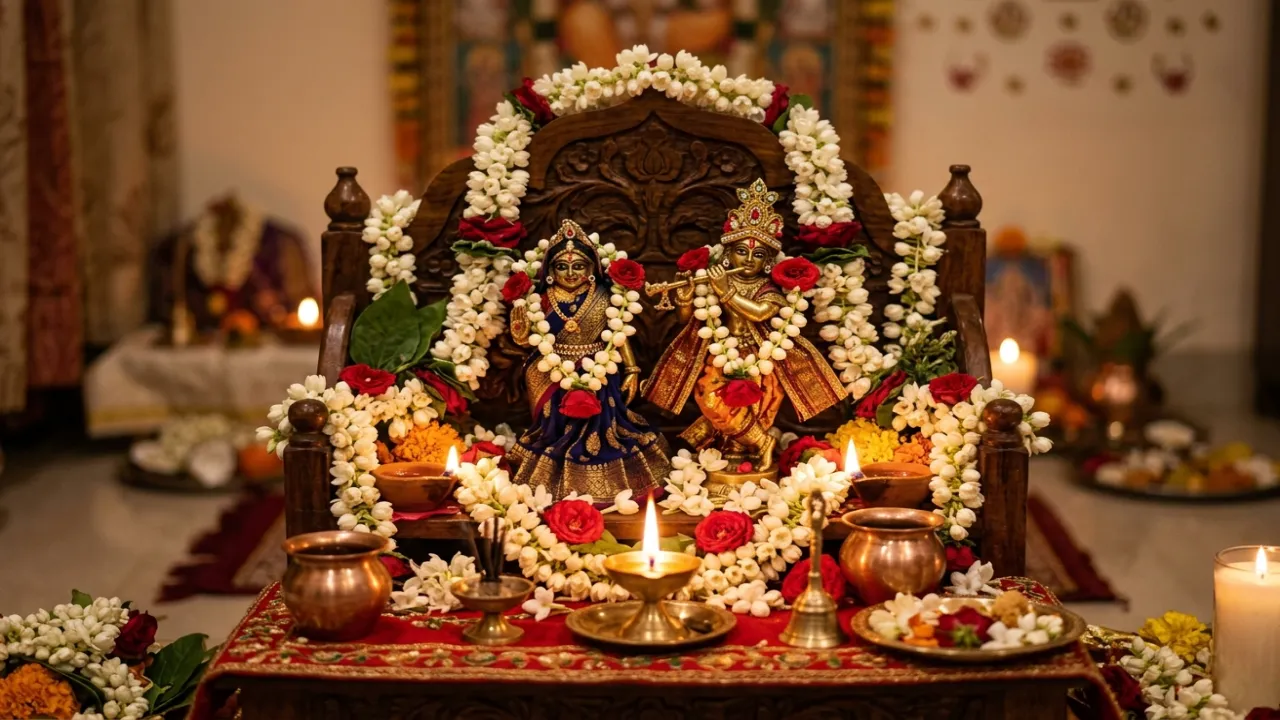
Goswami ji shared that Dhruvdas ji, in his 42nd leela, says you may count the raindrops falling from the sky, you may count the grains of dust on the earth, you may count the stars in the heavens, but you cannot count the sakhis.
One yuth (group) consists of one lakh (one hundred thousand) sakhis. Each yuth has a head sakhi. And there are countless such yuths.
Principally there are eight sakhis: Lalita, Vishakha, Champaklata, Tungavidya, Rangadevi, Sakhi Sudevi, Indulekha, and Chitra. Beyond these, the ninth is Vanshi Ali, who is Hit Sajani.
When Priya Lal enter Nibhrit Nikunj, Hit Sajani remains seated as Vanshi ji, the flute. And when They emerge to where the eight sakhis are present, she serves there in the form of the flute, ever ready in service.
Seeing Nikunj — Not With Your Own Eyes
A devotee asked: looking at my karma and my bhajan, I do not see how Nikunj could ever come within reach. But the longing is intense to behold it even once. Can Nikunj be seen in this manifest world?
Goswami ji's answer raised goosebumps. To hear such a teaching in the cool morning of Vrindavan must have been an experience beyond words.
You cannot see Nikunj with your own eyes. For that you need a lens. Which lens? The eyes of Harivansh Mahaprabhu.
And where do these eyes come from? From his vaani, his sacred utterances.
"उनकी वाणी को आत्मसात कर लो, उसको समझ लो, उसको हृदयस्थ कर लो, अपने रोम-रोम में बसा लो — अपने आप वो लेंस लग जाएगा। उनके नैन लग जाएंगे।"
"Absorb his vaani, understand it, settle it in your heart, let it pervade every pore of your being. The lens will fit on its own. His eyes will become yours."
13:02
The point is direct. Harivansh Mahaprabhu's vaani is the medium through which Vrindavan, kunj, nikunj, and nibhrit nikunj all become visible. The work is to let that vaani settle into every pore of your being.
The Path to Nikunj in One Glance
- Sharanagati must be complete. Nowhere should "my own will" run.
- Practice the mahamantra: Shri Radhavallabh, Shri Harivansh, Shri Vrindavan, Shri Vanchand.
- The mind and nature must transform. Counting beads alone changes nothing.
- The nij mantra comes by grace. Not by asking, but by becoming worthy.
- Harivansh Mahaprabhu's vaani must settle in the heart. This is the lens of vision.
- And after all this is done, Nikunj is still a matter of grace. Only by guru kripa and ishta kripa is it ever reached.
Related Teachings
- Premanand Maharaj Diksha: The Real Path to God-Vision
- How to Chant Radha's Name — The Simplest Path to Overcoming Maya
- Meera Bai's Lesson: Why the World Is Temporary | Naam Jap
Frequently Asked Questions
Independent writer, jaapak.com
I built the Jaapak app. I write in simple Hindi on the Bhagavad Gita and the satsang tradition — so seekers don't struggle with the scripture.
Read all articlesAbout this article
The commentary is based on the general understanding of the Sanatan tradition and written in accessible language. No verbatim quotation of any modern commentator is used.