Premanand Maharaj Diksha: True Vision of God
What does Premanand Maharaj diksha truly mean? Learn how naam jap (chanting the divine name) reveals God's authentic form, beyond art or scripture.
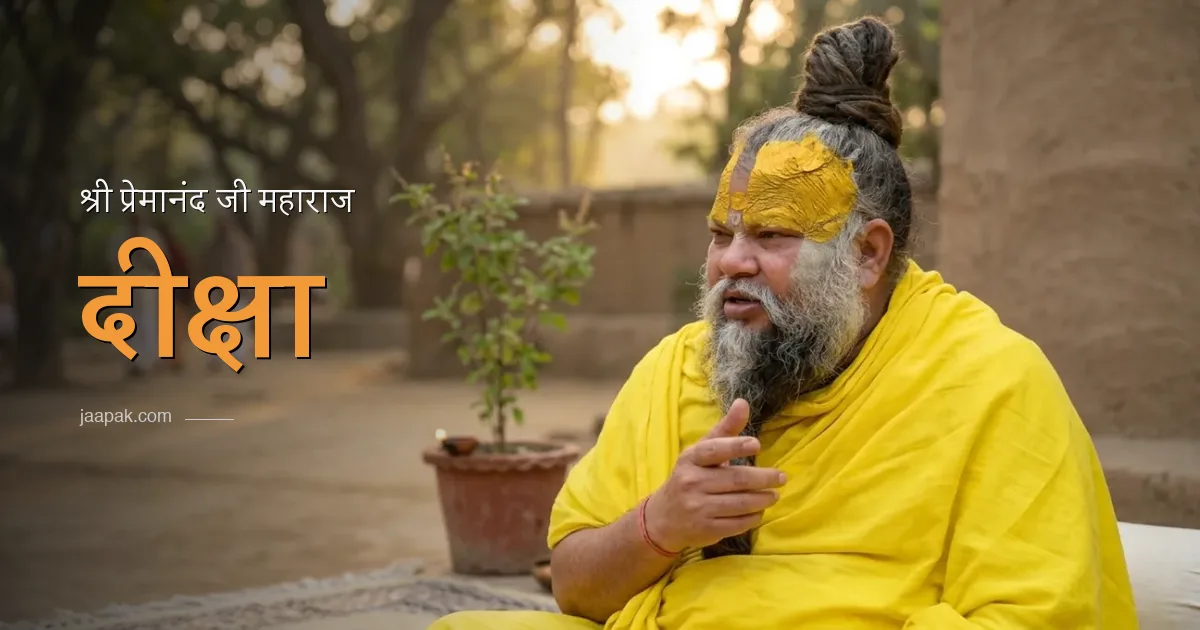
Most people, when they first encounter the phrase Premanand Maharaj diksha, imagine a private ceremony: a secret mantra whispered in the ear, sacred fire, flowers. That expectation is natural. But sitting in Maharaj ji's satsang in Vrindavan — the ancient north Indian town sacred to Radha and Krishna — shifts that picture entirely. Diksha (spiritual initiation) is not a ritual. It is a turning point, the moment a life's direction pivots from the outer world to the inner.
Premanand Maharaj Diksha — The Spiritual Meaning of Naam Jap
Diksha in the Bhajan Marg tradition (the devotional path taught through the Bhajan Marg lineage) is not simply receiving a guru-mantra. Its center is one radical commitment: making naam jap — the continuous chanting of the divine name — the pulse of one's life. While sitting, while walking, with every single breath.
When a seeker begins naam jap, a question arises naturally. A devotee once put it directly to Maharaj ji: "You and other realized saints have had the direct vision of God. Please describe God's form for us — so that those still seeking can get there faster."
That question belongs to everyone on this path.
God's Form Cannot Be Described in Crores of Ages
Maharaj ji's answer stops you cold. God and God's form are anirvacaniya — utterly beyond the reach of speech and intellect. The divine is not made of the five physical elements. It is chidananda, pure consciousness-bliss. And chidananda cannot be communicated through language that is itself built from physical substance.
Harivansh Mahaprabhu, the founder of the Radha Vallabha devotional tradition, once tried to describe Shri Ji's form (Radharani, the supreme expression of divine love in the Braj tradition of Vrindavan). He wrote that the beauties of Braj are so luminous that crores of Lakshmis would faint upon seeing them — yet even those Braj beauties bow their heads before Shri Ji. And still, that form defies all description:
"जो कोटि कलप लगी जीवे रसना कोटिक पावे, तउ रुचिर बदनारबिंद की शोभा कहत न आवे।"
"Even if one were to live for crores of cosmic ages, with crores of tongues — still the radiant beauty of Shri Ji's lotus face could never be fully told."
4:42
Maharaj ji adds a further observation. The eyes that have truly seen God can no longer speak. The tongue that speaks has not truly seen. Every description in scripture and poetry is therefore pointing at an outer form — a gesture toward something that cannot be captured. The paintings we know as Krishna? They are the artist's own feeling and imagination. No ink has ever been made that can render Krishna's dark chidananda radiance as it actually is.
All scripture, all poetry, all sacred art: they are signposts. Not the destination.
Naam Jap — The Only Authentic Revealer of God's Form
If language fails and art falls short, how does one come to know God's true form?
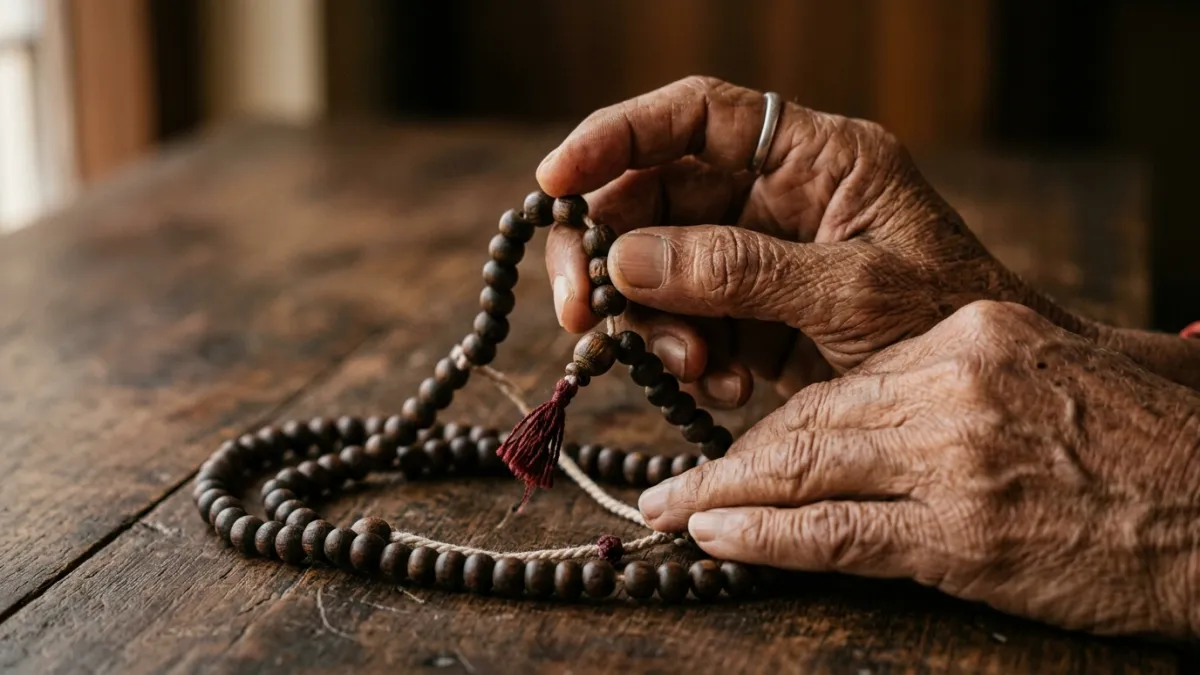
Here Maharaj ji gives a very direct answer:
"सही रूप का परिचय नाम कराता है। जैसे आप राधा राधा राधा राधा जपेंगे, तो जो राधा रूप आएगा; जो कृष्ण कृष्ण जपने से कृष्ण रूप आएगा, वही! आज तक कोई ऐसा रूप नहीं।"
"The name itself gives the true introduction to the form. When you chant Radha, Radha, Radha, Radha — the form of Radha that appears is the real one. When you chant Krishna, Krishna — that form is it. No one to this day has ever produced something like it."
5:25
This took me time to absorb. My instinct had always been: first understand the form, then I will chant. Maharaj ji reverses that logic entirely. The form does not come before the name. The form comes through the name.
No painter, no poet, no sculptor has given us that authentic, stable vision. What appears through naam jap is permanent. It is chidananda. Maharaj ji is clear: chant the name deeply and abundantly. This is not calling out to God from a distance; it is the process of genuine, direct introduction.
The Mother and Child Story — True Longing Is the Key
This sadhana (spiritual practice) bears fruit only when the seeker carries genuine longing. And that longing is the rarest thing of all.

Maharaj ji tells a story. When a small child cries, the mother first offers a toy. If the toy settles the child, she returns to her work. If the child keeps crying, she sends the older sister. If the sister's arms don't console either, only then does the mother herself come to comfort the child.
God operates exactly this way. First come the toys of maya: wealth, fame, social standing. Then the riddhis and siddhis (mystical attainments and powers). Out of millions, perhaps one person refuses to be satisfied by any of it. At that point, God says: "This one won't stop. I have no choice but to come."
If you offer sweetened cream to someone desperately thirsty, they won't drink it. They want water. Likewise, the person who genuinely wants God finds that even the pleasures of Brahma's realm feel like ash in the mouth.
The path to meeting God is simple, says Maharaj ji. The genuine desire to meet is what is rare. This longing is the first condition of diksha — and it awakens through naam jap, through satsang, and through listening to the sacred lila-katha (stories of the divine).
Preparing for Diksha — A Heart Free from the Six Vices
For that longing to awaken fully, the seeker must purify the inner being (antahkaran). This is the real preparation for diksha.
Lust (kama), anger (krodha), arrogance (mada), pride (mana), greed (lobha), attachment (moha): as long as these inhabit the heart, how can God reside there? Seeing another's wife as a mother, treating another's wealth as poison — these are not externally imposed rules. When God becomes genuinely dear, these attitudes arise on their own. Deceit and pretension simply fall away.
Maharaj ji connects this to a beloved verse from the Ramcharitmanas (the devotional epic composed by Tulsidas), where God describes the heart fit for his dwelling: free from lust, anger, arrogance, pride, attachment, greed, grief, obsession, and malice, with no room for deceit, pretension, or illusion. In such a heart, Raghunath (Lord Ram) himself comes to live.
This one verse holds the complete preparation for diksha. No rage, no envy, no deceit, no pretension — God lives willingly in such a heart.
And where does the strength to overcome these six vices come from? Naam jap. Practiced consistently and sincerely, it dissolves impurities and a natural desirelessness (nishkamata) emerges on its own. The impure mind craves; the purified mind simply rests.
The Heart of Premanand Maharaj Diksha
When naam jap deepens and the heart grows pure, the divine form — which no painter could render and no poet could describe in crores of ages — begins to appear. Not through outer ceremony alone, but through genuine longing, sustained practice, and a life slowly oriented toward God.
The path is simple. The longing is rare. Begin where you are.
This article is compiled from the satsangs of Shri Premanand Ji Maharaj. It is meant for spiritual inspiration only and is not a substitute for guidance from a living teacher. All images in this article are digitally created.
Frequently Asked Questions

Independent writer, jaapak.com
I built the Jaapak app. I write in simple Hindi on the Bhagavad Gita and the satsang tradition — so seekers don't struggle with the scripture.
Read all articlesAbout this article
The commentary is based on the general understanding of the Sanatan tradition and written in accessible language. No verbatim quotation of any modern commentator is used.