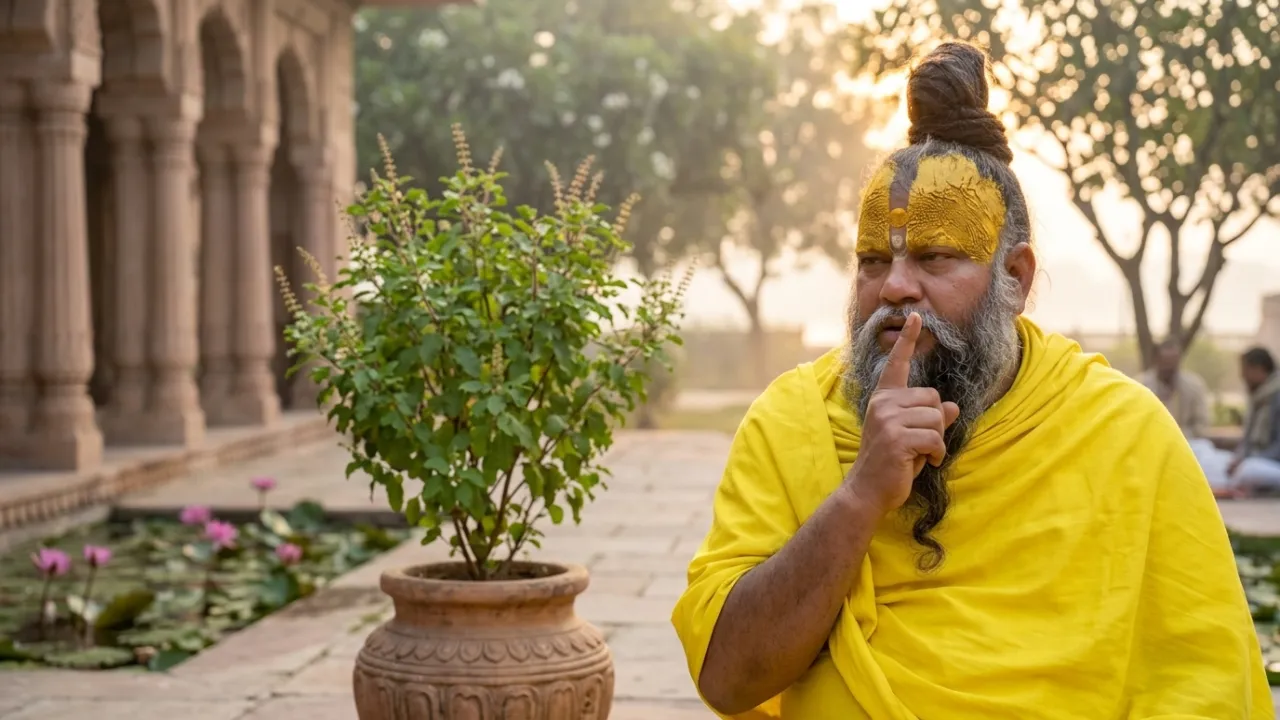
What Is Nikunj? The Sacred Inner Bower of Radha and Krishna Where No One Enters Uninvited
What is Nikunj? The innermost sacred grove of Radha-Krishna in Vrindavan — a space no one enters by merit alone. Teachings from the Radhavallab tradition.
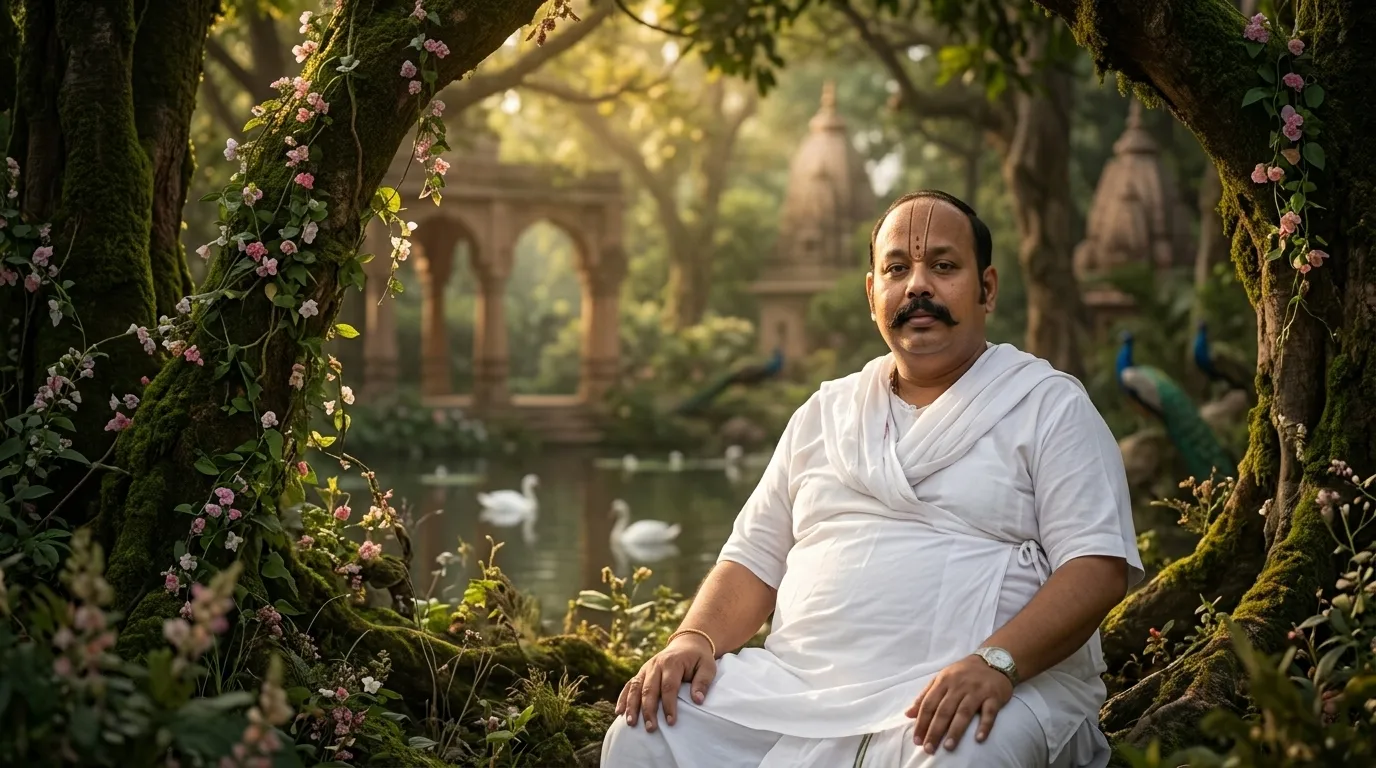
There is a place in Vrindavan — the sacred forest-town in the Braj region of northern India, eternally associated with Radha and Krishna's divine love — where even God does not enter by his own will. Where no amount of austerity, scholarship, or years of chanting earns you access. Where no entrance exam exists, no merit badge gets you through the door.
The only key is something rarer. Something you cannot demand. Something that can only be given.
Shri Mohit Maral Goswami Ji, in his Hit Vaarta discourse, revealed the mystery of this place — Nikunj — with a clarity that sends a shiver through the soul. The statement is direct: Nikunj is the private, intimate sanctuary of Shri Radha and Krishna, where no fourth person may enter. Only Priya Lal (the beloved divine couple), their companions (sakhis), and Shri Vrindavan itself. That is all.
Nikunj — The Private Garden of Priya Lal
Nikunj is not an ordinary location — geographic or metaphysical. It is the innermost dwelling where Shri Radha (revered as Priya, "the Beloved") and Shri Krishna (Lal, "the Cherished One") reside in perfect intimacy with their closest companions, enacting their eternal lilas (divine play).
To understand Nikunj, Goswami Ji maps the spiritual geography of Vrindavan as concentric circles:
- The outermost is Braj Vrindavan — the entire Braj Mandal, the broad landscape of Krishna's life and leelas
- Within it lies Vrindavan Dham — the sacred town itself, the heart of that landscape
- And at the very center of that heart lies Nij Vrindavan — Priya Lal's own private garden. This is Nikunj.
"निकुंज में केवल प्रिया लाल, उनकी सहचरी और श्री वृंदावन — इनके अलावा चौथे का प्रवेश नहीं।"
"In Nikunj, only Priya Lal, their companions, and Shri Vrindavan — no fourth person may enter beyond these."
— Shri Mohit Maral Goswami Ji
Shri Harivansh Mahaprabhu — the 16th-century saint who founded the Radhavallab Sampraday, a tradition of devotion centered entirely on Radha as the supreme reality — established the earthly Vrindavan as a mirror of Nikunj, a training ground. Here, a seeker practices. Cultivates the feeling, the longing, the inner disposition of the sakhis. When this practice ripens — through their grace — the door to Nikunj opens.
How Does One Reach Nikunj? — Everything Begins with Surrender
Goswami Ji explains the path with refreshing practicality. He draws a comparison most modern listeners immediately understand: just as getting into IIT requires clearing an entrance exam and meeting eligibility criteria, Nikunj too has a sequence.
The starting point — non-negotiable, foundational — is Sharanagati (complete surrender).
Not partial surrender. Not "I take refuge, except in these areas of my life." Total, unconditional taking of shelter in the Divine. Goswami Ji is unambiguous: as long as "mine" persists anywhere — as long as my opinion, my agenda, my will still asserts itself — the surrender is incomplete.
When Sharanagati matures, the seeker receives Nijata — the state of true intimacy — and with it, the Nij Mantra (the personal, intimate mantra of this path). But here Goswami Ji says something that stops you cold:
"इतनी माला कर लोगे या इतना समय हो जाएगा तो तुम्हें निज मंत्र प्राप्त हो जाएगा — ऐसा नहीं है। जब तक मन नहीं बदलेगा, जब तक स्वभाव नहीं बदलेगा, तब तक लेने की चेष्टा भी नहीं करें।"
"It is not that after completing so many rounds of prayer beads, or after a certain number of years, you will automatically receive the Nij Mantra. Until the mind changes — until the very nature changes — don't even try to acquire it."
Sit with that for a moment. Many seekers approach their guru asking for the Nij Mantra as though it were a diploma waiting at the end of a fixed course. Goswami Ji says: it isn't that. It is kripa datt — a gift of grace, not a prize of practice. You do not ask for it. You become worthy of it — and even then, the decision is not yours to make.
The Master's Key — A Parable That Stays With You
To make this concrete, Goswami Ji offers an analogy that lands with quiet force.
Imagine a household with several servants — someone who sweeps, someone who washes dishes, someone who drives the car. All are servants. All are devoted. But would the master of the house reach into his own pocket, pull out the key to his private locker, and hand it to just any one of them — saying, "There's a bundle of cash in there; go bring it for me"?
No.
That key goes only to the servant in whom the master has complete trust. And here is the crucial point: that trust is not established by the servant's proclamation of loyalty. The seal is placed from the master's side.
"कौन सा ऐसा सेवक रहता है कि घर का मालिक अपनी जेब में से चाबी निकाल के दे और कहे कि लॉकर में सौ की गड्डी रखी है, वो निकाल के ले आओ?"
"Which servant is there to whom the master reaches into his own pocket for the key and says — there is a bundle of hundreds in the locker, go and bring it?"
The Nij Mantra is that key. And the key is given by grace, not taken by persistence. A servant may keep saying "I can fetch it, trust me" — but the master will not hand it over until he himself recognizes the servant is ready. This is not discouraging. It is clarifying. It tells you exactly where to direct your energy: not into asking for more, but into becoming more.
Kunj, Nikunj, and Nibhrit Nikunj — Three Levels of Sacred Space
This distinction is among the most important in Radhavallab theology — and among the least understood.
Goswami Ji explains it through the zones of a home:
Kunj is the outer garden. The yard where everyone comes and goes freely. The cowherd boys (gwal-bal), the cows, the calves — all playing together. Open, abundant, joyful. Accessible to all devotees.
Nikunj is the living room inside. Not everyone reaches here. Access is restricted — only the sakhis (the divine companions) and Priya Lal are present. This is the space of intimate service and closeness.
Nibhrit Nikunj is the innermost chamber — the bedroom. Here, only Priya Lal and Hit Sajani (Vanshi Ji, the most intimate companion) dwell. Even the Ashta Sakhis — the eight principal companions including Lalita and Vishakha — do not enter this space.
Three levels. Moving inward: Kunj → Nikunj → Nibhrit Nikunj. At each level, access narrows and intimacy deepens. The closer you draw to the center, the more you must leave behind — including, ultimately, even your own spiritual standing.
The Sakhis — A Number Beyond Counting
How many divine companions surround Radha-Krishna? Goswami Ji cites the poet-saint Dhruv Das, who says in his 42nd leela: count the raindrops falling from the sky, count the particles of dust on the earth, count every star in the night sky — but you cannot count the sakhis.
One yuth (a sacred circle or gathering) contains one hundred thousand sakhis. Each yuth has one presiding head sakhi. And the yuthas themselves are beyond number.
The principal eight — the Ashta Sakhis — are: Lalita, Vishakha, Champaklata, Tungavidya, Rangadevi, Sakhi Sudevi, Indulekha, and Chitra.
And then there is a ninth: Vanshi Ali — the Hit Sajani, the most intimate of all companions.
When Priya Lal enter the Nibhrit Nikunj, Hit Sajani Vanshi Ji remains there with them in her personal form. And when they return to the outer spaces where the Ashta Sakhis dwell, she takes the form of the bansuri (the flute), ever-present, ever in service.
Beholding Nikunj — Not Through Your Own Eyes
A devotee once asked Goswami Ji: "Looking at my practice and my chanting (jap), it does not seem like Nikunj will ever come to me — but the longing is deep. Just once, to behold it. Is it possible to glimpse Nikunj in this lifetime?"
Goswami Ji's answer is beautiful.
Not through your own eyes — no. For that, you need a lens. And the lens is this: the eyes of Shri Harivansh Mahaprabhu.
Where do you find those eyes? In his vani — his sacred words and compositions.
"उनकी वाणी को आत्मसात कर लो, उसको समझ लो, उसको हृदयस्थ कर लो, अपने रोम-रोम में बसा लो — अपने आप वो लेंस लग जाएगा। उनके नैन लग जाएंगे।"
"Absorb his vani completely. Understand it. Let it settle into your heart. Let it pervade every fiber of your being — and the lens will fit itself into place. His eyes will become your eyes."
The Mahaprabhu's sacred compositions are the medium through which Vrindavan, Kunj, Nikunj, and Nibhrit Nikunj can all be seen — not as concepts to analyze, but as living realities to experience. The path is to let that vani sink so deep it becomes inseparable from who you are.
The Path to Nikunj — At a Glance
- Complete Sharanagati (surrender) — nowhere must "mine" still assert itself
- Practice of the Maha-Mantra — Shri Radhavallab, Shri Harivansh, Shri Vrindavan, Shri Vanachanda (the full mantra, not just half)
- Transformation of mind and nature — counting beads alone changes nothing; the inner disposition must shift
- Nij Mantra comes by grace — not by asking, but by becoming worthy
- Harivansh Mahaprabhu's vani absorbed into every cell — this is the lens for beholding
- Even after all of this — reaching Nikunj is a matter of grace alone. It is reached only through the grace of the Guru and the grace of one's Ishta (the Divine Beloved)
Frequently Asked Questions
Independent writer, jaapak.com
I built the Jaapak app. I write in simple Hindi on the Bhagavad Gita and the satsang tradition — so seekers don't struggle with the scripture.
Read all articlesAbout this article
The commentary is based on the general understanding of the Sanatan tradition and written in accessible language. No verbatim quotation of any modern commentator is used.