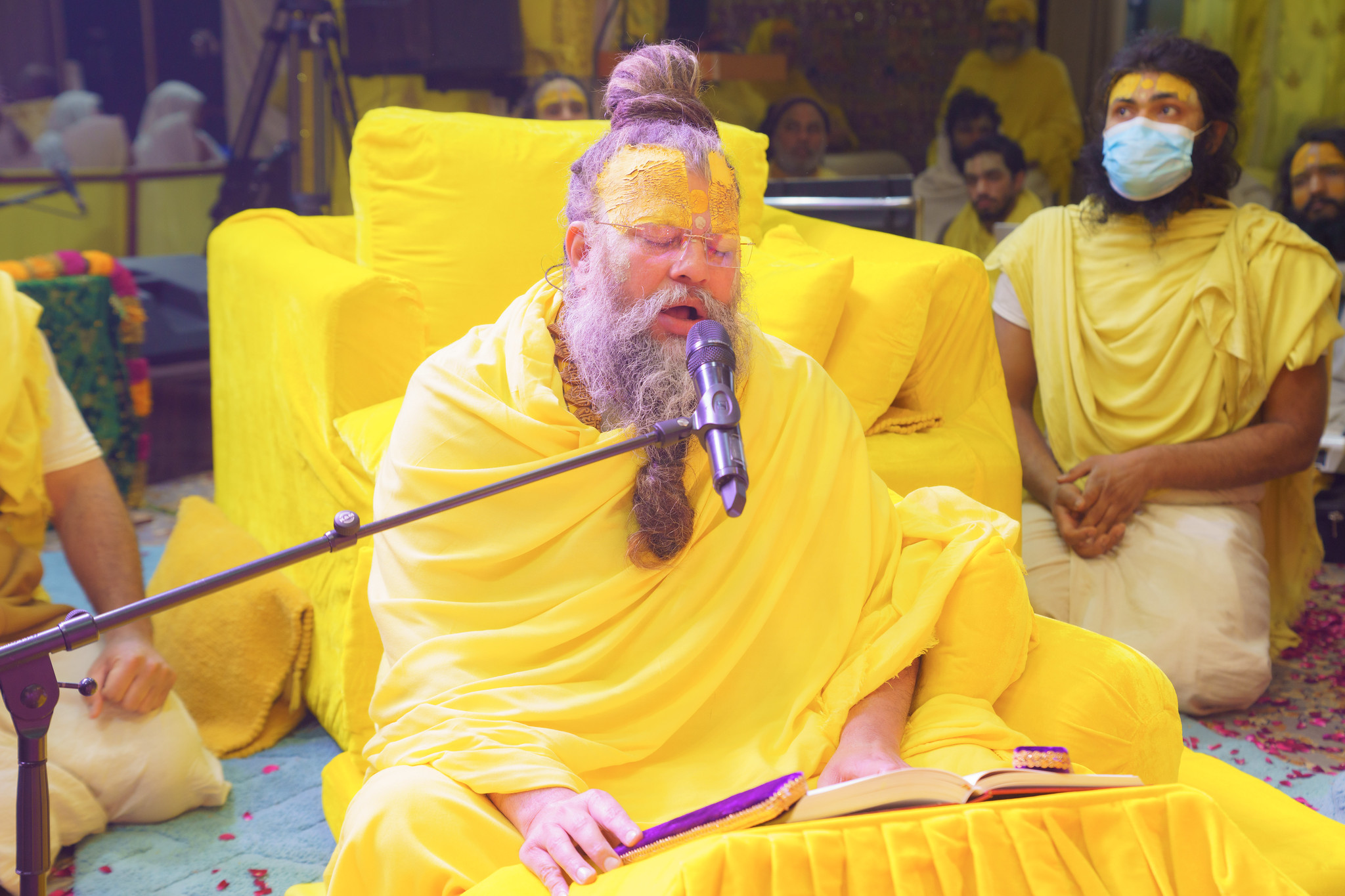
Can Chanting Erase Your Sins? Maharaj Ji's Direct and Honest Answer
Shri Premanand Ji Maharaj explains how naam jap (chanting the divine name) transforms karma, reduces sin's intensity, and protects the soul from new wrongdoing.
There's a question that quietly haunts many sincere seekers: Can years of accumulated wrongdoing actually be undone? And if divine name chanting — naam jap — is so powerful, why do great saints still suffer? Isn't that a contradiction?
Shri Premanand Ji Maharaj addressed both questions directly in this satsang. His answers are neither comfortable nor discouraging — they're honest. And that honesty is exactly what makes them worth sitting with.
Does Chanting the Divine Name (Naam Jap) Really Erase Sins?
This is an ancient question, not a modern anxiety. During a satsang, Pradeep Ji from Jaipur asked Maharaj Ji directly: "Does God truly determine the fruits of a person's actions?"
Maharaj Ji said yes — and then explained what that means for us.
"अब अगर उस हिसाब को बदलना चाहते हो, तो नाम जप करो। दूसरों का उपकार करो। तीर्थों का अवगाहन करो। भगवान की कथा सुनो, जिससे सारे पाप तुम्हारे नष्ट हो जाए।"
"If you want to change that ledger, then chant the divine name. Help others. Visit sacred places. Listen to the stories of God — so that all your sins are destroyed."
But here's the nuance that most people miss: the fruit of sin doesn't vanish without being experienced. That's the law. What naam jap (chanting the divine name) does is change the intensity of what you must go through. What would have been unbearable becomes bearable. The soul wakes up. And an awake soul commits far fewer new mistakes. That is the whole chain.
Don't fear your past. Start chanting.
But if chanting is so powerful, why do the greatest saints still endure suffering? That's the question Maharaj Ji takes up next — and the answer will shift something in you.
The Law of Karma — Even the Greatest Saints Are Not Exempt
Maharaj Ji named two figures whose stories stop you in your tracks.
Sri Ramakrishna Paramahamsa — a saint from childhood, a supreme devotee of Ma Kali. Still, he died of throat cancer. Hanuman Prasad Poddar Ji — the revered editor of the Kalyan magazine, a saint known for his extraordinary bhakti (devotion). He too suffered cancer of the abdomen. These were not men of wrongdoing. This was the account carried from past lives.
And then Maharaj Ji gave the most striking example of all — God Himself.
Sri Ram (the divine avatar of Vishnu, worshipped across India as the ideal king and husband) killed Vali by striking him from behind a tree, hidden. So when he returned as Sri Krishna (his next avatar), at the very end of his earthly life, a hunter's arrow struck his foot — and from there he departed to the supreme abode. Even God, in his human form, was not exempt from the cosmic law.
"कर्म प्रधान विश्व रच राखा, और जो जस करे तास फल चाखा।"
"The world is built on the primacy of karma. Whoever acts in whatever way must taste its fruit."
Karma is of two kinds — good and harmful. Both must be experienced. Avashyam bhoktavyam kritam karma shubhashubham — what has been done, good or bad, must be lived through. No sage, no saint, no avatar is an exception.
In human law, a clever lawyer might find a loophole. In God's court? The entire account settles in an instant. Final.
This reframes everything. If even God, in human form, lived by this law, then karma is not punishment — it's a universal constant we all exist within. Naam jap doesn't lift you out of that law. It gives you the strength to pass through it. That distinction sounds small. It isn't.
Which is perhaps why great saints, even while suffering, remain so calm.
Chanting and Awareness: Sin Lives in Unconsciousness
This teaching is surprisingly simple — once you hear it, you can't unhear it.
When there is no naam jap, a person lives in a kind of fog. And it is in that fog that most wrongs happen. Not through deliberate cruelty, but through carelessness, inattention, the half-asleep drifting of an unanchored mind.
"जब तक नाम जप नहीं, तब तक बेहोश ही हो।"
"As long as there is no naam jap, you are unconscious."
But when chanting is steady? The moment the mind begins to tilt toward something harmful, something inside resists — a heat, a brake. Maharaj Ji described it precisely: "A strength will rise inside you — no, no! We must not do this wrong action."
This, I think, is the deepest power of naam jap. It stops sin before it happens. No law can do that. No vow can do that. Only the living contact of the Name.
Maharaj Ji gave the example of the great sage Narada — how in genuine devotion, Narada becomes fully alive in that feeling, completely present. Naam jap keeps the soul like that: awake, aware, not drifting.
And Maharaj Ji adds something else alongside chanting — something that surprises people at first: service to parents. It has a direct, practical connection to clearing past karma.
Service to Parents: The Force That Amplifies Chanting
Sachin Soni Ji, calling in from the USA, asked Maharaj Ji: how can someone living abroad serve their parents and still build a future for their children — is that even possible?
Maharaj Ji's answer was immediate.
"मातृ देवो भव, पितृ देवो भव! ऐसा हमारा वेद कहता है। वो साक्षात भगवान है।"
"Let your mother be your God. Let your father be your God. This is what our Vedas say. They are God in living form."
Those who do not serve their parents, Maharaj Ji said, cannot make real spiritual or worldly progress. Whatever they build today will crumble tomorrow — because everything they have came through their parents' grace.
For those living overseas, the question of how is real. Maharaj Ji's answer is practical: distance is not the obstacle. What matters is the intention of service, regular contact, and ensuring your parents' needs are genuinely met. Invite them to live with you, or go stay with them — whichever is workable. But don't turn away. Those who cause suffering to aging parents, he said, are heading toward certain misery.
Naam jap and service to parents together form a double force. They work on the accumulated impressions (sanskaras) of past wrongdoing from two directions at once.
And these two combine with a third. Together, they form what Maharaj Ji calls the forces that protect you.
Three Forces That Free You from the Grip of Past Karma
Maharaj Ji was unusually direct in this satsang.
The force of the Name (naam-bal) weakens the impressions of past wrongs. The mind becomes purer, the intellect cleaner. Without naam jap, Maharaj Ji said, no matter how many spiritual discourses you attend, maya (the pull of illusion and worldly attachment) will fill your mouth again.
The force of service (seva-bal) accumulates merit. The good karma earned through serving God and parents builds like a protective shield against new wrongdoing. It deposits in what Maharaj Ji called the divine bank — and it draws interest.
The force of helping others (paropkar-bal) generates fresh positive karma, and gradually lightens the overall karmic ledger. And running beneath all three is sattvic living — clean food, self-restraint, pure conduct. That is the foundation on which the other three rest.
"नाम बल, भगवान का सेवा बल, परोपकार, यह बचा लेगा।"
"The force of the Name, the force of service to God, and helping others — these will save you."
Does naam jap make the fruits of karma disappear? No. But it changes your capacity to endure them. It shifts circumstances. That is the real role of these three forces.
This Is What Human Life Is For: Maharaj Ji's Final Teaching
Maharaj Ji distilled the entire satsang into one statement.
"इसलिए हर समय नाम जप करो! अच्छे आचरण करो! अच्छा भोजन पाओ। दूसरों का उपकार करो। यही मनुष्य जीवन है। यही देवत्व है।"
"Therefore, chant the divine name at all times. Conduct yourself well. Eat clean. Help others. This is human life. This is what it means to live like a divine being."
There is no reason to be paralyzed by the weight of the past. The door of naam jap is open right now.
One small commitment to begin: a single mala (rosary) of chanting each day. That's it. Just that. Slowly, awareness comes. And when awareness comes, the root of wrongdoing begins cutting itself.
Radhe Radhe.
Source: #945 Ekantik Vartalaap & Darshan / 19-06-2025 / Shri Hit Premanand Govind Sharan Ji Maharaj
This article is compiled from the satsangs of Shri Premanand Ji Maharaj. The original video is available at the link above. All images in this article are digitally created.
Frequently Asked Questions

Independent writer, jaapak.com
I built the Jaapak app. I write in simple Hindi on the Bhagavad Gita and the satsang tradition — so seekers don't struggle with the scripture.
Read all articlesAbout this article
The commentary is based on the general understanding of the Sanatan tradition and written in accessible language. No verbatim quotation of any modern commentator is used.